
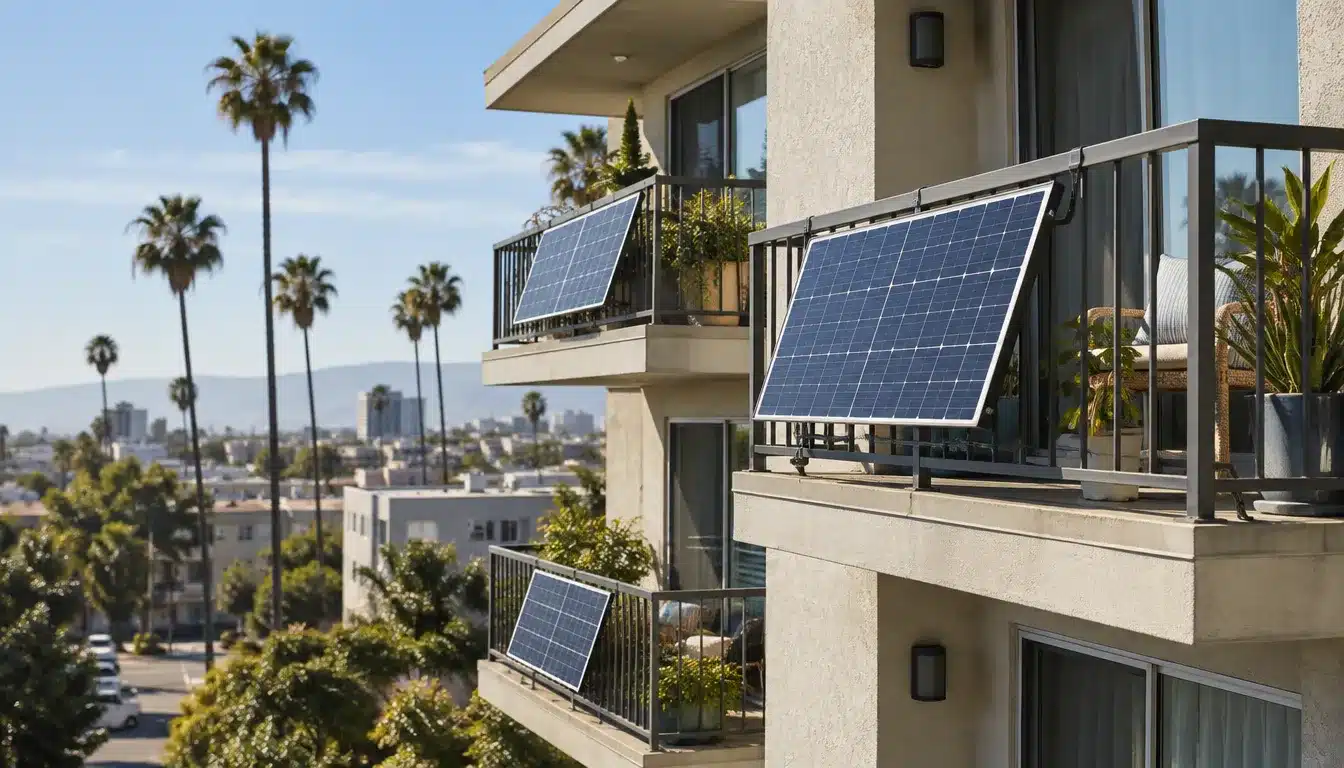
California has legalised plug-in solar panels of up to 1,200 watts, letting renters and homeowners plug small systems into a wall socket without first asking their utility for permission.
Governor Gavin Newsom signed the California plug-in solar bill into law on 30 September. Senate Bill 868, known as the Plug and Play Solar Act, takes effect on 1 January 2027. It lets homes plug small solar kits into a normal socket with no grid contract from the utility.
Lawmakers in both houses passed the bill in late August, so the signature ends its journey. With 39 million people, California is now the largest US market for these balcony kits. The Environmental Working Group (EWG), which backed the bill, says California is the tenth state to make them legal.
What the new law allows
Under the law, each home can run plug-in kits with a total output of up to 1,200 watts. Utilities can’t charge fees for them or make people ask first. However, every kit must carry UL safety approval or the same from another national test lab. To protect line workers, kits must also shut off within seconds if the grid goes down.
Many kits hang on a balcony rail or sit in a garden. They feed power straight into the home, so the household buys less from the grid. That makes them a good fit for renters and flat owners, who often can’t put panels on a roof.
Bill savings and costs
State Senator Scott Wiener, a San Francisco Democrat, brought the bill forward in January. EWG and the Abundance Network sponsored it. EWG says a single 400-watt kit can cover about 14% of the power an average flat uses. On its figures, that saves about $250 a year, while kits start at around $500.
Wiener framed the law as an answer to high power prices. “These small, easy-to-use solar panels will give everyone, including renters, the relief they desperately need on our outrageous energy bills,” he said. “Electricity costs have reached ridiculous levels here in California, and now that the Plug and Play Solar Act is law, Californians have a much-needed tool to provide relief.”
Bernadette Del Chiaro, EWG’s senior vice president for California, also welcomed the move. “This new law will deliver cleaner power, greater energy independence and real savings for consumers,” she said.
Power prices and heat
EWG says power prices in California have nearly doubled in the past ten years. As a result, the state now pays the second-highest rates in the country. The group also links the law to health. Its recent report found that extreme heat events have risen 55% across the state.
High bills, EWG argues, leave many people unable to run air conditioning on the hottest days. Cheap power from a balcony panel would make cooling less costly. So backers see the law as a health measure as well as an energy one.
A sunset clause in 2030
The California plug-in solar law also has a time limit. Using wording the utilities asked for, the Assembly added a clause that ends the grid contract waiver on 1 January 2030. EWG says this gives the market four years to grow and gives lawmakers time to drop the clause.
Meanwhile, EWG expects kit prices to fall as more homes buy them. Cheaper kits would, in turn, bring solar within reach of more renters and low-income homes before that date.
A growing US market
Utah became the first state to make plug-in solar legal in 2025, and several more have since followed. Plug-in solar has also become legal in Great Britain. Even so, Europe still has a big head start. In Germany alone, homes have fitted more than 4 million kits, EWG says.
For California plug-in solar, the size of the state is the main point. Del Chiaro said California “can now use the power of its enormous market to dramatically accelerate the adoption of this technology.” Shops and installers now have until January 2027 to get ready.