
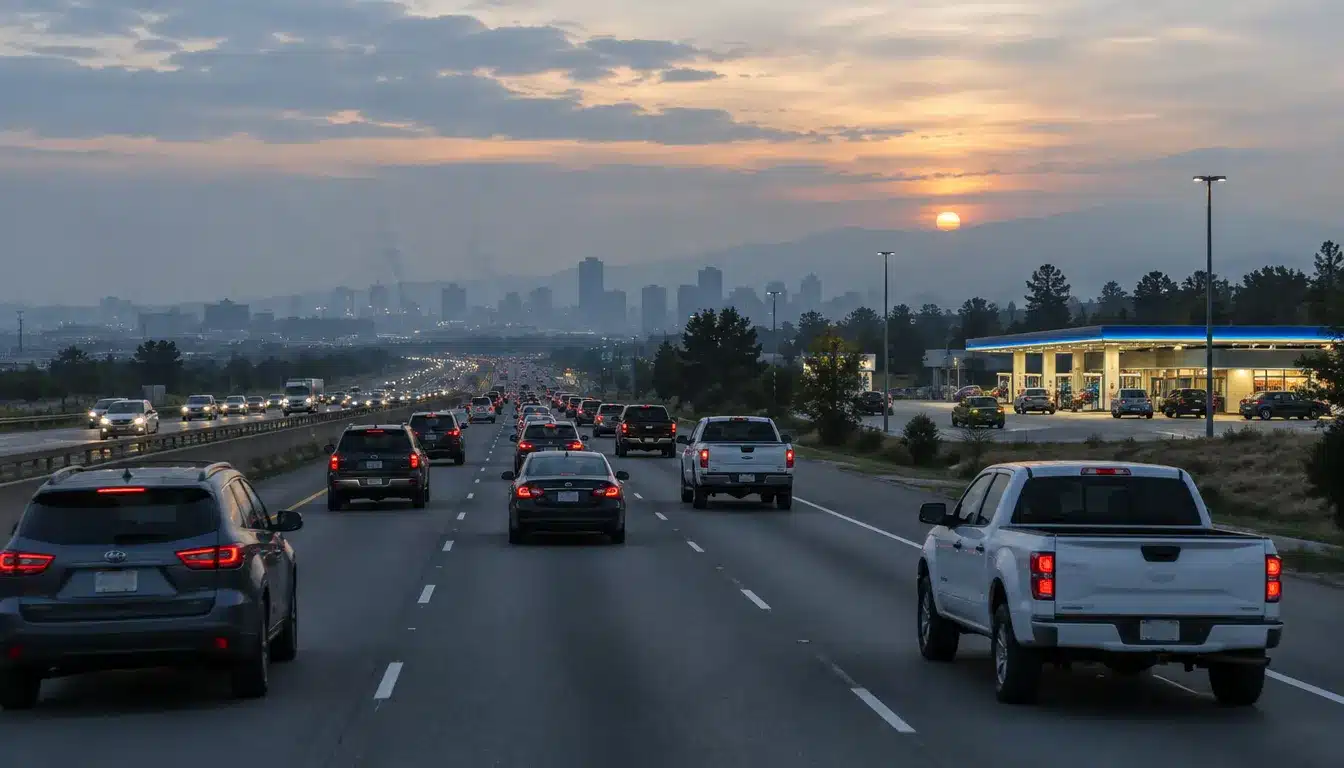
The US transport department has finalised weaker fuel economy standards for new cars and light trucks, cutting the fleetwide target for model year 2031 from about 50.4 to 34.9 miles per gallon.
The Trump administration finalised a rollback of federal fuel economy standards for new passenger cars and light trucks on 28 September. The National Highway Traffic Safety Administration, part of the Department of Transportation, published the revised Corporate Average Fuel Economy rules. As a result, the efficiency bar that carmakers must clear through model year 2031 falls sharply.
The department estimates the new rules equate to a fleetwide average of about 34.9 miles per gallon for model year 2031. By contrast, the standard set under the Biden administration would have required around 50.4 miles per gallon. That tougher target was pushing carmakers to invest more in electric vehicles. So the new rule weakens the main federal efficiency lever on cars and trucks.
Washington frames the cut as consumer relief
The department says the change gives carmakers more flexibility and will lower the average price of a new vehicle. It also expects the rule to lift new car sales. Throughout, the administration has described the Biden-era rules as an electric vehicle “mandate”.
Transportation Secretary Sean Duffy presented the rollback as a win for buyers. “Thanks to President Trump’s leadership, we have finally ended the illegal mandate,” he said. In his words, those rules had “forced automakers to produce more expensive electric vehicles that American families didn’t want.”
The Alliance for Automotive Innovation, which represents vehicle makers, also backed the decision. John Bozella, its president and chief executive, said the earlier standards were “out of step with market realities and customer demand”. He added: “Today’s final rule is an appropriate course correction.”
Health and climate groups plan to fight the rule
Critics say weaker fuel economy standards will mean less efficient cars, more greenhouse gases and more harmful air pollution. Harold Wimmer heads the American Lung Association as president and chief executive. He said the rule “will create more air pollution, harm health and accelerate climate change”. He also said there was “no reason to weaken standards that are technologically feasible”.
Transport produces about 28 per cent of US greenhouse gas emissions, Environmental Protection Agency data show. That puts it ahead of electricity generation at 25 per cent and industry at 23 per cent. So rules on vehicle efficiency bear directly on the country’s biggest emitting sector.
Environmental and health groups have said they will challenge the new standards. Katherine García leads the Sierra Club’s Clean Transportation for All work. She said the group “will fight this senseless rollback every step of the way”.
Fuel costs climb as projected savings vanish
The final rule confirms plans President Trump announced in December. Since then, however, the war in Iran has pushed pump prices sharply higher. The American Automobile Association now puts the national average at $4.48 a gallon.
Jason Schwartz is regulatory policy director at the Institute for Policy Integrity, part of New York University’s School of Law. He said the repeal leaves households more open to price shocks. He noted that the 2024 fuel economy standards were projected to save consumers $80bn in fuel costs. They were also expected to avoid more than $125bn in climate damages.
“Households that are already stretched thin will pay the price,” Schwartz said. In addition, the institute estimates that more than $17bn in projected annual consumer savings are now at risk from the administration’s wider regulatory rollbacks.
US carmakers face a divided global market
Dan Becker, director of the Center for Biological Diversity’s Safe Climate Transport Campaign, also attacked the timing. “Trump is tanking sensible mileage standards at the worst possible time for consumers, who’re getting hit with sky-high prices at the pump,” he said.
Meanwhile, Chinese electric vehicles keep gaining ground in markets such as Argentina. BYD overtook Tesla in 2025 as the world’s largest maker of electric vehicles. Becker warned that US carmakers could end up on the sidelines “while clean cars advance around the world”.