China and the EBRD have put billions behind Türkiye’s wind, solar and grid build-out as the Leaders’ Summit closed. New tools for catalytic capital, building efficiency and waste give climate tech companies clearer routes to finance and buyers.
The second half of the Leaders’ Summit produced a run of clean energy finance deals centred on the host country’s power sector. Alongside them came smaller instruments that start-ups and their investors can use directly. They include a public directory of catalytic capital and a buildings efficiency compact.
China backs 7GW of Turkish wind and solar
Türkiye has signed an agreement with China’s National Energy Administration that envisages about $15bn of investment. According to the COP31 Presidency, the package covers 7,000MW of new solar and wind, new energy storage and 4,000MW of transmission capacity. It also includes technology transfer and local production of wind turbine equipment.
Energy minister Alparslan Bayraktar said the cooperation would “expand our renewable energy capacity and enable technology transfer”. The initial agreement names no individual projects or suppliers so far. Storage integrators and grid equipment makers should therefore watch for tenders as the deal moves forward.
EBRD commits $6bn to Türkiye’s REACT platform
The European Bank for Reconstruction and Development plans to invest $6bn over five years through REACT, the Türkiye Renewable Energy Acceleration and Clean Transition platform. REACT is designed to mobilise up to $300bn by 2040 across the renewable energy value chain. It supports a new national target of 175GW of installed solar and wind by 2040.
Other backers include the World Bank, the IFC, GFANZ, the Climate Investment Funds, KfW and UNIDO. EBRD President Odile Renaud-Basso said the bank has “a substantial footprint in Türkiye’s energy sector”. However, the $6bn sits apart from the $300bn goal, which isn’t yet fully financed.
GFANZ opens a directory of catalytic capital
The Glasgow Financial Alliance for Net Zero has launched a public Catalytic Capital Repository, hosted by the Global Capacity Building Coalition. It lists concessional and catalytic debt, catalytic equity, guarantees and grants linked to investment vehicles in emerging and developing economies. Its first cohort includes more than 30 institutions across North America, Europe, Africa and Asia.
Mary Schapiro, vice chair of GFANZ, said the tool makes catalytic capital “easier to find, compare, and access”. For developers raising blended finance in emerging markets, that means one place to compare providers of concessional capital and guarantees.
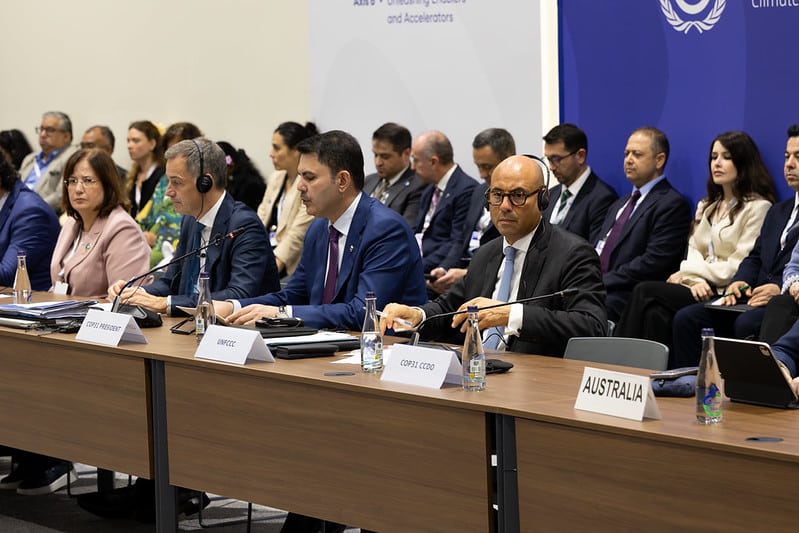
UN Climate Change Executive Secretary Simon Stiell, COP31 President Murat Kurum, and UNDP Administrator Alexander De Croo attend the “COP31 Legacy Initiative High-Level Event and Strategic Roundtable – Climate Implementation Bridge: From Commitment to Implementation.” (Photo: © UN Climate Change – Kubilay Ciftci)
Industrial decarbonisation platform gains a private finance partner
GFANZ also signed a memorandum with Türkiye’s Ministry of Industry and Technology. It becomes the private finance partner to the Türkiye Industrial Decarbonization Investment Platform (TIDIP), which focuses first on steel, cement, aluminium and fertilisers. The partners will build a programme to engage private lenders and tackle investment barriers.
Minister Mehmet Fatih Kacır called it “an important step in strengthening the private finance dimension of the Platform”. Meanwhile, the Presidency said TIDIP projects will receive up to $250m from the Climate Investment Funds. The platform’s goal is to mobilise more than $6bn by 2030.
Buildings compact sets a 2035 efficiency target
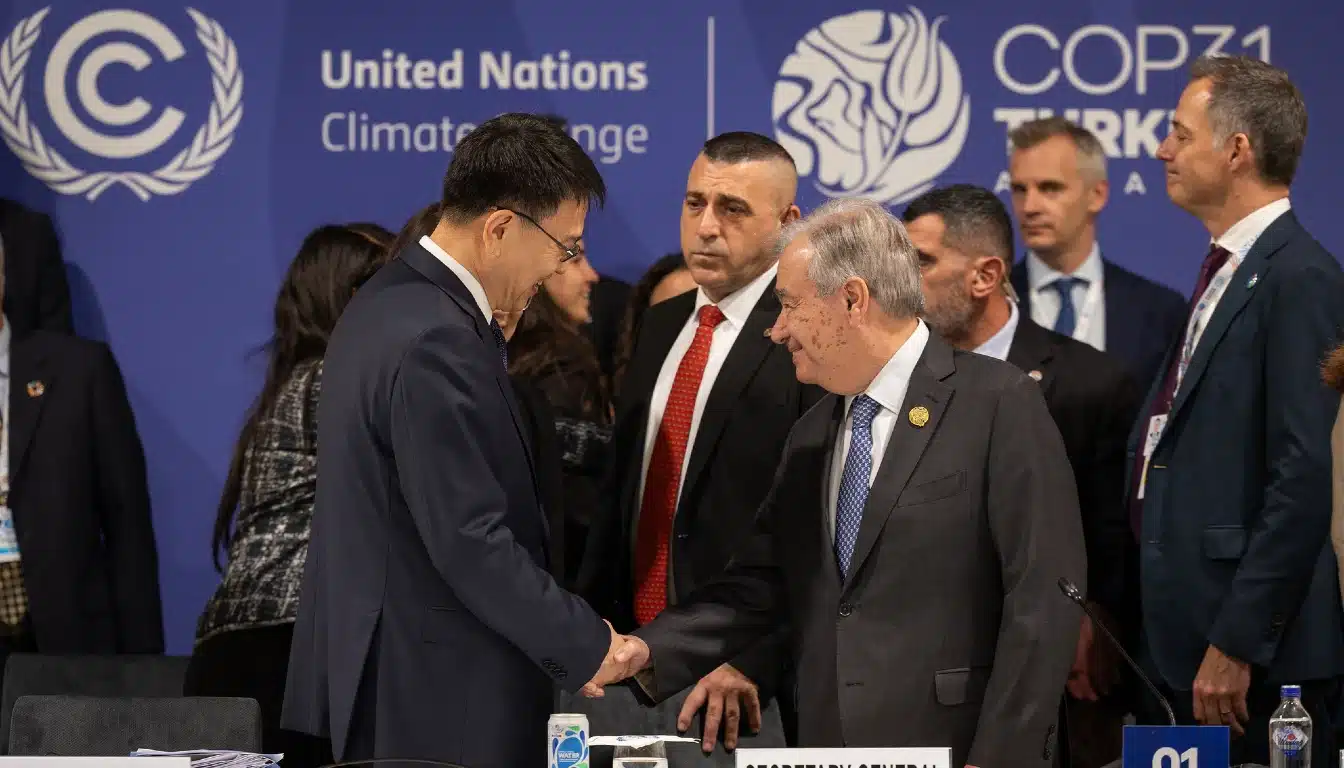
Countries endorsed the Antalya Compact for Energy Efficient Buildings on the summit’s second day. It backs a 25 per cent cut in the operational energy intensity of the global building stock by 2035. It also supports faster efficient electrification of buildings, in line with the 35-by-35 goal.
Six projects won Sustainable Building Awards from two competitions run by Türkiye with support from UNEP’s Global Alliance for Buildings and Construction. Inger Andersen, executive director of UNEP, warned that the “window to transform the buildings sector is narrowing”. As a result, heat pump, controls and retrofit companies now have a dated international target to cite with customers.
Zero waste districts will measure avoided methane
The first international Zero Waste Districts will try out waste reduction, reuse, repair and recycling at neighbourhood scale. Their work includes measuring avoided methane emissions. The opening cohort has 20 districts, and the Presidency wants to scale that to 100.
According to the Presidency, the waste sector produces about 20 per cent of human-caused methane. Leaders also backed a goal to halve projected growth in municipal solid waste by 2035. A second goal lifts the circular material use rate to at least 15 per cent. The district measurement work builds on the Presidency’s wider focus on landfill methane.
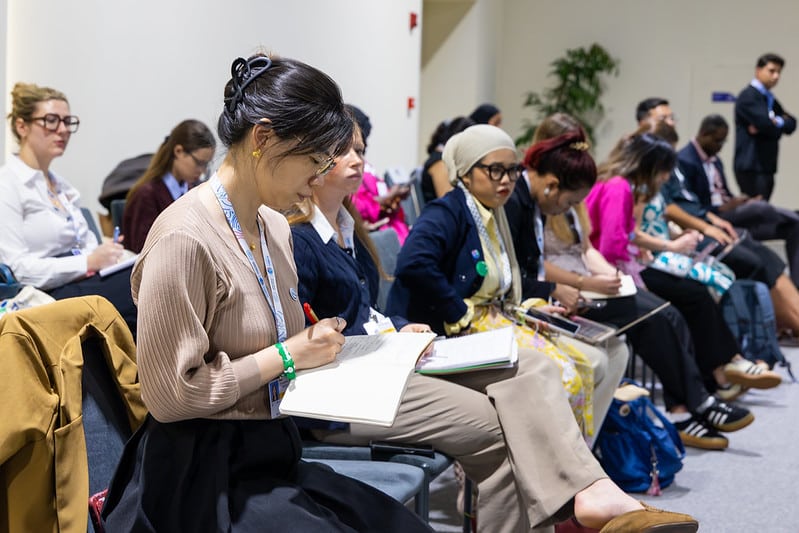
Participants attend the “Youth-led Climate Forum Thematic Part III – Delivering on Adaptation and Loss and Damage: What actions should be implemented to deliver on the decisions” session. (Photo: © UN Climate Change – Kubilay Ciftci)
Green industry push reaches the poorest economies
Leaders backed the Antalya Green Industrialization Compact, which is meant to grow investment in, and markets for, near-zero and low-emission industrial production. Industry accounts for roughly a quarter of direct global CO2 emissions, the Presidency noted.
The Presidency also launched the LDC Green Industrialization Facilitation Mechanism, with the UN Technology Bank for Least Developed Countries as its secretariat. It connects green industrial projects in those countries with technology, technical support and finance. It starts with ten pilot countries, working alongside international organisations and multilateral development banks.
Resilience money moves towards project pipelines
A new Sustainable Urban Resilience Financing Facility will help countries and cities turn resilience priorities into investment-ready projects. In addition, the Climate Investment Funds announced up to $190m in adaptation finance for five countries and a region under its ARISE programme. Tariye Gbadegesin, chief executive of CIF, said “what is often missing is the catalytic finance needed” to make priorities investable.
The Pacific Resilience Facility has secured more than $200m in pledges. The Minderoo Foundation pledged $5m, becoming the facility’s first philanthropic donor.
What to watch next
The Finance and Trade Day on 13 November brought trade ministers, UNCTAD and the WTO together on low-carbon value chains. We’ll report on the day’s announcements in our next digest on 14 November. Industry Day follows on 16 November. On carbon markets, 31 countries have authorised more than 348 million credits for international transfer. Talks now focus on putting Article 6 rules into practice. The second week will show whether the voluntary compacts gather more signatories before the summit ends on 20 November.