Altitude’s VP explains how site-level data, flood mapping and smarter cooling can protect hotel revenues as heat, fire and drought redraw Europe’s tourism map
A hotel can lose a season’s revenue without a single flame touching it. When a region burns, floods or bakes, guests book elsewhere, and some stay away the following year too.
That shift sits at the centre of Hotels and climate change, a new report from Altitude, the climate risk platform run by AXA Climate. It sets out what heat, fire, flood and drought now cost hotel owners, and how data can guide where they spend on resilience.
Travel and tourism will contribute $12tn to the global economy in 2026, the World Travel & Tourism Council forecast in May. That is 9.9 per cent of world GDP, and the sector supports about 376 million jobs, roughly one in nine worldwide.
Théophile Bellouard, VP of Altitude at AXA Climate, describes the platform as “the decision infrastructure for climate resilience”. Speaking on the Climate Solutions News podcast, he said Altitude helps “any organization that will either own, build, finance or manage real assets to turn climate exposure into decisions and decisions into actions.”
Hospitality is one sector among many on the platform, alongside infrastructure, agriculture and food. “We have a lot of clients in that space and that’s the reason also we’ve decided to publish that study, deep diving a bit on the topic, on the impacts and what could be done,” Bellouard said.
When the destination becomes the risk
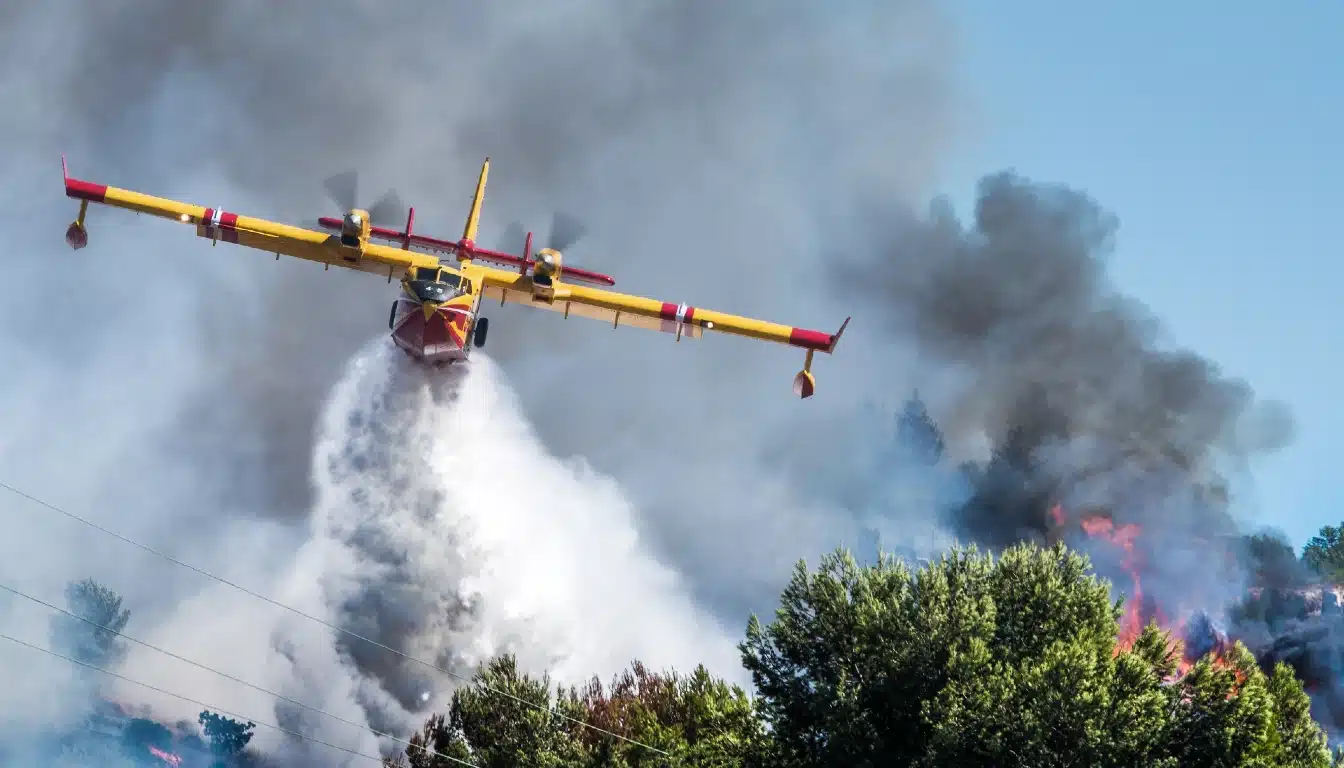
The report opens with the wildfires that swept the Gironde in south-west France this summer. More than 220,000 people were evacuated within a few days, and hotels on the Cap-Ferret peninsula shut overnight at the height of the season. In Saint-Émilion, more than 80 kilometres from the fires, hotels and restaurants reported mass cancellations running into September.
The hospitality consultancy MKG put daily losses in late July at between €1.8m and €2.3m, according to the report. That is close to two thirds of the Gironde’s usual daily turnover.
France is the world’s most visited country. It received a record 102 million foreign tourists in 2025, who spent €77.5bn, according to figures from the economy ministry and Atout France. French hotels recorded about 220 million overnight stays across the year, INSEE data show. The Gironde alone drew 9.1 million visitor stays in 2025, worth €3.8bn to the local economy, according to the department’s visitor survey cited in the report.
For Bellouard, the episode shows how far climate risk now travels. “I think it shows that the destination becomes the risk and it’s no longer the building that is at risk,” he said. “It’s a strong illustration of assets, hotel here, that have not been damaged at all, but still they are losing revenues. And they lose revenue even in the longer term because the region now is not looking safe.”
He pointed to research from Portugal that tracked hotel revenues after major wildfire seasons. “Hotels that were directly hit by the wildfires, they still lose around forty, forty-three percent actually of their revenues the year after,” he said. “And nearby hotels who were not impacted are then still losing twenty-four percent of the revenues the year after.”
That slow recovery, he argued, is still missing from most financial thinking. “The fact that this recovery can take a long time is something still underpriced in all models,” he said.
Wildfires burned more than one million hectares across the EU in 2025, the European Commission said in March. That was the worst year since its fire monitoring records began in 2006.
Travellers are moving, and investors are watching
Booking.com’s 2026 Travel and Sustainability Report, based on a survey of 32,500 travellers, found that 74 per cent weigh extreme weather risk when choosing a destination. Nearly a third have cancelled or changed a trip because of it.
Bellouard reads those figures as a shift in when and where people travel. “It’s not a matter of occupancy rate, it’s a matter of booking patterns that are changing,” he said. “People are just basically shifting their holidays in time and places, going in on the shoulder season or just going in places where it’s gonna be cooler.”
The European Commission’s Joint Research Centre has modelled where that leads. Under a 3 to 4°C warming scenario, it projects summer tourism demand on southern Europe’s coasts falling by 10 per cent by 2100. Demand in Nordic countries would rise by more than 5 per cent.
Accor chief executive Sébastien Bazin said in February 2025 that the group had dropped two planned hotels on Mykonos. He cited water shortages and fire risk. Bellouard said due diligence on tourism assets has become far more detailed as a result.
“Investors particularly are conducting much more deeper, granular, thorough due diligence when looking at tourism or accommodation businesses,” he said. Many of these assets sit “in very exposed regions, in the seafront or in the mountains,” he added, where chronic change compounds extreme events. “A ski resort, if you no longer have snow in five to ten years or if you have a shorter ski season, is going to be at risk.”
For him, the purpose of climate screening is plain financial accuracy. “Looking at climate risk in due diligence, it’s really a matter of estimating how it impacts cash flows,” he said. “So you make sure that you’re projecting your cash flows, both revenues and costs, properly, so in the end the valuation you’re making is the right one.”
Insurance costs and the limits of national schemes
CBRE estimates that hotel insurance spending rose by 19.5 per cent in 2023, with sharper rises in regions exposed to hurricanes and floods.
Bellouard declined to forecast AXA’s own pricing, which he said rests on “a huge underwriting work conducted by underwriters”. He did point to strain on France’s natural catastrophe regime, which keeps assets insurable by adding a surcharge to property policies. That surcharge rose from 12 per cent to 20 per cent on 1 January 2025.
Other countries run different backstops, he said, but all face the same question. “The big question is how do you finance them, and do you still have everyone paying the same, or should people more exposed pay more on that? Should companies or individuals pay more on that? It’s all questions that are debated in a lot of countries.”
How Altitude turns hazard data into euros
Altitude’s model rests on two inputs: the hazard a site faces and how vulnerable the building is to it. Hazard covers questions such as whether a hotel sits in a flood-prone area or faces a month or two of 30°C heat. “And then you need to cross that with vulnerability,” Bellouard said.
Vulnerability depends on details such as whether a hotel has a basement and what sits inside it. The platform models 23 hazards globally across time horizons from 2030 to 2050 and several warming scenarios. It applies vulnerability profiles to more than 90 asset types. “You know that a campsite and a five-star hotel don’t have the same typical vulnerability when exposed to the same level of hazard,” he said.
The output starts as a low, medium or high risk score. The more useful step comes next, he said: “translating that into euros. So basically how much does it cost in terms of extra energy demand for cooling? How much does it cost in terms of repairing damages if you get flooded or destroyed by cyclones?” Altitude splits those costs between property damage and business interruption, because each points to different actions.
Bellouard said about 90 per cent of Altitude’s data is proprietary. For flooding, it uses Fathom, a flood risk specialist founded at the University of Bristol. The two companies expanded their partnership in March, adding Fathom’s FathomDEM+ terrain model, which uses machine learning to produce near-LiDAR elevation data worldwide.
Bellouard said resolution drove the choice. “They have global models covering the whole world with thirty-metre resolution data, which is critical for flood,” he said, “because you know that a few tens of centimetres of water in one part or another part of a hotel will have totally different consequences.” On large portfolios, that detail also helps “avoid false positives and false negatives” when flagging flood risk.
Satellite data only goes so far, he added. “If you really want to understand and mix the two information, that’s where you need to have field visits or eyes on site.”
Reading the numbers: rankings first
The report includes a worked example of a fictitious French group with 60 hotels. Under a high-emissions scenario, Altitude flags 41 of the 60 sites as at very high risk of extreme heat, flooding or tropical cyclones by 2040.
One property, a four-star hotel in central Paris, faces more than a metre of water in a 1-in-1,000-year river flood. A €50,000 watertight barrier cuts its modelled flood damage from €4.0m to €2.8m by 2040.
Bellouard was clear that the figures are illustrative. “It’s purely a fictitious example with fake data,” he said, and the €1.2m saving is a cumulative figure to 2040 under the high-emissions scenario. Owners should use results like these to compare assets across a portfolio.
“You can have very important trust in the ranking between different hotels rather than the result itself or the business model itself for one specific asset,” he said. “Because of all the generic assumptions that are made when you want to come up to that kind of results, not taking into account all the very specific vulnerability of a hotel.”
The second use is spotting no-regret moves. “If you have a measure that is inducing savings in any warming scenarios, even in the short term, it’s something you could go for very quickly and it’s an easy decision to make,” he said. Measures that pay back only in the long term, and only under high emissions, deserve a second look.
Keeping the heat out before cooling it down
Bellouard treats extreme heat as a different kind of risk from flooding. “When you’re in a flood-prone area or on the seashore, basically you were always exposed to flood risk,” he said. “The probability is changing, the intensity is changing, but it was a known risk. Extreme heat is a new one.”
The International Energy Agency estimates that air conditioners and fans already use nearly 20 per cent of the electricity consumed in buildings worldwide. During this June’s heatwave, some French hotels had to rehouse guests after air-conditioning units failed under thermal overload, the report notes.
Bellouard’s first rule is to stop heat getting in. That means low-tech measures such as external shading, planting around buildings, green roofs and walls, and night ventilation. “That kind of stuff are blocking the heat outside of the building,” he said. Insulation and energy management come next, including cooling only the rooms that guests occupy.
System design also counts. “If you’ve been designed for the last ten years’ temperature, then basically you’re working outside of the usual range of the system, so you’re consuming more and you have a higher rate of failure in the end,” he said. “But if you’re projecting your temperature to 2040, for example, and you size, design your systems on that, then basically it’s more efficient and it works better.”
He also sees room for heat recovery. Hotels need cool air for rooms and hot water for laundry and bathrooms. Producing both from the same system improves efficiency overall, he said.
Where the money should go first
Asked where he would put a single adaptation budget line for a global hotel portfolio, Bellouard chose the refurbishment cycle. “Every year you have a capex plan for refurbishment and for improving the whole portfolio,” he said. “If you just add on top some measures for adaptation, making sure that design is well done, then basically the additional cost is super low.”
After that comes triage, ranking assets by exposure and by value. “If some hotels are generating twice more revenues than others and they are at the same level of climate exposure, then you want to work on the most valuable one,” he said.
His first euro would go on a site visit. “How do you make sure that you are capturing exactly the reality of a hotel, of the way it works and the way it’s vulnerable?” he said. “I think that’s how you make also the best decisions on the ground, locally and not in a central office.”
Gaps for start-ups to fill
Bellouard sees three openings for climate tech start-ups. The first is capturing building vulnerability at scale. “How can you use satellite imagery, street view, drones, computer vision surveys, that kind of stuff,” he said, “so you are capturing that and you’re accelerating the way you’re building your adaptation programmes.”
The second is proving that adaptation works. “If you’re able to connect that, then you can negotiate basically lower premiums on your insurance. You can negotiate better financing of your projects,” he said. “But you need a proof to do that. And that’s still very difficult.” Sensors or new financing mechanisms could close that gap, he suggested. Schroders found a related problem when it ranked 102 adaptation activities: impact and returns rarely meet.
The third is water. Drought and water scarcity rank among the main risks for accommodation, he said, especially around the Mediterranean. He named grey water reuse and rainwater harvesting as areas ripe for new technology. The report cites the Noosa Pacific Resort in Australia, which stores 16,800 litres of rainwater beneath its car park. The hotel uses it for irrigation and water features.
“All around the Mediterranean basin there are so many hotels impacted by droughts that the market is huge, and the need for the planet is huge,” Bellouard said.
Resilience moves from the building to the region
Bellouard joined the interview with a virtual backdrop of snow-capped mountains on his video call, the kind of view that sells winter holidays. In his view, the value of that scenery now depends on how well the whole destination copes with heat, fire, flood and drought. The same holds for every coastline and vineyard that draws guests.
For hotel owners, managing climate risk now means looking beyond the property line. The tools to do it at portfolio scale now exist. Bellouard’s advice is to start with the data, check it on the ground, and build adaptation into the spending already planned.