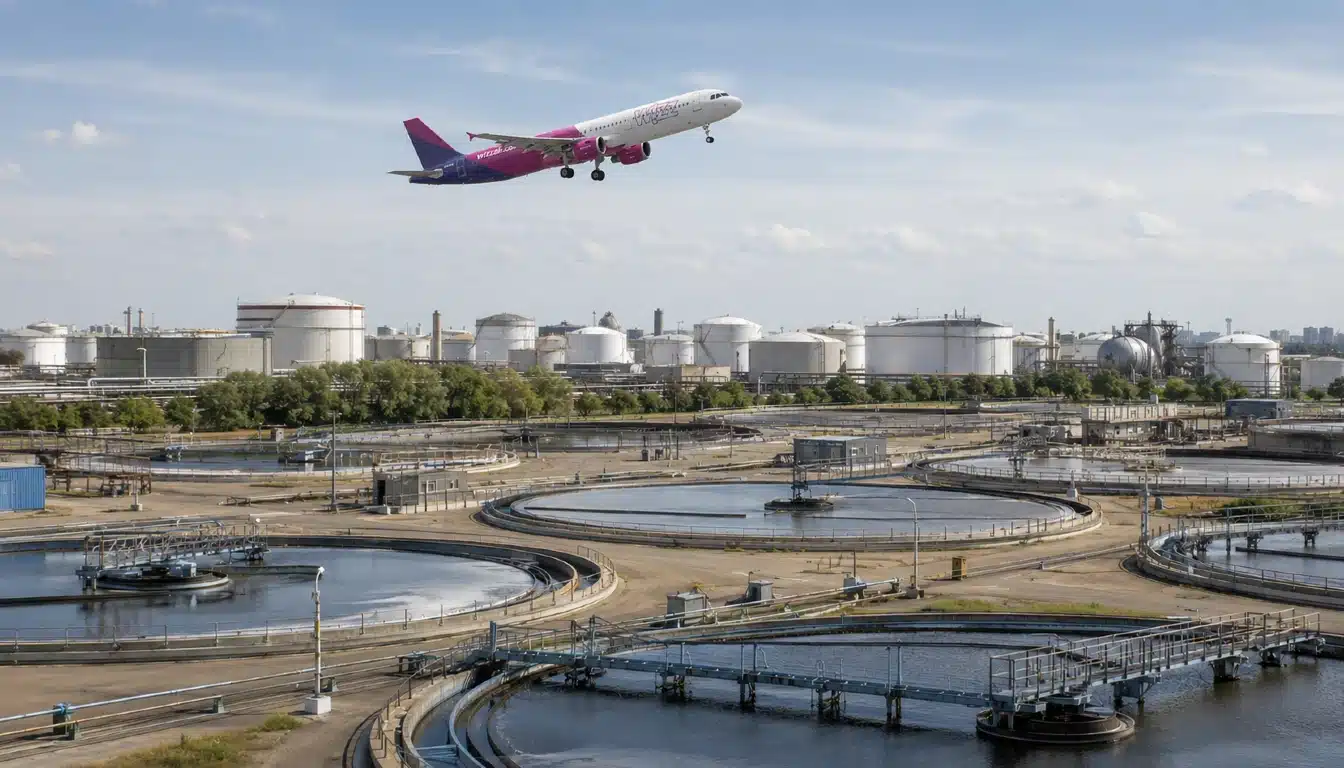
Firefly Green Fuels is turning treated sewage into jet fuel. The feedstock is free, abundant, and about to lose the disposal route it has relied on for decades.
Aviation is the hardest transport sector to decarbonise. Batteries are too heavy for long-haul flight, hydrogen remains years away at scale, and the sustainable fuels that already work mostly depend on feedstocks in short supply. So the search continues for a fuel that is cheap, abundant, and genuinely low carbon. One Bristol company thinks the answer sits at the end of every sewage works across the world.
Firefly Green Fuels turns treated sewage, known in the industry as biosolids, into sustainable aviation fuel. The company has a first UK plant in development at Harwich and an offtake deal with Wizz Air worth close to a billion dollars. The feedstock behind it is the residue most people would rather not think about.
A feedstock found by elimination
Firefly Green Fuels is new, but the search that produced it is not. James Hygate, founder and chief executive of the business, started an earlier company, Green Fuels, in 2003, building biofuel equipment in more than 90 countries using waste oils and fats. The limits of that supply became clear early.
Hygate recalls recognising early that feedstocks were limited. The company had set itself, in his words, “a lofty goal of decarbonising aviation” in its entirety, a “gigaton level” challenge. “We looked at every waste, we looked at every material there, every process,” he said. Each option failed on one of three counts. It was too expensive to make, it could not meet the sustainability tests, or the process was too complicated.
Wet biomass kept surfacing as a candidate. That line of thinking led the team to sewage, and Hygate is quick to correct the obvious assumption about how the idea arrived.
“I wasn’t sat in the bathroom one morning and thought, guess what, I can turn this into fuel,” he said. “It really was a long drawn out process to actually identify this as the ideal feedstock for making large quantities of cheap SAF.”
A disposal route about to close
Biosolids are the final output of anaerobic digestion at wastewater plants. For years they have been spread on farmers’ fields. That outlet is now closing, and the reason is what makes Firefly’s timing ideal.
“The current disposed route is disappearing because of forever chemicals, microplastics and metals,” Hygate said. “So around the world this is kind of now getting phased out, so it’s a problem waste.”
Those contaminants come from the whole sewer network rather than the human body. Biosolids concentrate whatever survives treatment, so PFAS (the ‘forever chemicals’) bind to the solids, microplastics arrive from synthetic textiles and packaging, and metals largely from industrial discharge. Sharper lab detection and tighter rules have caught up with the risk, and some jurisdictions now ban land application outright over fears the residues enter the food chain.
The volumes involved are substantial. The UK produces around 1.1 million tonnes of dry solids a year, and Germany, the EU’s largest producer, about 1.85 million. The United States generates far more, roughly 7 million tonnes annually. Every one of those tonnes now has to be disposed of somewhere.
In the UK, Hygate estimates biosolids could supply around a third of the 2040 SAF mandate. Abroad the numbers climb. Firefly’s US partner, the biosolids firm Synagro, processes 16 million tonnes a year. “You could, if you can convert that into liquid fuels, would double the US output of SAF,” he said.
Add animal slurries and other regulated wet wastes, and the ceiling rises further. “You can decarbonise aviation in its entirety, which is kind of mind blowing,” Hygate said. “There’s just millions and millions [of tonnes] of this material out there, basically.”
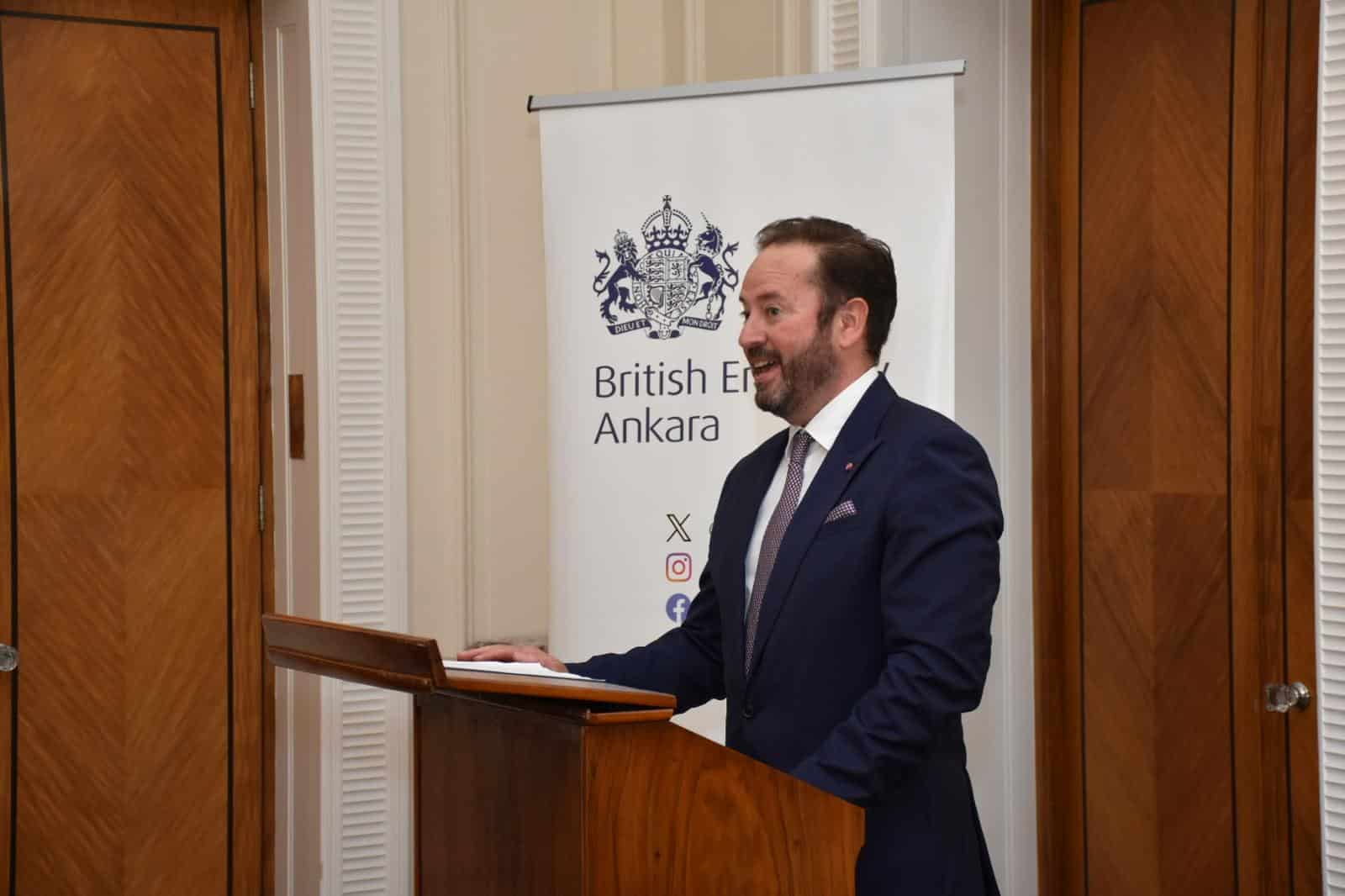
James Hygate delivers a speech in Ankara at the announcement of the agreement with Turkish engineering firm Altaca.
The pressure cooker at the heart of it
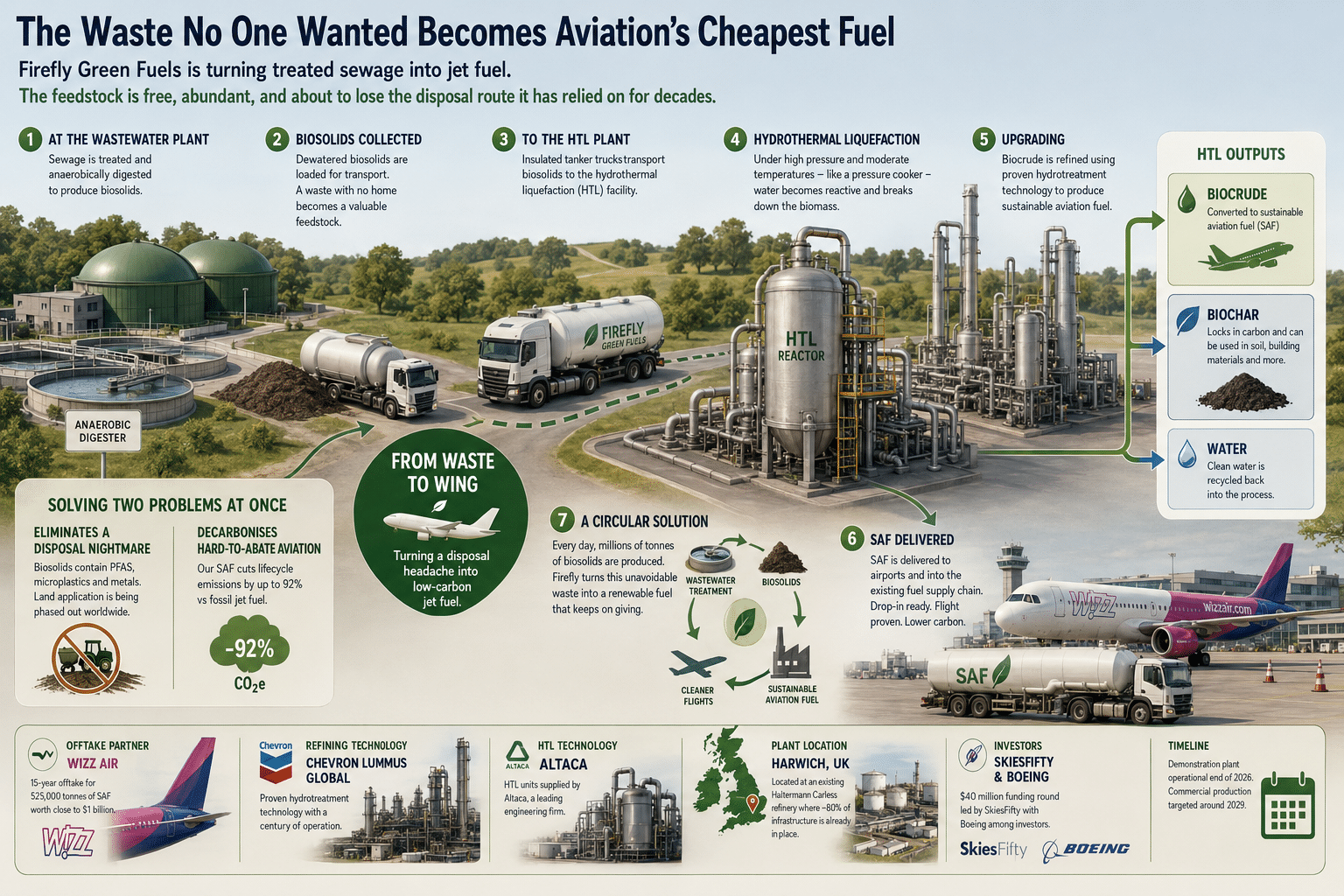
The conversion rests on hydrothermal liquefaction, or HTL, a process dating to the 1970s. Hygate uses an everyday analogy to describe it.
“In its most simplistic form, it’s like a pressure cooker,” he said. “So you take in wet materials, so wet biomass, and you put it under sort of relatively high pressure, kind of moderate temperatures, to the point where the water becomes reactive and it breaks down the material that’s in there.”
The output is a biocrude close to fossil crude, plus biochar and water. The biocrude then goes through hydrotreatment, a refining step the oil industry has run for a century. Hygate frames the chemistry as an accelerated version of a natural process.
“You think about fossil fuels, they’re still biofuels, they just take millions of years to make,” he said. “This is a way of speeding that up into a much, much faster process.”
Independent analysis by Cranfield University put the carbon saving at 92% against fossil jet fuel on a lifecycle basis. That figure excludes any carbon capture. Because the biochar locks in fixed carbon, and because the HTL stage releases capturable CO2, Hygate sees further room. “There is the potential to get this effectively to a carbon neutral or a carbon negative fuel,” he said.
Why negative-cost feedstock changes the financial equation
The economics turn on where the feedstock sits today. Water companies pay to dispose of biosolids, so a buyer that takes the material solves a growing liability. That gives Firefly an input with a negative cost, feeding a product airlines will buy at volume.
The partnerships around it are built to reduce risk. Firefly signed a 15-year offtake with Wizz Air for 525,000 tonnes of SAF, a deal reported at close to a billion dollars, on top of an earlier £5 million investment from the airline.
Downstream refining runs on Chevron Lummus Global technology under an exclusive arrangement.
The upstream HTL units come from the Turkish engineering firm Altaca.
The commercial plant will sit at an existing refinery in Harwich owned by Haltermann Carless, where Hygate reckons 80% of the infrastructure is already in place.
“We have de-risked the technology by using proven technology,” he said. A demonstration facility is in construction and, in his words, “should be operational end of this year.” The Harwich plant is targeted for commercial production around 2029, backed by a $40 million round led by the fund SkiesFifty, with Boeing among the investors.
The process at a glance
Feedstock first, fuel second
Policy has moved in Firefly’s favour. The UK’s SAF mandate is already running, and the Sustainable Aviation Fuel Act reached the statute book in March 2026, bringing a Revenue Certainty Mechanism that guarantees producers a fixed strike price over a 15-year contract. Hygate wants a model that works without such support, so the approach can travel. “It can be done in an incentivised market, which is really important,” he said.
What sets Firefly apart, in his account, is the direction of demand. Where most SAF firms chase scarce feedstock, Firefly fields approaches from suppliers wanting rid of the material.
“We are feedstock driven,” Hygate said. “We have people contacting us about the production of SAF.” Utilities in the United States and Latin America, including Brazil’s Sanepar, are among the inbound interest. “We exist to decarbonise aviation, but actually we solve this wastewater treatment challenge that’s out there.”
Hygate has seen this pattern before. Green Fuels grew after a 2003 order banned used cooking oil from animal feed, sending a discarded material onto the market overnight. Biosolids, he argues, follow the same logic at a far greater scale. “We’re all making it every day. There’s loads of it,” he said.
A weight worth carrying
Once Hygate saw the issue, and potential solution, he hasn’t been able to let it go. “Once you’ve worked out you can fix this massive problem, you can’t not do it,” Hygate said. “It suddenly consumes you, it’s quite a hard weight to carry.”
Aviation leaves few options. “You can’t do anything with aviation other than SAF,” he said. “But at the moment, there’s basically no second generation SAF.”
If Firefly’s numbers hold, a waste stream produced every day, in every country, could become a serious source of low-carbon jet fuel, while lifting a disposal headache off the water industry at the same time. The material no one wanted may yet take off as an energy solution.