
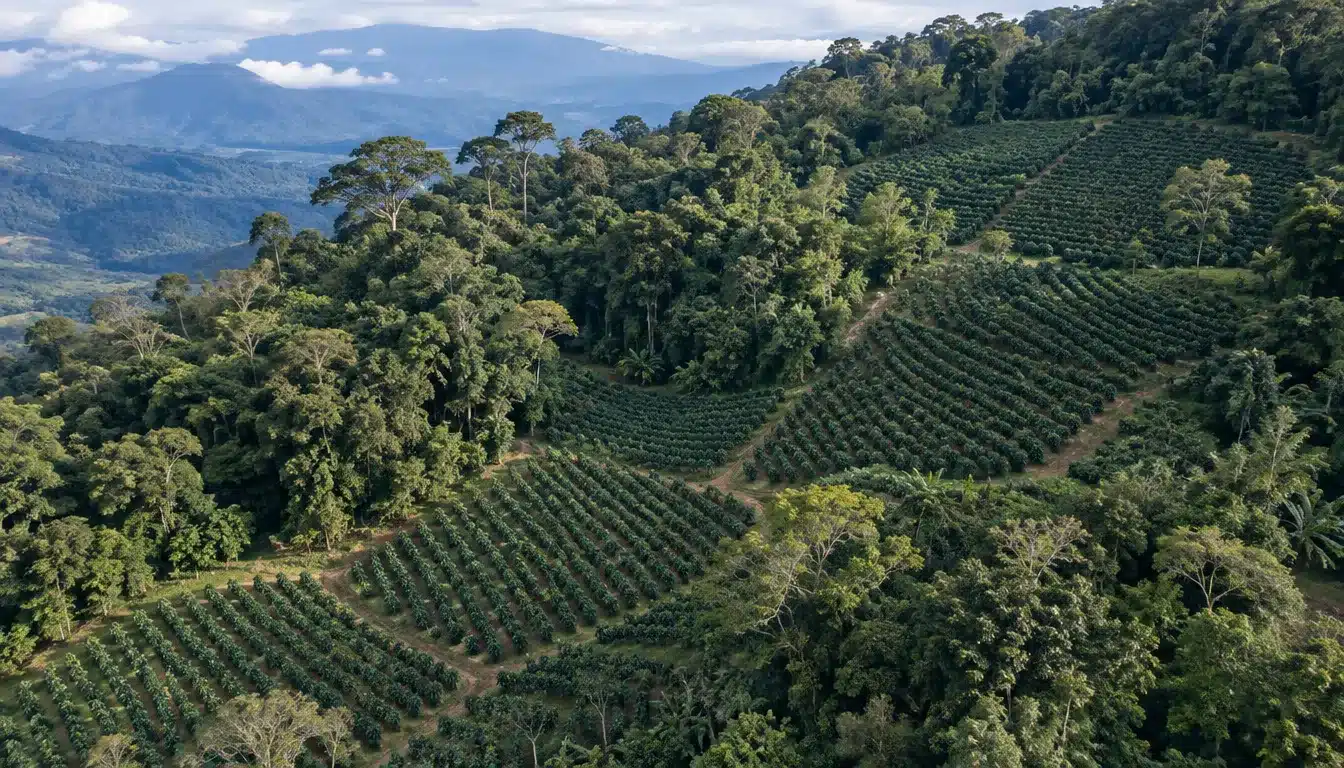
The London start-up uses geospatial AI to trace cocoa, coffee and rubber back to the farm plot, giving smaller importers a cheaper route to compliance before EU deadlines arrive.
Epoch, a London start-up that traces cocoa, coffee and rubber to where they were grown, has closed a $4.25m seed round. Burnt Island Ventures and Sand River led the round, which takes total funding to $6.26m. The company wants to help small and medium-sized importers comply with EU deforestation rules.
Epoch will spend the money on its product, its technical base and its sales team. Its first product automates compliance with the EU Deforestation Regulation, known as EUDR. However, the company lists EUDR as only one of five use cases, and carbon removal is another.
How the tool works
Users start with a list of supplier names. From there, Epoch finds each supplier’s sites and the farm plots linked to them. It then checks those plots for signs of forest loss and legal risk. Its AI tools and software agents map farms, plantations and mines from satellite data.
The output is a due diligence statement with cited findings. Importers can then file that statement through TRACES, the EU’s submission system. For instance, a small coffee importer could upload the names of three exporters and receive a statement ready to file.
Customers can use Epoch’s own platform or assistants such as ChatGPT, Claude and Gemini. Epoch says private customer data stays on each customer’s own systems. Because the tool works from supplier names, buyers don’t need to collect plot coordinates first.
Smaller firms face the same duty
The regulation entered into force in June 2023. It covers cattle, cocoa, coffee, oil palm, rubber, soya and wood products. Under the EU deforestation rules, companies must trace each product to its plot of origin and submit a due diligence statement.
The obligations apply to large and medium operators from 30 December 2026. Most micro and small operators follow on 30 June 2027. As a result, smaller firms will soon carry the same tracing duty as their larger rivals.
Epoch also argues that official data has gaps. In a June 2026 analysis, the company found that the EU’s forest map wrongly flagged 75 per cent of the coffee plots it surveyed. It concluded that no single map should decide whether a supplier complies.
Founders and backers
Jinal Surti, Epoch’s co-founder and chief executive, started the company in 2023 after work moving money into emerging markets. Surti was an early employee at Ripple and a founding executive at Menai. Meanwhile, William Ouellette, the co-founder and chief technology officer, helped start Soilwatch. That firm helped developers plan voluntary carbon market projects.
Surti argues that older methods can’t keep up. “Supply chain compliance has been built on questionnaires, audits and certifications, and that toolkit is incomplete,” Surti said. By contrast, “one sweep across a supply chain, using geospatial AI and agentic research, produces evidence,” according to Surti.
The investors are backing a small team. Christine Boyle, a partner at Burnt Island, was upbeat. “Epoch is a team of 14 that operates like a team of 140, punching way above their weight!” Boyle said.
Greg Robson, founding partner at Sand River, went further. “Epoch is best placed to be the single source of truth for the first mile,” Robson said. The first mile is the farm end of the chain, where good data is hardest to find.
A crowded compliance market
Epoch joins a busy field of EUDR software providers. In July 2024, osapiens raised a $120m Series B led by Goldman Sachs Alternatives. Sourcemap raised a $20m Series B in June 2023, while Copenhagen-based Complir closed an $11m seed led by General Catalyst.
Epoch also works as a data supplier to larger platforms. Assent and Resilinc, for example, already embed its data. So the company sells direct to small importers and reaches bigger buyers through partners.
Tracing land use is part of a wider push to account for value chain emissions. For smaller importers facing EU deforestation rules in 2027, though, the immediate test is simpler. They need a statement that regulators will accept.