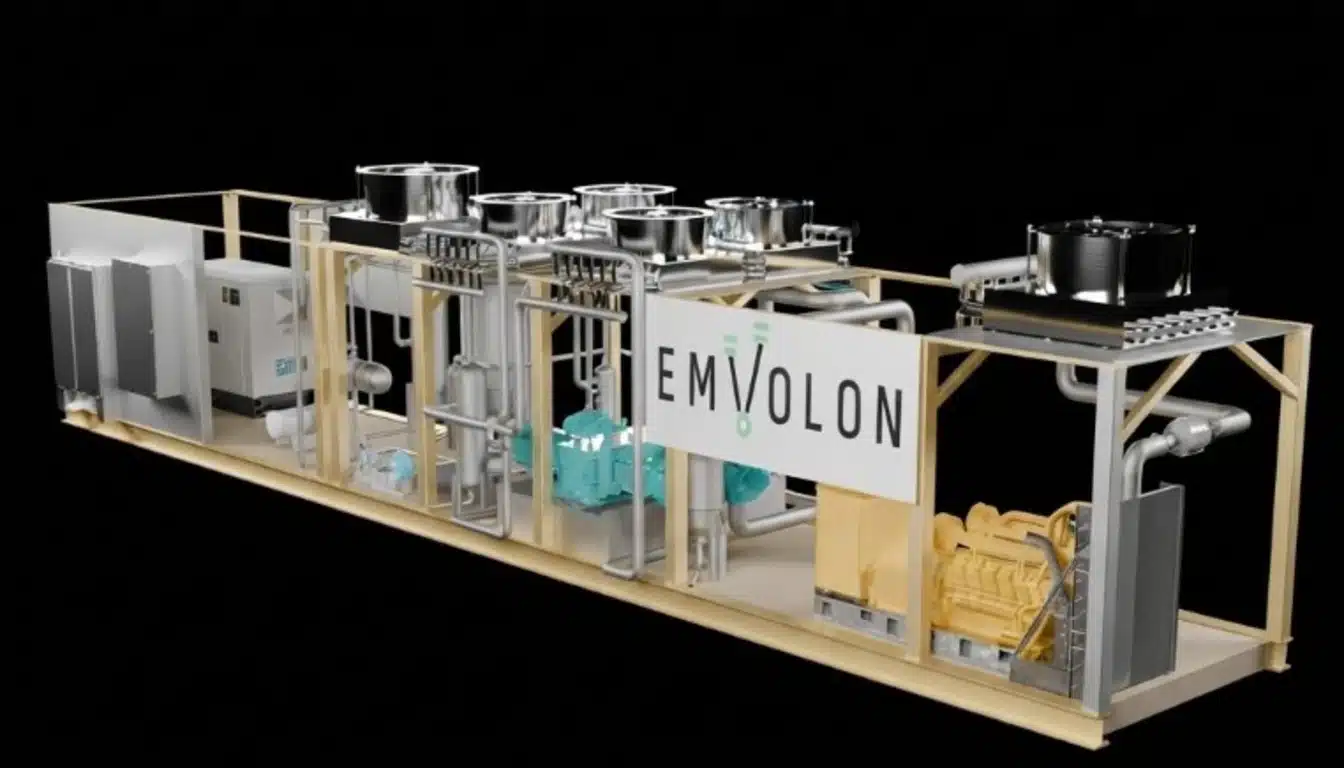
The MIT spinout will build its first commercial system, which uses engines and off-the-shelf kit to make liquid fuel at landfills and farms, with a purchase option worth up to $450m.
Emvolon, a Massachusetts company that converts waste methane into liquid fuels, announced on 27 October that it had raised $22m. The total combines a Series A round with non-dilutive federal and state grants. MassVentures, VX Ventures and Wagner Carbon are among the investors, and the company named no lead.
The money will pay for Emvolon’s first full-size modular unit and fund its growth. That unit turns waste methane into biomethanol. The system builds on a pilot with Montauk Renewables. That earlier trial ran at a landfill, the kind of site Emvolon now wants to serve at commercial scale.
Small plants at the source
Emvolon shrinks a chemical plant down and takes it to the waste site. Its patented system uses standard engines and other off-the-shelf parts to turn gas rich in methane into liquid fuel. That way, it avoids the cost of a large plant.
The units arrive prefabricated on skids and run off-grid. As a result, they can sit at landfills, dairies, wastewater treatment facilities and industrial flare sites. Emvolon is aiming at North America and key markets abroad.
A buyer lined up
Emvolon has a deal with Freepoint Commodities that runs for several years. It gives the trader the first right to buy. It covers up to $450m of biomethanol and liquid fuels, which Freepoint would sell through its global physical distribution network. Target markets include maritime shipping, aviation, heavy transport and specialty chemicals.
Emvolon says a joint venture plans to scale production to 50,000 tons a year across multiple sites. The company puts the market at $40bn a year and growing. It also cites a premium of $1,000 a tonne for high-quality biomethanol that meets RED III, the EU’s revised renewable energy directive.
Why biomethanol
Methanol is already a widely traded chemical, used to make plastics, solvents and fuels. Some shipowners have also ordered vessels that can run on it. So biomethanol made from waste gas can slot into markets that already exist.
Freepoint’s target sectors share one problem. Shipping, aviation and heavy transport all need liquid fuels that batteries can’t easily replace. In addition, the RED III premium gives European buyers a clear price signal for compliant fuel.
Leadership and backers
Emmanuel Kasseris, co-founder and chief executive of Emvolon, put the case succinctly. “The world is wasting an enormous energy resource every day,” Kasseris said. He added that the round gives the company “the capital to deploy our first commercial system”.
Emvolon spun out of MIT in 2021 and is based in Woburn, Massachusetts. Eric Bensaude is joining its board.
Bensaude was once managing director of LNG commercial operations at Cheniere Energy. He has also led global LNG at EDF Trading, and he has more than 30 years in energy trading. Earlier, Bensaude was an associate at Booz Allen Hamilton.
What the first system must prove
The first commercial unit is now the real test. Small modular plants avoid the cost of large industrial builds, yet each one produces modest volumes. So Emvolon’s case depends on copying units across many sites and keeping them running.
Waste methane has long been an awkward feedstock because it’s spread across many small sites. Emvolon’s answer is to bring the plant to the gas. If the economics hold, the Freepoint option gives it a ready route to buyers in shipping and aviation.
The model also depends on cheap feedstock. Landfills, dairy farms and sewage works already give off gas rich in methane. For site owners, a unit that turns that gas into a saleable product could open a new revenue stream.
Investors will watch the first unit closely. In particular, they’ll want to see steady output and costs that justify the premium Emvolon expects. Until then, the joint venture’s 50,000-ton target for waste methane remains a plan.