UNDO Carbon can prove its carbon removal science works. Crushed silicate rock goes on a field, rainwater reacts with it, and carbon comes out of the air. It is a measurable process, and the company has already spread the rock at scale and won a global prize for doing so. The harder problem is paying for the years between spending the money up front and earning it back. That problem, more than the chemistry, is what now decides how fast enhanced rock weathering (ERW) can grow.
ERW speeds up something the Earth has done for hundreds of millions of years, turning a geological timescale into a commercial one. UNDO Carbon, founded in 2022 and based in the UK, ranks among the most advanced operators in the field. It has so far spread more than 313,000 tonnes of silicate rock across farms in Scotland and Ontario, aiming to remove roughly 69,000 tonnes of CO2.
In April 2025, UNDO was named third runner-up in the $100 million XPRIZE Carbon Removal competition, earning $5 million. The grand prize went to Mati Carbon, which deploys enhanced rock weathering at scale in India. Two weathering companies in the top four marked a strong endorsement of the pathway. UNDO’s buyers now include Microsoft, Barclays, British Airways and McLaren Racing.
To understand more about UNDO Carbon, the ERW process and how to overcome the barriers to scale, we spoke with Alex Bury, head of finance at the company. Her answer to almost every question returned to the same place. The weathering works. The financing is the hard part.
Why The Cost Curve Sits At The Front
Most carbon removal pathways carry heavy capital costs. Enhanced rock weathering does not. As Bury put it, “we’re not building a CAPEX item here. There are other CDR pathways that rely on CAPEX, biochar machines, for example. You don’t have that with ERW.” The model instead leans on existing mining and farming infrastructure, which makes it cheap to replicate but awkward to finance.
The awkwardness lies in timing. UNDO pays to buy, move and spread the rock long before any credit exists. The credits then arrive slowly, as the rock weathers. “We have quite a lot of upfront OPEX costs,” Bury said. “And then the credits are generated over a period of years. Depending on the speed at which the rock weathers that could be 10 to 15 years.”
That working capital gap is the problem Bury spends her time solving. The feedstock choice partly shapes it. In Canada, UNDO uses wollastonite, a fast-reacting mineral that generates credits sooner. “The faster that the rock weathers, the better,” she said. “It means we can generate those carbon credits more quickly. It means that the project can reach profitability.” Basalt, used in the UK, weathers more slowly but is far more abundant, which matters for the long term.
From Upfront Cheques To Payment On Delivery
The early market ran on goodwill capital. Buyers such as Microsoft paid upfront, funding the operating costs before any credit was delivered. That is changing. “We’re increasingly seeing a shift towards payment only on delivery of credits,” Bury said. As buyers tighten terms, the financing burden moves back onto the developer, and debt becomes essential to bridge the gap.
UNDO has already built a template. In October 2025, it signed its third agreement with Microsoft, to remove 28,900 tonnes of CO2 by 2036, supported by a debt facility from Inlandsis, a Canadian climate fund managed by Fondaction Asset Management. Bury described this coupling of an offtake with matched debt as “a first of a kind, really, really exciting proof of concept.” The structure releases capital in step with verified delivery, tying funding to real progress.
She wants the next stage to look different. A deal-by-deal approach does not scale. “What I would like to see in the future is a move to a much more scalable modular debt structure which isn’t so intrinsically linked to an offtake,” she said. “We need to see a much bigger market-wide approach to the debt.” Lenders will want repayment security, of course. Bury believes a track record can provide it. “Once you can prove that this process works, right? Rock goes down, rock reacts a certain way, credits are delivered. It’s a pretty simple model which can scale extremely quickly.”
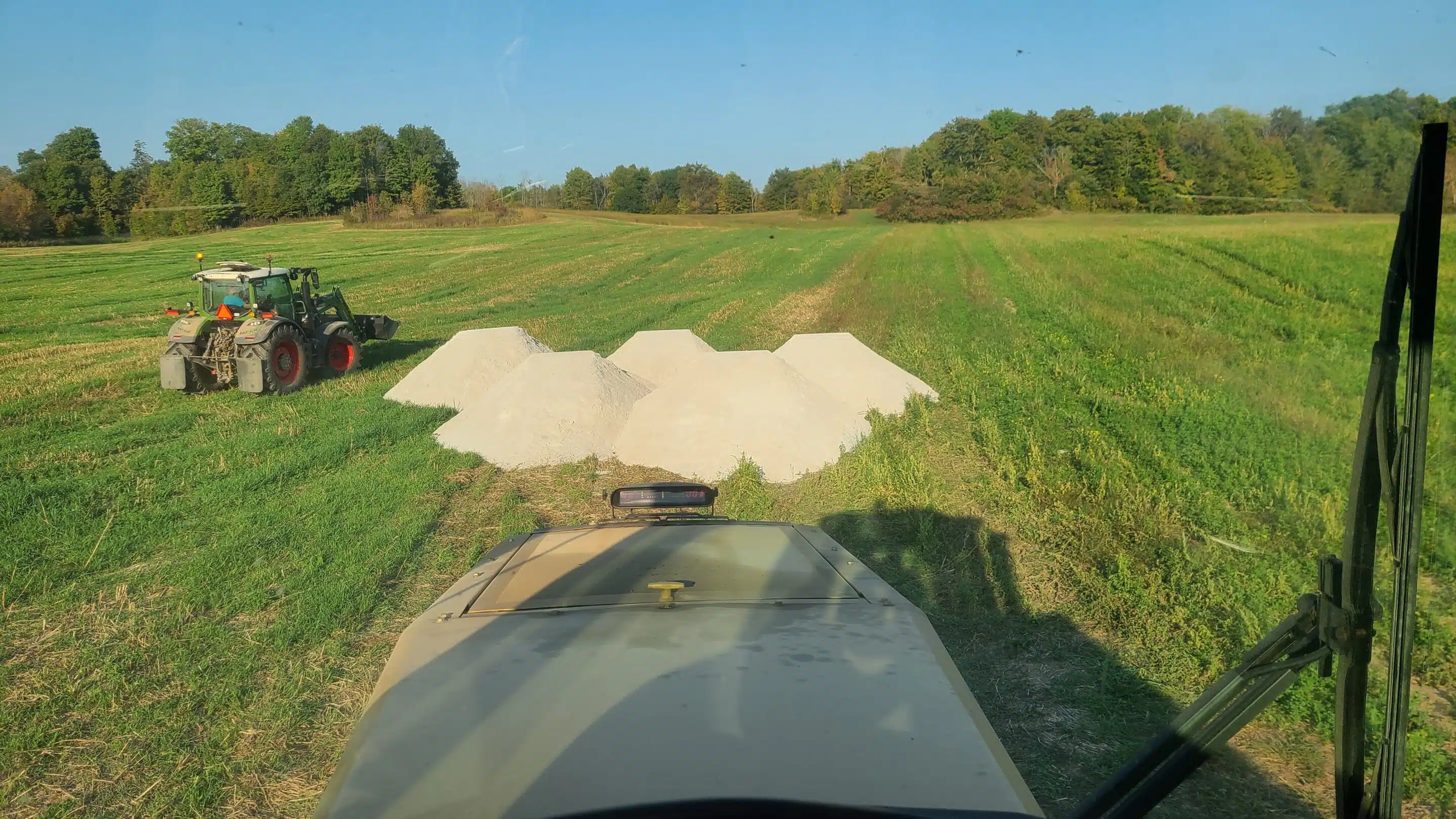
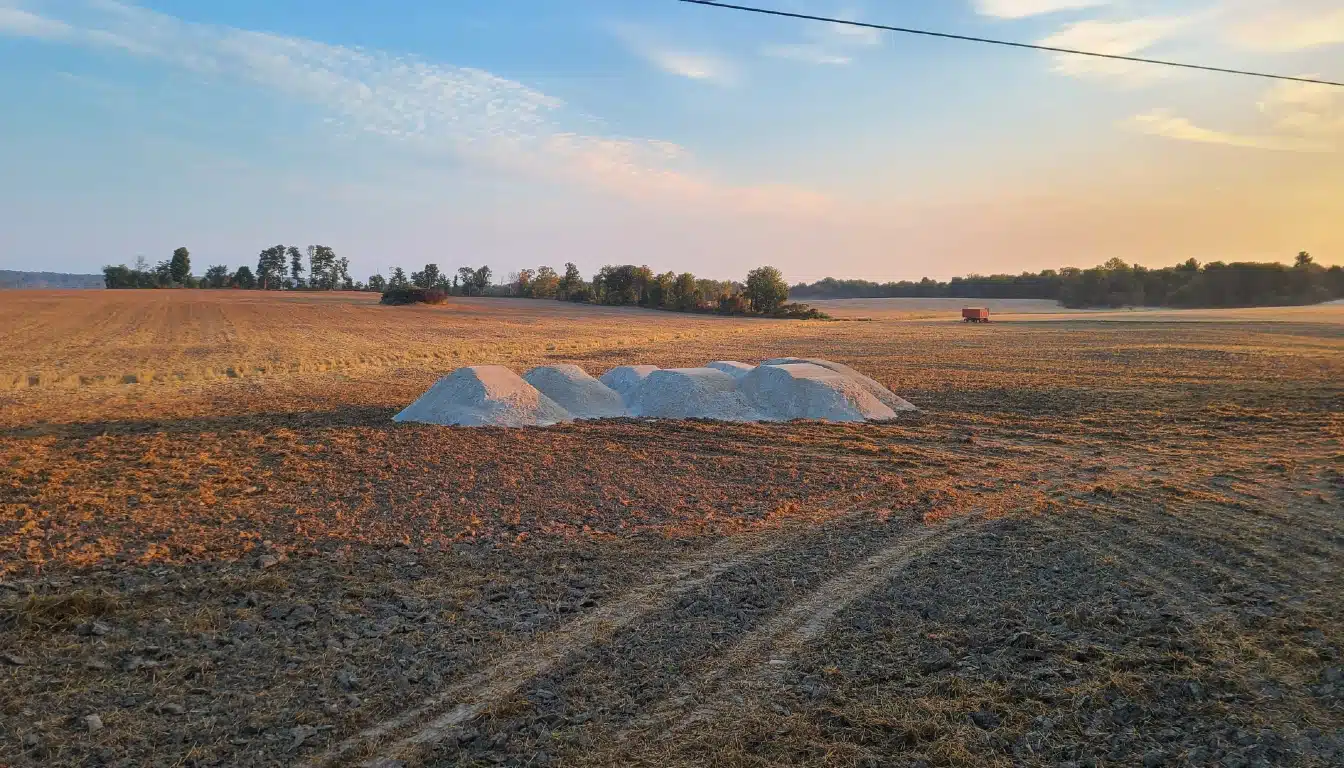
Crushed wollastonite ready for spreading
Insurance And An Agricultural Lender
Two other tools are reshaping how these deals get done. The first is carbon removal insurance, now a genuine product. UNDO has used it to de-risk upfront payments on smaller offtakes where debt does not fit, and within debt structures themselves. “It’s been very catalytic to get some deals over the line,” Bury said. She expects reliance on it to fade as the market matures. “Ultimately, we need the cost of credits to come down. That’s going to increase in demand.”
The second is a new kind of backer. In November 2025, Farm Credit Canada made a strategic investment in UNDO, with a plan to triple Canadian operations into 2026. An agricultural lender brings a different lens than a climate fund. “The stamp of approval that comes with an investor like Farm Credit Canada, who did a huge amount of [due diligence] on both us and the ERW process, is a really great step forwards,” Bury said. For Ontario farmers, FCC is a trusted name, and that trust lends legitimacy to weathering as a farming practice rather than a bolt-on.
You can also listen to the audio podcast of the conversation with Alex Bury. You can listen here on the website through Acast or search for Climate Solutions News on Spotify, Apple Podcasts, Amazon Music or YouTube.
The Measurement Bottleneck
Behind the financing problem sits a scientific one, and the two are linked. Lenders and buyers need confidence that the credits are real. That confidence rests on measurement, reporting and verification, known as MRV, which remains one of the hardest issues in carbon removal. Bury called it measuring “geochemical reactions in a very open system.” Soil is complicated, with different crop types, soil types and pH ranges, so the chemistry varies from field to field.
Measurement is also expensive, and cost feeds straight back into the price of credits. “It’s really important that we reduce the cost of MRV so that we can reduce the cost of the credits,” Bury said. UNDO’s approach is to monitor a fixed number of intensive sites spanning the key variables, then extrapolate, rather than take ever more measurements as it scales. That method is built into the new Isometric methodology for the pathway, which Bury sees as the direction the sector needs.
On 2 June, UNDO took aim at a specific weakness in that process. The company announced a new measurement technique called SAT-C, or SATuration-Centrifugation, developed with scientists from Newcastle University and the James Hutton Institute and published by Cambridge University Press. Traditional porewater extraction depends on natural soil moisture, which restricts data collection in dry periods. SAT-C combines intact soil core collection, controlled saturation with deionised water, and centrifugation to recover porewater whatever the moisture level.
The aim is year-round data across climates and seasons, which matters as droughts grow more frequent. UNDO founder and CEO Jim Mann framed measurement as the gating factor for the whole pathway. “Without tackling the measurement bottleneck, enhanced rock weathering will not become the climate tool our planet needs it to be,” he said in the release. “SAT-C is the critical unlock that will make enhanced rock weathering more credible, auditable and financially viable over time.”
The work carries an unusual collaborator. McLaren Racing’s Accelerator programme, part of the team’s net-zero-by-2040 commitment, has helped prototype a battery-powered soil auger that reaches 30cm in compact or frozen ground. UNDO says the latest version has cut sampling time by 70% and associated emissions by 90%.
Kim Wilson, Director of Sustainability at McLaren Racing, described “Accelerator engineers applying high-performance engineering and a racing mindset, to this urgent environmental challenge, to help accelerate climate solutions at pace.”
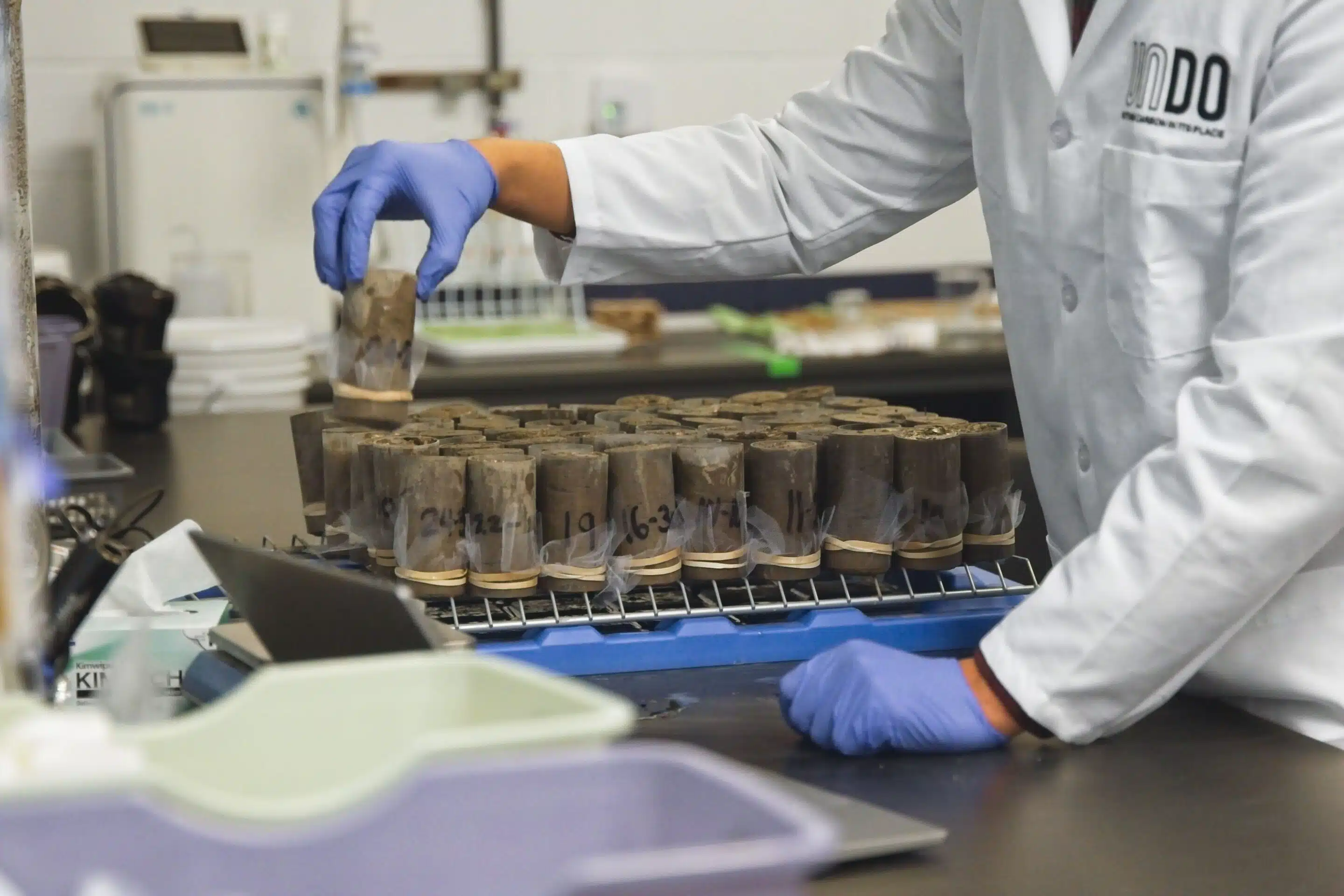
Setting out saturated soil cores for SAT-C prep.
What It Takes To Reach A Billion Tonnes
UNDO’s stated ambition is to remove a billion tonnes of CO2. Ask Bury what stands between the company and that figure, and the answer is unequivocal. “It’s pretty obvious that demand is the most important thing for us and across the CDR space.” The early buyers built the market. Now others must follow. “We’re seeing a move on from the early stage buyers like Microsoft who have done incredible work,” she said. “We now need to see other buyers in the space step up.”
Bringing in a buyer like Barclays shows how slow that work can be. UNDO’s 6,538-tonne deal was the bank’s first carbon removal purchase. “They take a lot of time, they take a huge amount of trust, a lot of site visits,” Bury said. A risk-averse institution needs more reassurance than a seasoned buyer such as Microsoft. Momentum helps. Each deal makes the next one easier.
The political backdrop cuts both ways. US conditions have turned harder, though Bury sees that countered elsewhere. “That’s offset with some really positive news in the EU and Japan,” she said, pointing to a possible convergence of the voluntary market with compliance markets. Public appetite plays a role too. She wants more companies to commit seriously to net zero, and thinks the public can push them there.
So all this means the gap between scientific proof and commercial scale is not really a question of chemistry, because the weathering works. It is whether the financial infrastructure can develop fast enough to carry it, whether the buyers show up, and whether the measurement can be trusted at scale. UNDO’s bet is that better data unlocks cheaper capital, and cheaper capital unlocks demand.
Mann put the financing case plainly earlier this year, calling innovative financing “the catalyst for unlocking gigatonne-scale carbon removal.” That, rather than technology, does seem to be where the real issue now lies.