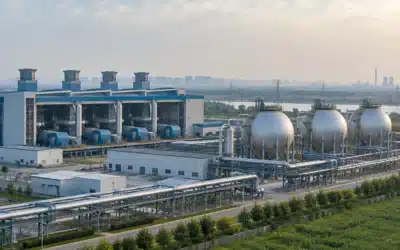
A 60MW liquid air energy storage plant in China’s Qinghai province is feeding the grid, giving the long-duration technology its first test at this scale.
China Green Development Investment Group has connected a 60MW, 600MWh liquid air energy storage plant to the grid in Golmud, Qinghai province. Its partner on the project was the Technical Institute of Physics and Chemistry at the Chinese Academy of Sciences. The plant can discharge continuously for 10 hours.
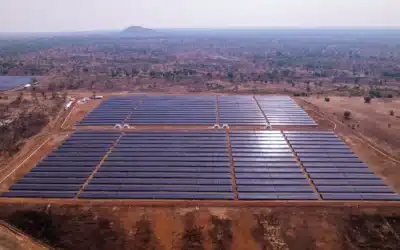
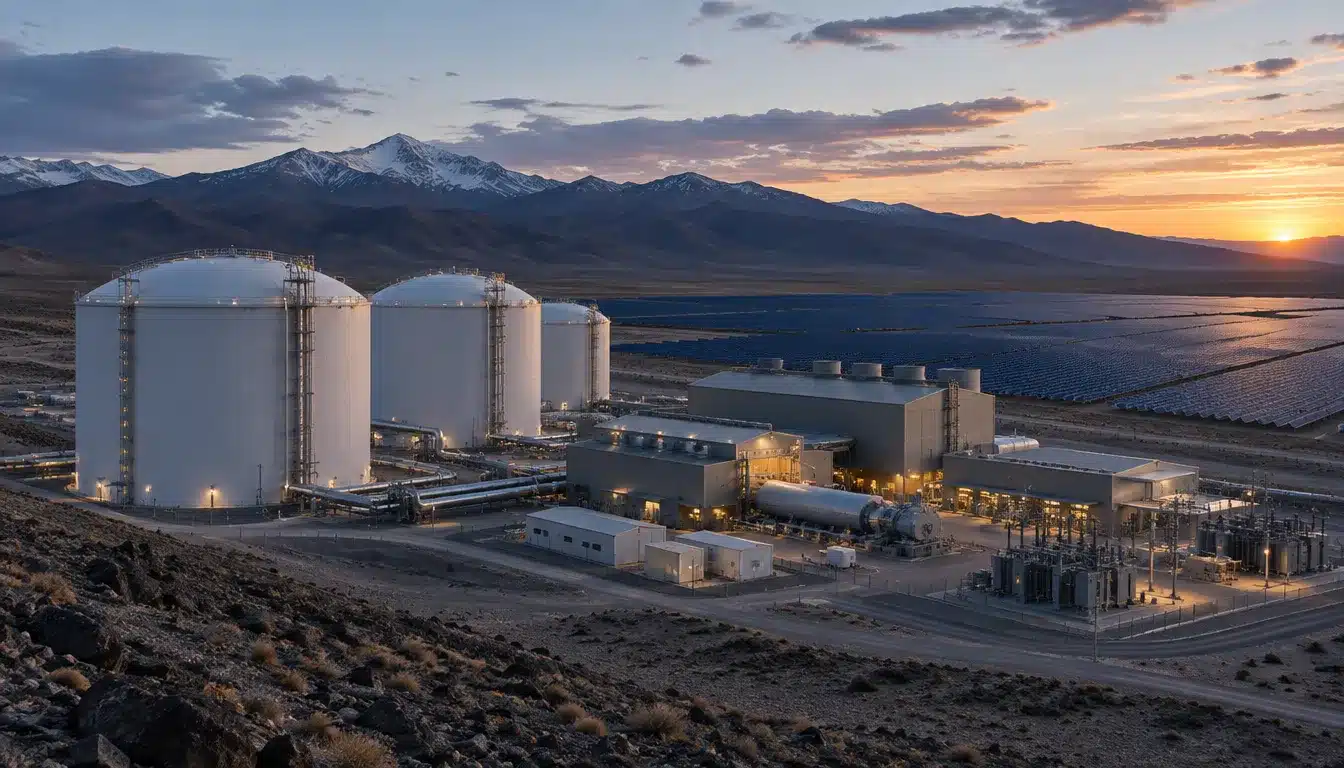
The developer says it is the world’s largest grid-connected liquid air energy storage installation by power and energy capacity. It synchronised with the grid on 30 October and has started producing power. Construction began in July 2023 on a site in the Qaidam Basin, next to a 250MW solar plant.
How the system stores power
Liquid air storage uses ordinary air as its working fluid. When power is cheap or plentiful, a three-stage centrifugal compressor squeezes purified air to about 7MPa. The plant keeps the heat from that step as hot water at up to 195°C.
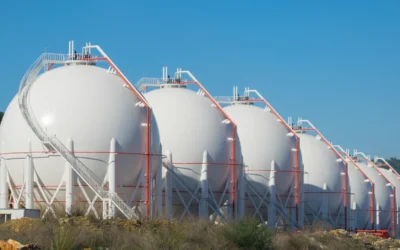
Next, the system cools the air in stages until it turns liquid at about minus 194°C. It then sits in insulated tanks close to atmospheric pressure. When demand peaks, the plant pumps, heats and vaporises the liquid to drive turbines.
The plant saves the cold released during that step for the next cycle, so less energy goes into the following charge. Liquid air is roughly 750 times denser than ambient air. As a result, the tanks hold a lot of energy in a small space.
In addition, the plant’s rotating machinery can give the grid inertia, which helps keep frequency stable. Solar panels provide none on their own, so a spinning store is useful in a region dominated by them.
Built with domestic equipment
Chinese manufacturers supplied all the main equipment, including the large compressors, liquid expanders, cryogenic heat exchangers and control systems. The design grew out of earlier Chinese Academy of Sciences work, which proved the process at a 100kW scale. According to the developer, the project combines seven technologies with fully independent intellectual property rights.
Scaling that up to tens of megawatts was the core engineering task. Meanwhile, the high-altitude site added its own construction problems. The project team also developed a low-temperature store that holds cold at atmospheric pressure.
Beijing has since placed the plant in its national programme of new-type energy storage demonstrations. The National Energy Administration also lists it among its major first-of-a-kind energy technologies.
What the plant adds to the grid
The facility can absorb about 600MWh of surplus renewable power each day. Over a year, it should deliver around 180GWh, roughly the consumption of 30,000 homes. It emits no carbon dioxide or other pollutants while it runs.
That profile suits a region with large solar farms, where output peaks at midday and falls away after dark. As a result, a 10-hour store can move a large share of daytime generation into the evening and night. Lithium-ion batteries, by contrast, are usually built to discharge for two to four hours.
Efficiency remains the open question
However, the developer hasn’t published a round-trip efficiency figure for Golmud. Industry estimates put liquid air energy storage at 50% to 60% on average, rising to 60% to 70% with advanced heat recovery. Lithium-ion batteries typically return well over 80% of the power they take in.
Round-trip efficiency measures how much electricity comes back out for each unit put in. For liquid air, most losses come from compression, cooling and the heat that escapes between cycles. That is why heat and cold recovery sit at the centre of the Golmud design.
So liquid air makes its case on duration, siting and materials. Its tanks need no scarce minerals. The plant also needs no underground cavern, unlike compressed air energy storage schemes such as China’s 700MW Jintan project. That gives developers more freedom over where they build.
Elsewhere, Highview Power is building a 300MWh liquid air plant in the UK. Golmud now gives grid operators and developers performance data from a much larger unit. How it runs through its first winter at altitude will shape how quickly others follow.