RE.Think Energy founder Wangari Muchiri believes Africa can skip a generation of power infrastructure, as it did with phones and banking, if policy, finance and local manufacturing catch up with the solar already on its rooftops.
Much of Africa skipped the landline and went straight to mobile phones. In Kenya, many people then moved straight to mobile money without ever opening a bank account. Energy planners now ask whether electricity can follow the same path, with rooftop solar and batteries arriving before the grid does.
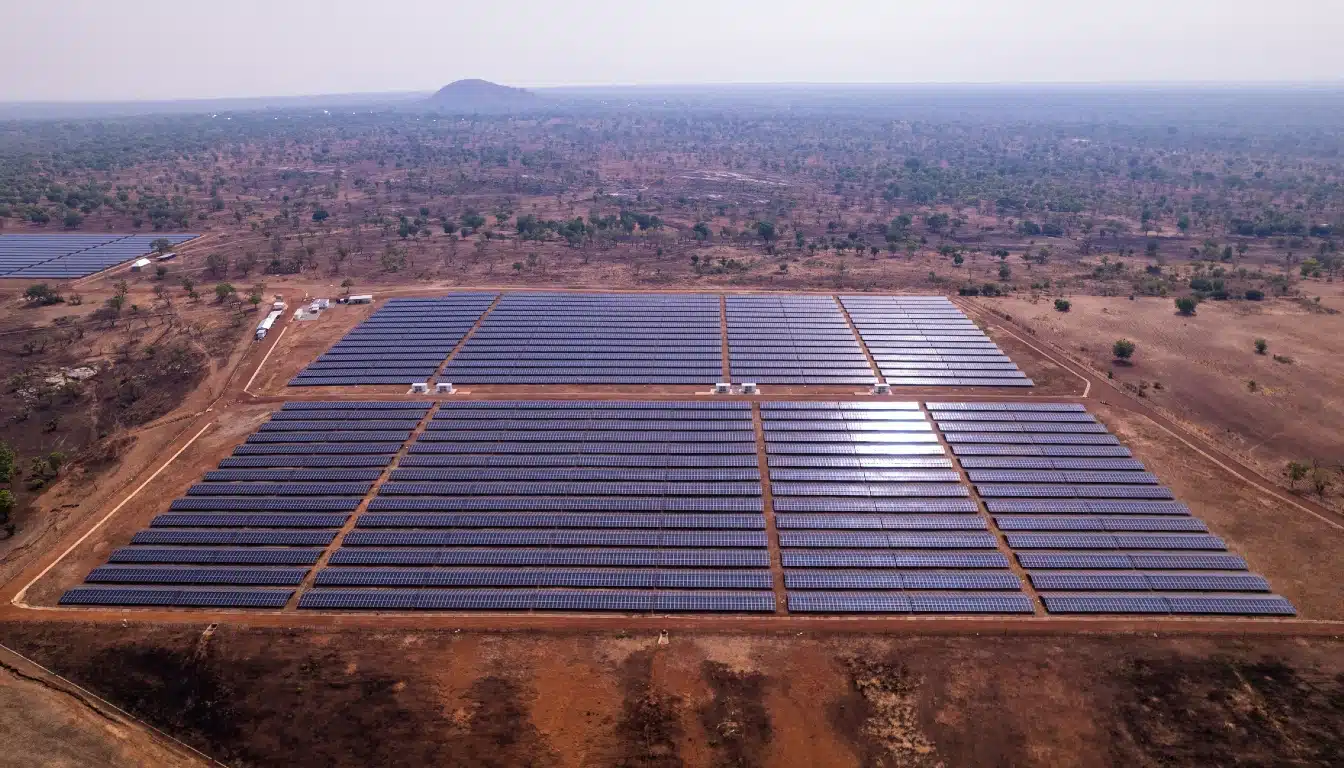
Ember, the energy think tank, expects Africa to install a record 17GW of solar in 2026, up 45 per cent on last year. In its analysis published on 26 August, it estimates that about three-quarters of that capacity is distributed solar on homes, businesses and mini-grids. Much of it doesn’t show up in official statistics.
Wangari Muchiri has tracked this shift from inside the industry. A Kenyan renewable energy engineer, she was previously Africa Director at the Global Wind Energy Council (GWEC). There she led its Africa Wind Power initiative across more than 15 countries. She now advises GWEC and the Global Solar Council. She also runs RE.Think Energy, a Nairobi-based non-profit working to scale up renewable energy in Africa.
Speaking on the Climate Solutions News podcast, she welcomed the comparison with telecoms. “I think we’ve seen it in several sectors in Africa,” she said. “Imagine what can happen in the energy space when energy is really an enabler for all sectors.”
A career that started on the roof
Muchiri chose the sector before most of her peers took it seriously. “I was in the sector long before it was interesting to anyone in 2008,” she said. “I remember when I went to study renewable energy engineering, some of my peers making fun of me that I was learning to go climb a roof and put something on the roof.”
Her mother had been reading a book about the coming revolutions of the world, which listed climate and renewable energy alongside big data and social media. So Muchiri picked renewable energy engineering from the course list at the University of New South Wales in Sydney. A family event at home settled the matter. “My father had just installed a solar panel on my grandmother’s roof, and I saw how that changed her household, bringing lighting and enabling her to have a mobile phone so we could communicate with her,” she said.
She returned to Kenya in 2015, after the green building firm she worked for in Australia opened an office there.
Linking supply to demand
Muchiri founded RE.Think Energy after six years of work with NGOs and GWEC across the continent. Developers kept running into the same obstacles. “A lot of developers on the continent need support, whether it’s connecting them to capital or technology,” she said.
Small project size deters investors. “One solar system here and one solar system there might not be interesting to big capital,” she said. “But aggregating several thousand hospitals or several thousand farms or schools then becomes an interesting business case.”
Development timelines add to the cost. “On average, it takes about eight years to develop a wind farm,” Muchiri said. Historically, she argues, each part of the system was planned in isolation. Developers built generation and hoped the grid would take it, while the grid hoped end users would buy the power.
RE.Think Energy tries to design projects around a known buyer from the start, whether a mine, a manufacturer or a national grid. “We’re trying to link the supply of power closer to the demand of the power,” she said. “Instead of taking eight years, it might take two or three. And that means you also don’t price the risk into the capital, which means it’s cheaper for everyone.”
In Nigeria, the organisation is working to aggregate demand from hospitals. Muchiri sees them as a useful test case because power demand there extends well beyond the wards. “With hospitals comes cold chain because of vaccines, it comes transport because of ambulances,” she said. Large hospital roofs also give unused space for panels. Her goal is to help more than 100 developers deploy projects faster, with cheaper capital, within five years.

Picture of Wangari Muchiri from the Obama Foundation website, where she featured in the 2019 Leaders Africa series.
Households are moving first
Unreliable grids in Nigeria, South Africa and Zambia are driving much of the growth. Muchiri pointed to frequent outages in Nigeria, the load shedding that hit South Africa in recent years and acute power needs in Zambia. “People are not waiting for projects to be developed,” she said. “The people themselves are actually voting with their own money. They’re saying this is what we’re going to put on our roofs.”
Lagos shows the scale of the change. “People are now starting to say there’s an outbreak of solar panels in Lagos,” she said. Ember’s figures show how far the market has spread. Chinese solar panel exports to Africa reached 23GW in the 12 months to June 2026, up 53 per cent. In 2023, South Africa took 52 per cent of the continent’s solar imports. By June 2026 its share had fallen to 20 per cent.
Battery storage is moving the same way. Storage was once seen as expensive and hard to install, according to Muchiri, but units as small as one kilowatt are now reaching homes. Some are portable. She also sees an opening in cold storage for farmers, where post-harvest losses remain high.
Muchiri still rejects a choice between rooftops and large plants. Households need off-grid power for homes, schools and hospitals, while industry needs utility-scale solar and wind farms. “Africa is going to industrialize, but it’s going to industrialize in a green way,” she said.
Policy as a signal to investors
For Muchiri, regulation decides how fast money arrives. “Money moves with trust. And I think policy creates a trust,” she said.
South Africa is her preferred case study. The government raised the licensing exemption for private embedded generation from 1MW to 100MW on 12 August 2021. On 15 December 2022 it removed the threshold entirely. “That really catalyzed the sector,” Muchiri said. By November 2023, electricity minister Kgosientsho Ramokgopa told parliament that the confirmed private pipeline had grown to 126 projects and more than 12,000MW.
Keeping manufacturing value in Africa
Imports alone won’t deliver the jobs Muchiri wants. “If we start to localize some of the solar manufacturing and assembly, if we start to localize some of the battery manufacturing, some of the productive use equipment, I think that’s also going to be really key for Africa,” she said.
Ember finds that 94 per cent of panels installed in Africa still come from China. African solar panel manufacturing should quadruple this year, although Ember expects most of that output to go abroad. Muchiri wants partnerships with manufacturers in China, India, Europe and the US built around technology transfer and local jobs.
A shift in tone at African Energy Week
Muchiri followed African Energy Week in Cape Town this month through RE.Think Energy’s partners. The event has long centred on oil and gas, and she noticed a change. “Now we’re seeing a lot more renewable energy conversations coming into play, which has typically not been the case at Africa Energy Weeks,” she said. She also saw more policymakers taking part, which she counts as a positive signal.
Her hopes for the next five years return to the comparison with mobile phones and banking that opened the conversation. “I’m really excited to see some of the African magic that we’ve done with mobile money and with all these other technologies that we’ve leapfrogged happen within this sector,” she said. She pictures distributed data centres running on cheap, abundant power, and enterprises that work with schools and farms. Above all, she wants Africans to have access to power, and the wealth creation that follows it.
African Energy Week 2026 took place at the Cape Town International Convention Centre from 12 to 16 October. The African Energy Chamber, which organises the event, reports that it drew 12,000 delegates and generated more than $17bn in new deals and commitments. The next edition runs from 4 to 8 October 2027. Programme and registration details are on the African Energy Week website.