British, Norwegian and Canadian development lenders have agreed to steer $10bn into climate projects in emerging markets by 2030. Finance ministers also heard that high borrowing costs are holding back clean energy and resilience projects in developing countries.
Antalya turned to money as the summit’s first week closed. Finance and Trade Day brought a joint push on emerging markets climate finance. It also brought a UN warning on the gap between goals and delivery. Meanwhile, negotiators received the first texts that could shape the final decision. For start-ups and their investors, the period produced a list of energy technologies judged ready by 2030. AI’s footprint drew fresh scrutiny too.
Three development lenders target $10bn by 2030
British International Investment, Norway’s Norfund and FinDev Canada launched a joint initiative called 10by30 on 13 November. The state-backed lenders aim to channel $10bn into climate projects in emerging markets by 2030, including the private capital they expect to attract. Under a memorandum of understanding, they’ll share deal pipelines, coordinate due diligence and co-invest in flagship transactions.
The target sectors are renewable energy, transmission and distribution grids, energy storage, sustainable fuels and industrial decarbonisation. Lucy Rigby, the UK’s Economic Secretary to the Treasury, described “practical action to unlock investment for the energy transition”. The partners say pooled due diligence should cut duplicated work and speed up decisions on joint deals.
Finance ministers hear the cost of capital is the barrier
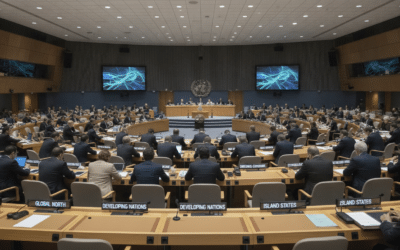
UN climate chief Simon Stiell told ministers that many developing countries are caught in a cycle of debt, disasters and high capital costs. “Finance must be affordable,” he said at the high-level ministerial dialogue on climate finance. He backed concessional and risk-sharing instruments to help projects scale, with early grants to build capacity.
UN Secretary-General António Guterres argued that each dollar of development bank capital could generate $8 to $10 in financing. He also urged wider use of guarantees to draw in private investors. One assessment presented at the summit projects an annual shortfall of $840bn against the $1.3 trillion goal for 2035. That warning follows a fall of more than 70 per cent in public climate finance pledges from rich nations.
Ten energy technologies judged ready for use by 2030
The World Economic Forum and the publisher Frontiers have named ten emerging energy technologies, each with a credible path to real-world use by 2030. The list includes virtual power plants, sodium, zinc and iron batteries, thermal energy storage and perovskite-silicon tandem solar cells. It also covers calcined-clay limestone cement, subsea HVDC interconnectors, modular nuclear reactors, building-integrated solar, floating offshore wind and next-generation lithium batteries.
According to the report, tandem cells can generate up to 20 per cent more energy from the same site. The calcined-clay cement can cut emissions by up to 40 per cent. “Many of the energy solutions we need already exist in labs,” said Frederick Fenter, chief executive editor of Frontiers. In his view, speed of deployment is now the main hurdle.
AI companies urged to publish their energy and water footprints
A UN-backed coalition has asked AI companies to disclose their energy use and their carbon, water and land footprints. Its Priorities for Action on AI and Climate Information Integrity launched on 13 November. The UN, UNESCO and Brazil co-chair the coalition, the Global Initiative for Information Integrity on Climate Change. The document also asks companies to assess how their systems affect climate information and to publish the findings.
Germany has committed more than $2.2m to research, communication strategies and public awareness work. Charlotte Scaddan, the UN’s senior adviser on information integrity, said the question is “whether people can rely on what they’re told by AI and about it”. The call adds to the presidency’s earlier push to rein in AI energy use at the summit.
Germany’s energy agency eyes Turkish battery manufacturing
Kristina Haverkamp, managing director of the German Energy Agency (dena), said both countries are seeing a boom in battery storage. Speaking in Antalya on 13 November, she said “a joint manufacturing venture would be a very promising business model”. She also suggested working together on processing critical raw materials into higher-value products.
On green hydrogen, Haverkamp pointed to Türkiye’s renewable potential, factories and ports. However, she named offtake as the main hurdle: “The challenge is finding buyers.” No agreement was signed, although the Turkish-German Energy Partnership recently expanded to cover raw materials.
Draft texts put electrification and adaptation finance on the table
The COP31 Presidency circulated an informal summary of reflections on a possible cover decision on 13 November. It lists a call to raise global electrification to 35 per cent by 2035. Action on methane and the transition away from fossil fuels in energy systems also feature. The note doesn’t reflect consensus, and a first draft of the decision is due early next week.
Some large developing countries oppose sectoral targets, including the electrification goal. Even so, a mention in the final decision would give the 35 per cent figure more weight with utilities and regulators. Separately, a new draft on the global goal on adaptation arrived late on 13 November. African countries want adaptation finance tripled to at least $120bn a year by 2035. Guterres warned that even tripling “would meet less than 30 per cent of what is needed”.
Finland publishes a fossil fuel exit roadmap
Finland published a domestic roadmap for moving away from fossil fuels at the summit on 14 November. It sets no legally binding deadline. Over 96 per cent of Finland’s electricity already comes from non-fossil sources, and the country aims for carbon neutrality by 2035.
In addition, Brazil’s COP30 presidency has brought its global roadmap for transitioning away from fossil fuels to Antalya. President Luiz Inácio Lula da Silva said Brazil should host the third conference on the subject, likely in 2028. “We have the moral obligation,” he said. Tuvalu is expected to host the second conference in mid-2027.
What to watch next
Science, Industry and Technology Day on 16 November should bring news on industrial decarbonisation and the presidency’s AI for Clean Technologies Initiative. Ministers now take over the hardest negotiating questions, with a first draft of the cover decision expected early next week. Ocean, nature and land use follow on 17 November. Finally, the Startup Zone’s Connect To Funds day on 20 November will match projects with finance as the summit closes.