The Austin startup has raised a $120 million Series A led by Spark Capital, betting that modular solar and storage can power data centres faster than the interconnection queue allows.
TAR launched in June and now employs 40 people. Spark Capital put in $100 million of the $120 million round. The name is an acronym for transformative American resources, according to the company website. Co-founders Pat Becker and Leonhard Soenke set out the plan after the raise.
Their target is aggressive. Power projects usually take years, held up by equipment lead times, construction delays and local opposition. TAR wants to deliver in under six months. Going off-grid removes the longest delay of all, because the company skips the interconnection queue entirely.
Modular blocks and robots
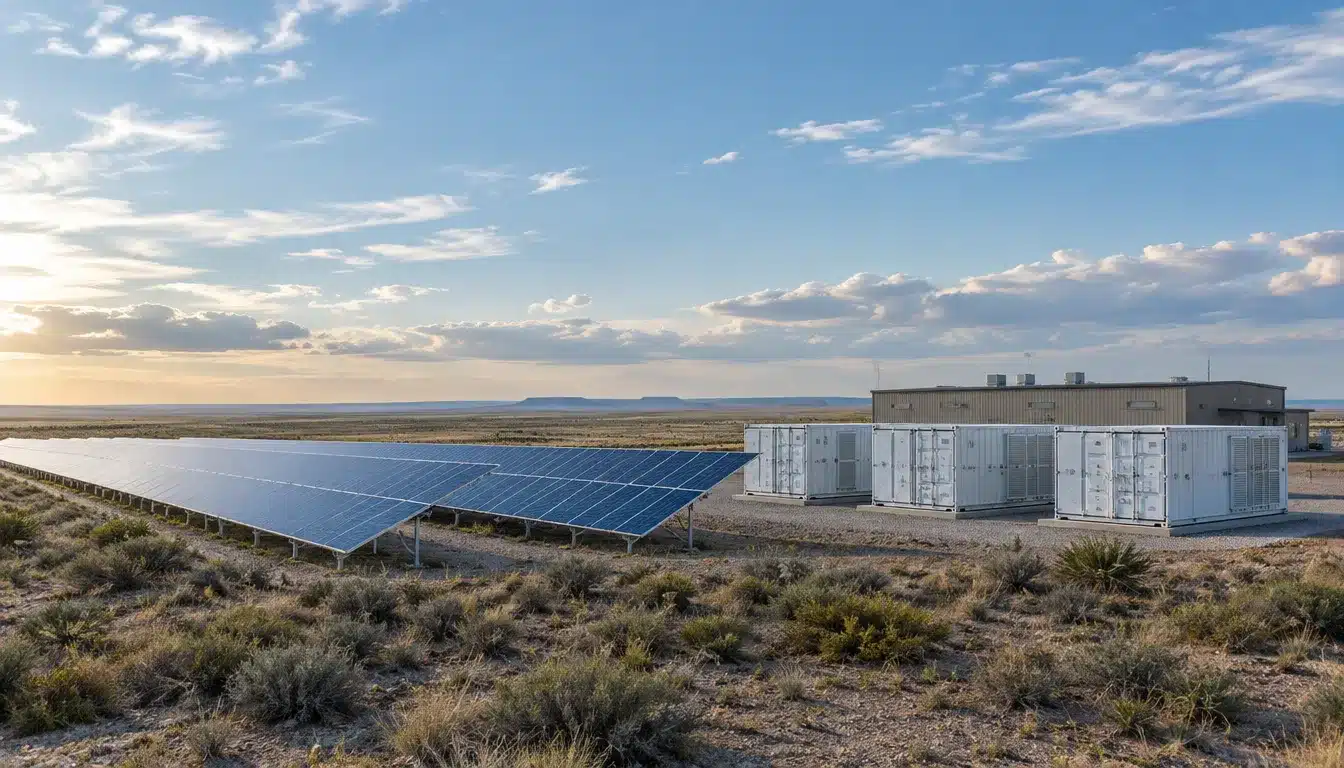
The company builds in modular units of solar, battery storage, power electronics and balance-of-plant systems. Those blocks can sit on a wide range of terrain. As a result, custom engineering is limited to foundations, drainage and high-voltage connections.
TAR also handles site selection, design, construction and long-term maintenance. Robotics will do much of the construction labour. The founders said that is the only way to hit the timelines they are targeting.
West Texas first
One project is under way with a large neocloud customer in West Texas, though the founders declined to name it. A manufacturing plant in the region integrates and tests the modular equipment before it ships. That plant should be finished this month.
West Texas came first for practical reasons. The solar resource is strong, land is plentiful and far from towns, and the energy workforce is experienced. TAR is now hiring 100 more people across power engineering, robotics, manufacturing, construction operations, procurement and logistics.
Clean power against a gas default
Most off-grid data centre projects in Texas run on gas. Oracle and OpenAI’s Stargate campuses use fleets of gas generators, and developers argue gas gives the constant baseload that data centres need. At another Stargate site in New Mexico, Oracle has invested in cleaner generation to offset its gas use after local backlash.
TAR takes a different route. It overbuilds solar and storage, keeping some gas for emergencies. The split between the two will vary by site and by sunlight. Overbuilding costs money, and so does the land it needs.
Becker and Soenke argue their gas-reliant rivals face their own bills. Those include the fuel itself, exposure to price swings, pipeline access and emissions control technology. “Our goal is to optimize the economics of the entire campus over its operating life, not simply minimize its physical footprint,” they said.
The supply chain question
No company escapes long lead times for power equipment. TAR tries to shorten them by sourcing most of its kit in the United States. “Most of what goes into a deployment can be sourced and, where needed, assembled domestically at the scale we’re operating at today and expect to need next year,” Becker and Soenke said.
That qualifier does a lot of work. Domestic supply at today’s scale is one thing, while domestic supply across a much larger pipeline is another. The founders did not answer questions about future projects.