
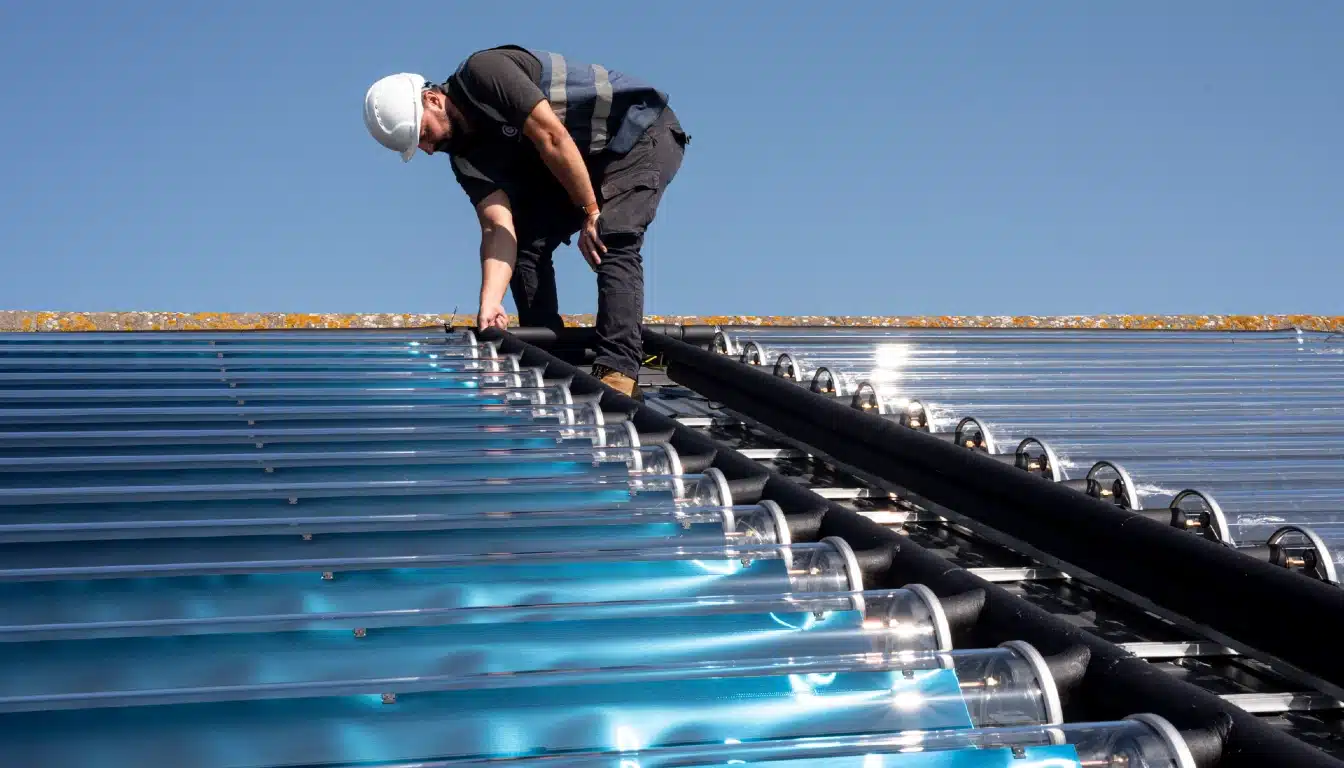
An £8.875 million investment from Great British Energy and Barclays Climate Ventures closes a £27 million Series B and pays for a UK factory making solar thermal collectors.
Great British Energy has invested £8.875 million in Naked Energy, the British solar thermal manufacturer. Barclays Climate Ventures put money in alongside it as an existing shareholder. The two investments close a Series B that Naked Energy puts at £27 million. Great British Energy is providing £7.5 million of the total through its Energy Engineered in the UK programme, the £1 billion supply chain scheme it launched in December 2025. This is the publicly owned company’s first solar supply chain investment. Its earlier solar money, £180 million for rooftop panels on schools and NHS sites, bought equipment rather than a stake in a manufacturer.
What the money pays for
The funding will establish a new automated manufacturing facility in the UK, bringing production in-house. That should reduce unit costs and support the next phase of commercial scale-up. The plant will create up to 40 direct skilled manufacturing jobs and around 100 indirect roles, figures calculated using ONS methodology. Its location has yet to be confirmed, and a further announcement is expected.
Dan McGrail, chief executive of Great British Energy, said: “Cutting our reliance on gas is one of the biggest challenges we face, both for energy security and for keeping bills down. Naked Energy has developed a technology that tackles this head on and when you see it working at iconic UK institutions like the British Library and Wimbledon, you understand what is possible.”
Great British Energy’s previous supply chain deal was a £40 million equity investment in the hydrogen electrolyser maker ITM Power in April. The first solar cheque has now gone to heat.
What solar thermal actually displaces
Naked Energy’s Virtu collectors use sunlight to warm water rather than generate electricity. They reach 120 degrees Celsius, which covers hot water, space heating and a good deal of industrial process heat. Heat pumps struggle at the upper end of that range. Solar thermal also works without drawing on a grid connection, so constrained sites can install it without waiting for capacity.
The commercial argument rests on what each technology displaces. Gas emits a fixed amount of carbon per kilowatt hour, and no upgrade changes the chemistry. Grid electricity keeps getting cleaner, therefore the carbon saved by a conventional solar panel keeps shrinking. Christian Albrecht, group business development director at Naked Energy, set out that case to Climate Solutions News in July.
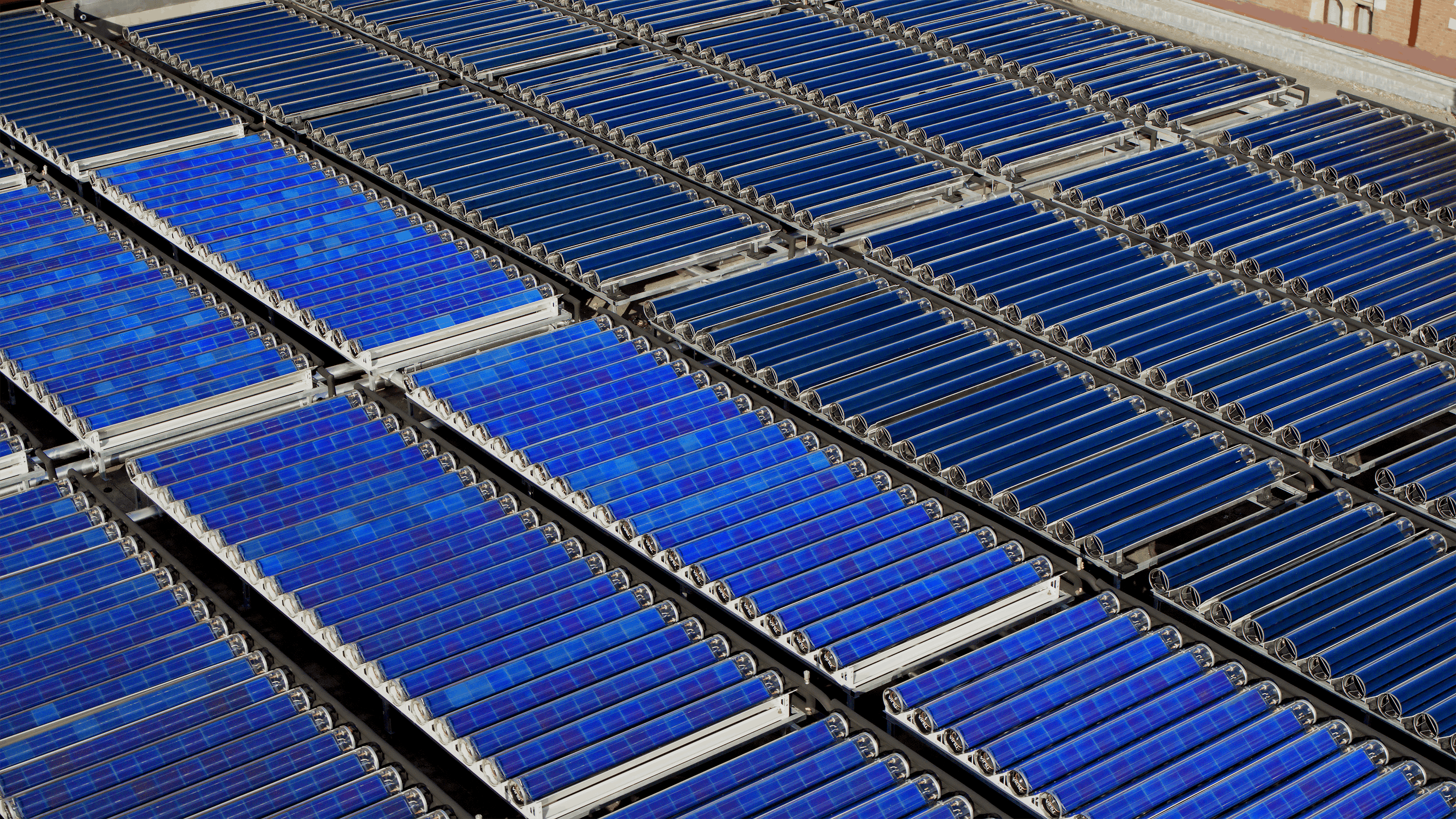
Part of Naked Energy’s installation on the roof of the British Library.
Public buildings and a subsidy gap
Great British Energy and Naked Energy also intend to explore how Virtu could go onto suitable public-sector buildings. That work includes financing models letting organisations adopt renewable heat without carrying the full upfront capital cost. The British Library installation was paid for by the Public Sector Decarbonisation Scheme, now closed to new applications after the 2025 spending review, with no replacement announced. Awarded phase 4 projects still run to March 2028. European mandates and renewable heat auctions have meanwhile pulled much of the company’s project pipeline abroad.
Miatta Fahnbulleh, appointed Energy Secretary on 20 July, said: “Homegrown, clean power is an opportunity to reindustrialise Britain as we’re backing UK supply chains to help deliver the energy transition. Great British Energy is supporting well-paid manufacturing jobs for communities, while providing cheaper and secure energy for households and businesses.”
The technology and the track record
The Virtu range includes high-density solar thermal collectors and hybrid PVT units generating heat and electricity from the same rooftop area. Naked Energy holds more than 20 patents. It was the first manufacturer of an evacuated hybrid solar PVT collector to win TÜV Rheinland certification. Because the collectors avoid self-shading, around 85 per cent of a roof can carry generating assets, against roughly 50 per cent for conventionally tilted panels.
That low profile also opens doors that stay shut to standard solar. Virtu was the only solar technology to receive planning permission at the British Library, a Grade I listed building, because it leaves the roofline unchanged. Systems also run at the All England Lawn Tennis Club and across projects in Europe and North America.
Daniel Hanna, group head of sustainable and transition finance at Barclays, said: “Our latest investment will help Naked Energy scale UK manufacturing, create skilled jobs and bring renewable heat to buildings across Britain. It shows how public and private capital can work together to strengthen UK energy security and grow a domestic renewable energy industry.”
What the deal signals
Christophe Williams, founder and chief executive of Naked Energy, said: “Heat is too often overlooked in the energy debate, despite accounting for a major share of fossil-fuel consumption. This investment will help us bring renewable heat to more hospitals, hotels, public buildings and industrial sites in the UK and internationally, while creating skilled jobs and export opportunities here at home.”
The company is also building out a wider platform around the hardware, covering system design software, performance monitoring and heat-as-a-service contracts delivered with E.ON. Those tools matter because upfront cost, rather than physics, is what stalls industrial heat projects. Public capital arriving behind a British manufacturer at this point suggests the state has noticed where the remaining emissions sit.