California’s Noria Energy has launched Airon, a single-axis tracker designed for floating solar, which the company says gives up to 20 per cent more output than fixed-tilt arrays at the same installed cost.
Solar panels produce more when they follow the sun. On land, trackers that swivel panels from east to west are now standard on large projects. On water they remain rare, because a floating array has to cope with waves, wind and changing water levels.
Airon is Noria’s attempt to close that gap. The launch also turns the company from a floating solar developer into an equipment maker. Sunrock Distributed Generation and the floating-structure manufacturer AccuSolar have joined as strategic investors. AccuSolar will build the hardware in the United States, while Sunrock provides co-development and financing.
Why floating solar rarely tracks
Floating projects have long used fixed-tilt platforms. Water moves, so a structure that pivots has to stay steady while it does. Airon handles that with a low-profile design, passive stabilisers and an automatic stow function.
The gain is density rather than size. Tracking lifts the yield of each panel without adding nameplate capacity. That helps where a reservoir has limited surface area, or where the local grid connection caps how much power can be exported.
“Floating solar can turn underused water surfaces into productive energy assets without competing for valuable land,” said Alex Mayer, chief executive of Noria Energy.
How the system is built
Airon uses a horizontal single-axis design. The standard layout puts one module in portrait, with a landscape option available, and it takes ordinary crystalline silicon panels. Floating torque tubes carry the rows, moored to a perimeter float that is anchored to the bed.
Ground coverage ratios run between 30 and 66 per cent. The standard tracking range is 20 degrees, extendable to 30, and each row supports up to four electrical strings. A 24V brushed DC motor drives the slew mechanism, powered either by string power or by small dedicated panels.
Control runs in tiers. Each row has its own tracker controller, reporting to regional gateways that manage up to 100 rows apiece. A main controller then handles up to four gateways. Above 35mph the system stows the panels automatically.
Tested on a reservoir, shipping in 2027
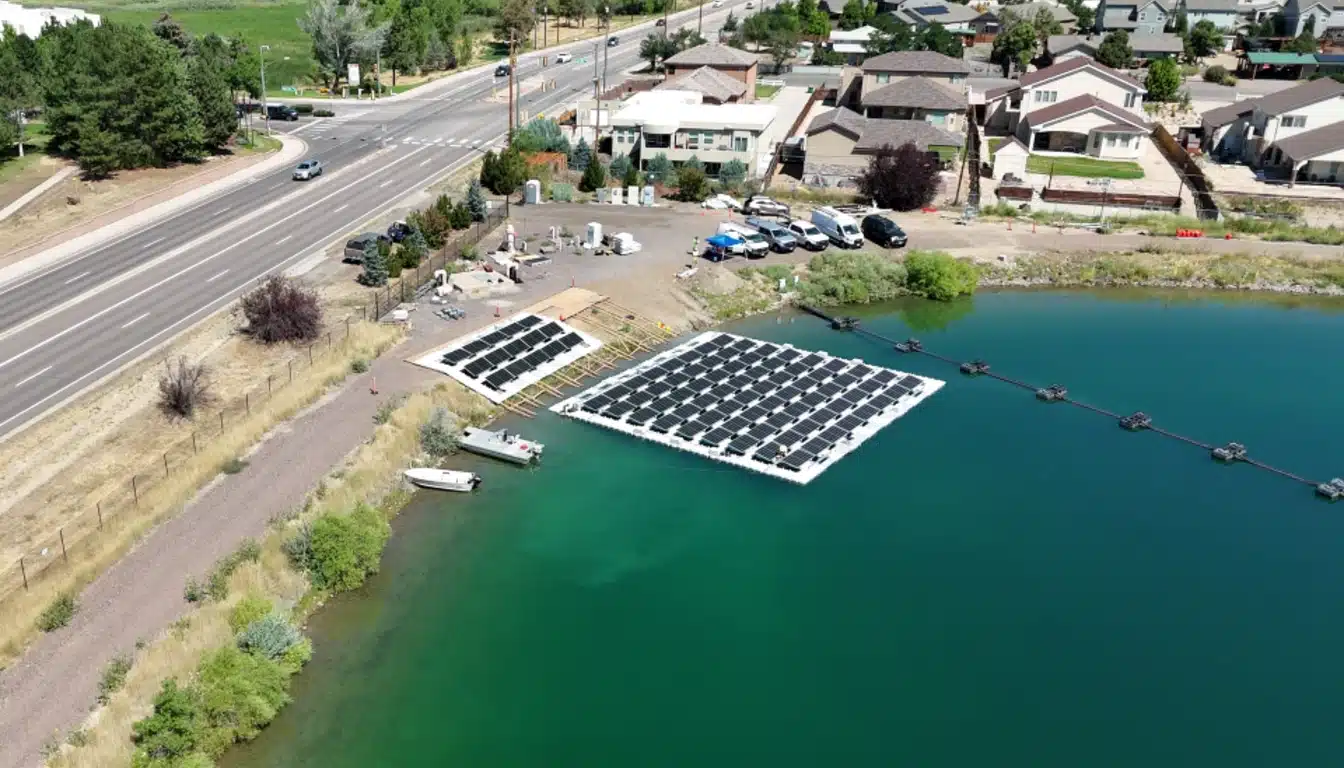
Noria ran a 50kW floating tracking system at the Fairmount Reservoir in Golden, Colorado, during 2025. A first commercial pilot follows late in 2026. Shipments of the fully certified system are due to start in mid-2027.
Supply is domestic throughout, so American developers should be able to claim domestic content bonuses under federal clean energy tax credits. The 20 per cent yield figure remains a company claim. Until the pilot runs, buyers have only Noria’s word for it.