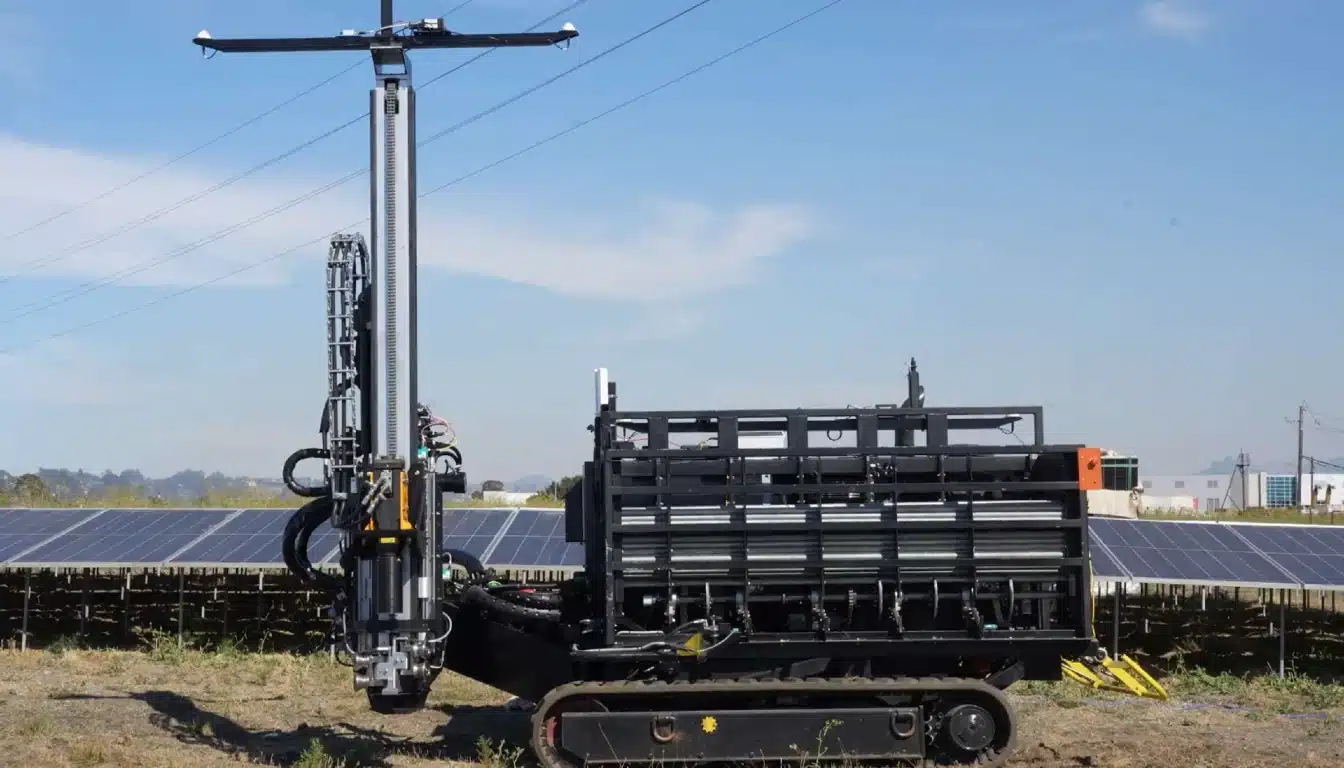
The Oakland start-up will use the money to grow its fleet of field robots, betting that robotic solar construction can ease the labour and land limits slowing new power projects.
Planted, a California company that builds solar farms with field robots, announced on 15 September that it had raised $31.8m. The round will pay for a bigger fleet for robotic solar construction and a new machine due late this year. Piva Capital and RA Capital Management Planetary Health co-led the raise. Breakthrough Energy Ventures, Gigascale Capital, Google and Khosla Ventures also took part.
The company says its growth is already steep. After deploying more than 10MW in 2025, it expects to reach 100MW this year. That would be a tenfold jump in a single year. Its project pipeline now tops 20GW.
Building on land that older trackers avoid
Planted combines planning software, dense solar arrays that follow the shape of the ground, storage and robots. As a result, it can build on slopes of up to 27% without grading the site first. Older tracker designs can’t use land like that, according to the company.
The layout also delivers twice the energy per acre, Planted says. So its projects take up less land and sit lower on the landscape. For instance, it will next build the Armoracia project for Aligned Climate Capital on 16 acres. That is 10 acres fewer than the original design required.
Less grading also means less earthmoving before any panels go in. That shortens the heavy civil work on site, which leaves the build itself as the main task for Planted’s robots.
Its completed work is still modest in size. The company finished Bowes Solar, an 11MW project in Illinois, for Cultivate Power. Meanwhile, its most recent build was a 28MW behind-the-meter plant serving a neocloud data centre. That project went from first call to power in ten months, with field work done in under three months.
Turning power plants into a production line
Eric Brown, chief executive of Planted, argues that deployment speed is now the main constraint. He said solar needs to be deployed “about five times faster than it is today” to reach the scale experts expect by 2050. In his view, supply chains, land, grid connections and skilled labour are all widening that gap.
His answer is to “turn the construction of a power plant into a manufacturing problem”. Accordingly, the new money will expand the robot fleet and launch Sage, the company’s next-generation robot. Planted says Sage more than doubles field productivity compared with its current machines.
Sage is a step towards a larger goal. Planted wants robotic solar construction to deliver a tenfold gain in what each field crew can build. Its existing fleet is already fully committed through 2027. Consequently, reservations for 2028 are open, and early buyers get first call on 2027 capacity as new units arrive.
Investors back a manufacturing model
Planted puts the shift simply. It says the constraint on new power has moved from generation to deployment. In other words, building the plant has become the slow step.
The backers frame the deal around speed as well. “Electricity demand is skyrocketing today, while new power generation often takes many years to come online,” said Ricardo Angel, managing partner at Piva Capital.
Mike Schroepfer, founding partner at Gigascale Capital, made a similar point. “When industries go from bespoke to manufactured, they unlock orders of magnitude more scale at a fraction of the cost,” he said.
Solar remains the largest source of new electricity supply worldwide. According to Planted, installations hit a record 664GW in 2025. Solar and batteries also dominate new US power plants this year. Planted’s bet is that robotic solar construction can take some of the pressure off stretched building crews.
From 2027, Planted also plans to offer “powered land”. These are sites that arrive with their own clean power and a compact footprint. The idea is that large new loads, such as data centres, can connect without adding strain for other ratepayers.