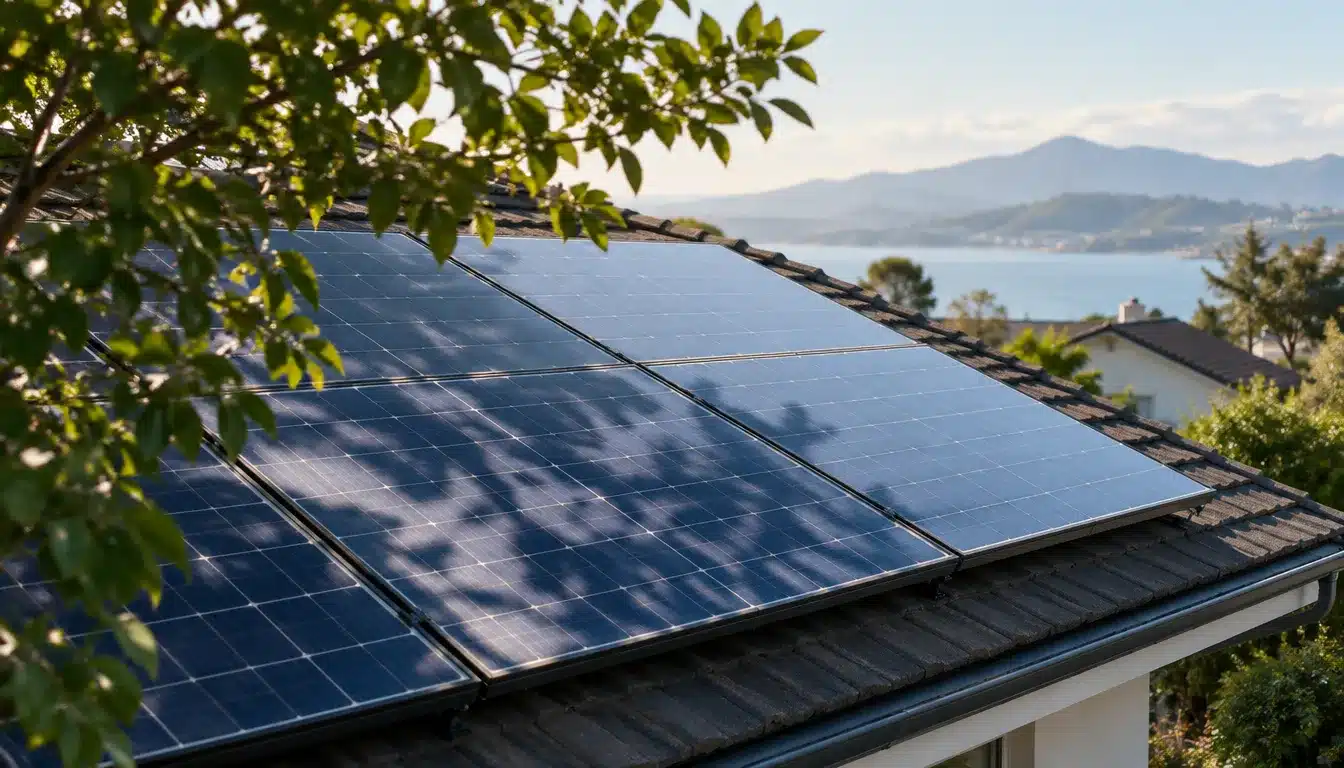
The San Francisco company’s Series A, led by VXI Capital, will expand manufacturing of smart solar panels that build power balancing, monitoring and rapid shutdown into each module.
Optivolt has raised $32m in a Series A round to scale its smart solar panels, which build power electronics into the module itself. VXI Capital led the round, which the San Francisco company announced on 21 October. RA Capital, Valo Ventures and Atlas Innovate also took part, taking Optivolt’s total funding to $42m. The new round is more than three times the $10m the company had raised before.
The company will use the money to expand manufacturing and production capacity. Its panels are aimed at homes, businesses and utility-scale projects, including sites built to power AI data centres.
Fixing the weak-cell problem
A standard solar panel links its cells so that they share one path for current. When a few cells underperform, because of shade or dirt for instance, output drops across a larger section of the panel. Optivolt says this costs conventional panels a significant share of their energy.
Most panels handle the problem with bypass diodes, which switch off a whole string of cells when one struggles. Optivolt replaces those diodes with what it calls a Power Balancer. The device moves energy between groups of cells in real time, so the healthy cells keep working.
The company reports that the Power Balancer reaches 99.4 per cent conversion efficiency under typical operating conditions. In its own tests under defined shading conditions, panels with the technology produced up to six times the power of panels using bolt-on optimisers. However, Optivolt notes that this result reflects specific test scenarios and doesn’t describe performance across all installations.
Fewer boxes on the roof
Solar systems often need extra hardware alongside the panels. That can include optimisers, microinverters and rapid-shutdown devices, which cut voltage quickly in an emergency. Optivolt builds rapid shutdown and monitoring into the panel. As a result, buyers may need less of that equipment.
The company says the savings depend on system design. Even so, fewer separate parts could mean simpler installation for both rooftop and larger projects. They could also mean fewer components to maintain once a system is running. Optivolt has shipped more than 20,000 panels with the Power Balancer so far.
The technology has also cleared several safety checks. Optivolt holds UL certifications for its junction-box enclosure, its panel-integrated electronics, its rapid-shutdown system and its module safety. It has 19 issued patents, with a further 27 applications pending.
Nine years of development
Rohit Kalyanpur, chief executive, founded Optivolt in 2017. The company has spent nine years on the technology. Kalyanpur said the team has “rebuilt the solar panel from first principles, embedding aerospace-grade power electronics” into its design.
The lead investor is VXI Capital, a new hard tech fund. Its founder is the former chief technology officer of the Defense Innovation Unit, part of the US military. Orin Hoffman is the fund’s managing director. “The next era of energy will not be built by simply installing more of the same passive solar panels we already have,” he said.
Investors are backing other ways to cut solar costs, too. In September, for instance, Planted raised $31.8m for building solar plants with robots. Optivolt’s bet is on smart solar panels that raise the yield of each module.
What the company still has to show
Several of the headline figures come from Optivolt’s own testing. That includes the six-fold output gain under shade, which applies only to the scenarios the company defined. Independent field data from large projects would give buyers a clearer view of the gains.
Still, the company now has the capital to test its approach at scale. Its smart solar panels are already in the field, and new manufacturing capacity is on the way. Over the next year, larger projects should show whether the savings hold up on real sites.