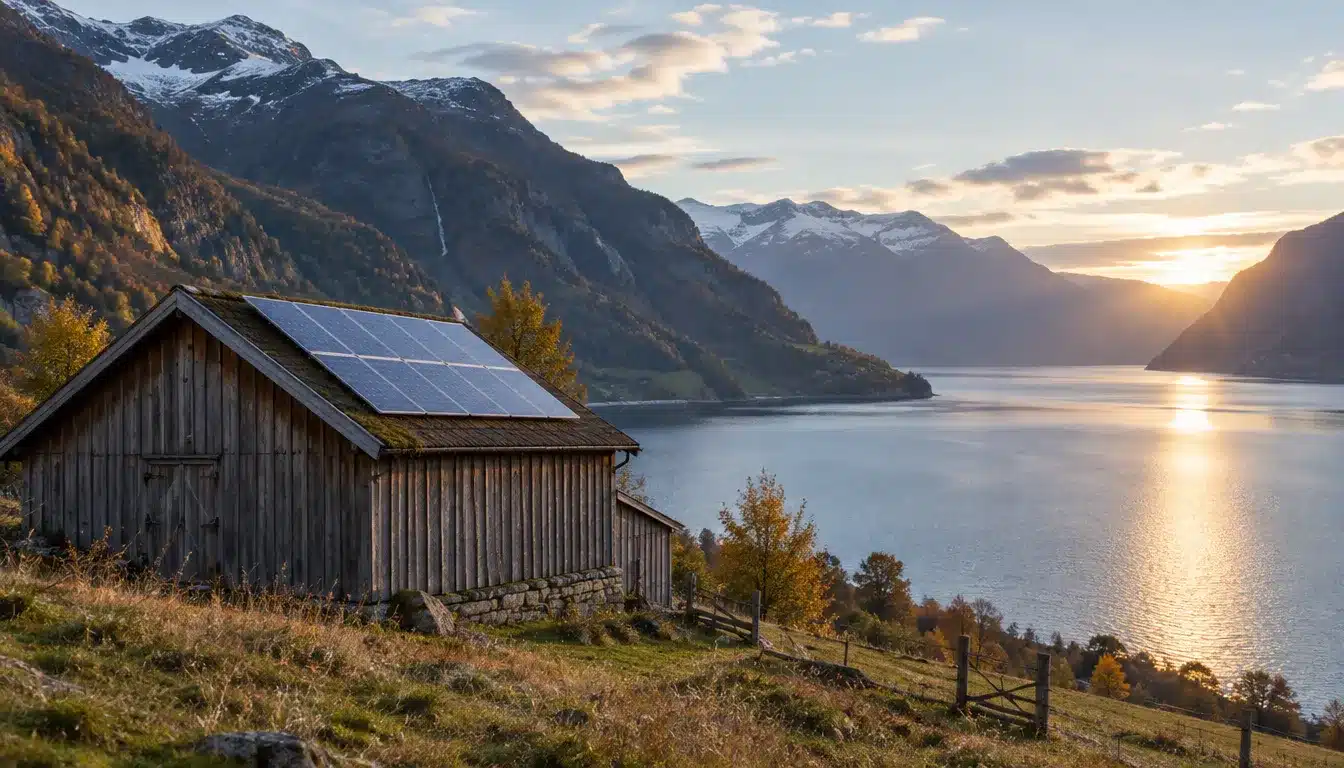
Installed capacity hit 1,003MW in mid-September, putting Norway alongside Denmark and Sweden, yet yearly additions are heading for their weakest total since 2021 as large parks stall.
Norway solar capacity has passed 1GW. Elhub, the central database where grid firms register meters, put the figure at 1,003MW in mid-September. The Norwegian Water Resources and Energy Directorate counted 964MW at the end of July.
The gap between the two is a matter of timing. Elhub updates daily, while the directorate updates monthly. It also adds older installs after the fact. Hassan Gholami, a senior consultant on solar and storage at Multiconsult, explained the difference.
He advises the market to use NVE as “the official reference” and Elhub as “the earliest signal of what is happening”. He expects the official dashboard to pass 1GW around the end of the year.
Solar and hydropower fit together
Hydropower supplies around 90 per cent of Norway’s electricity. Gholami said the milestone shows “solar is now a permanent part of the Norwegian power system, even if it is still a small one”.
The two sources sit well together. “Dry years, when low rainfall leaves reservoirs short of water, tend to be sunnier and therefore good years for solar production,” he said. In wet years the pattern reverses, and full reservoirs cover the shortfall. So solar helps the country use its reservoirs as seasonal storage.
That has value beyond the megawatt count. A dry year is when Norwegian power prices spike and exports tighten. Anything that eases the draw on reservoirs in those years is worth more than its share of output suggests.
Annual additions are shrinking
Norway solar capacity reached 1GW after Denmark, which got there around 2018, and Sweden, which did so in 2020. Both neighbours have since posted record deployment years. Norway has gone the other way.
This year looks set to be its weakest since 2021, with 80 to 100MW expected. Its best year remains 2023, at roughly 300MW. So the country is adding capacity more slowly now than it did three years ago.
Large parks are stuck
The large-scale market explains much of the weakness. Only five of Norway’s 16 licensed solar parks had been built as of May. Gholami blames weak profitability and a shortage of grid capacity.
Gholami said a single park of 20MW to 30MW equals “roughly a fifth to a third” of this year’s expected installs. Two or three parks finished in 2027 and 2028 would therefore move the annual figures noticeably.
Getting to 1GW a year needs far more than that. Licensing and council approvals must deliver “300 MW to 500 MW of new parks every year”, he said. He added that “those parks must actually be built”, and that there is no sign yet of it.
Rooftops are stuck too
The home market is close to a standstill. An optional fixed household electricity price, the Norgepris, has removed most of the financial case for rooftop solar. Parliament has ordered a study on a guaranteed floor price for building-mounted solar sold to the grid, due this year.
Gholami called that study “the first serious movement on the demand side in several years”. Rules letting people share solar power would help as well, he said. Sweden built a mass rooftop market on that basis.
Two paths from here
Much now depends on process rather than technology. If licensing speeds up and sharing rules widen, the first licensed parks should finish in 2027 and 2028. Norway solar capacity could then add 1GW a year by around 2030 or 2031.
The other path is flatter. If licensing stalls and the market leans on rooftops alone, annual additions stay between 100MW and 300MW for the rest of the decade. Solar is reshaping power systems worldwide, yet Norway’s second gigawatt may take almost as long as its first.