
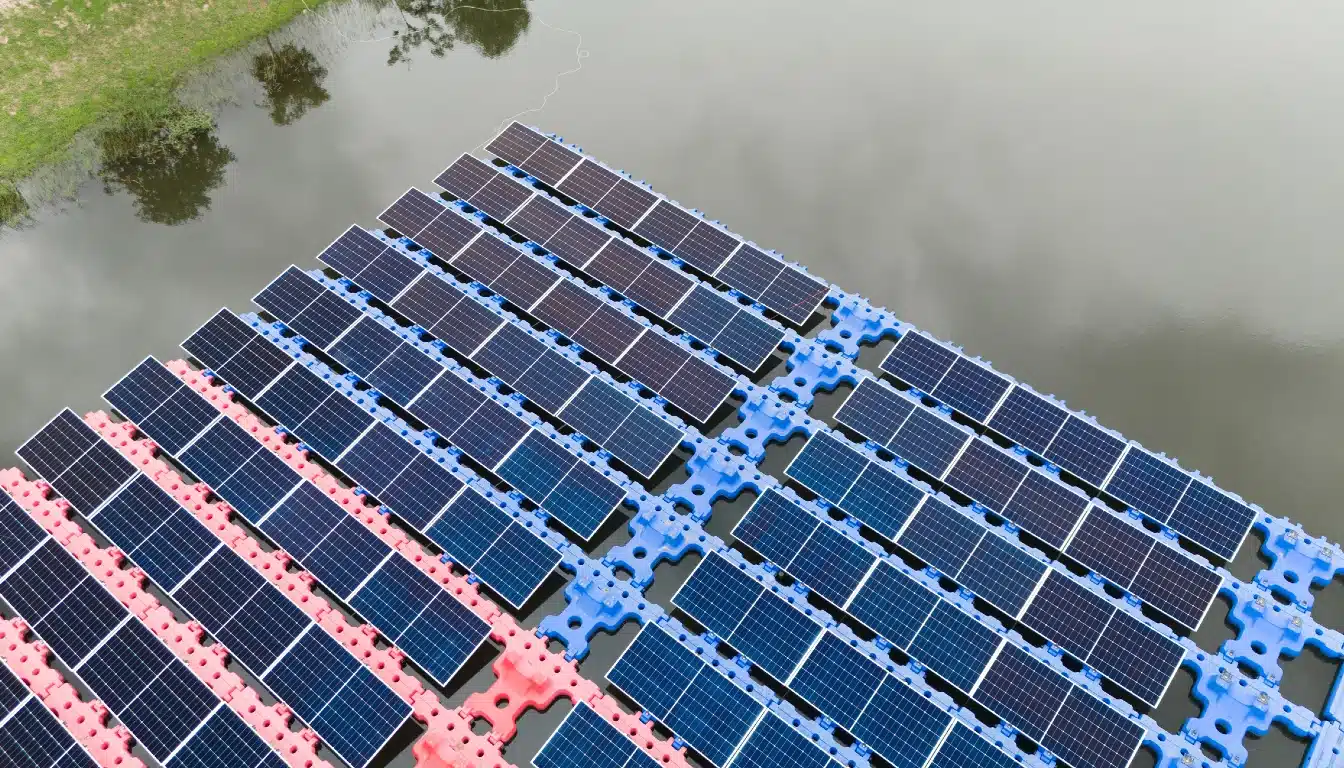
New analysis suggests floating solar could grow dramatically in the UK. The research, commissioned by Bluefield and conducted by CBI Economics, projects capacity exceeding 40GW by 2050. That would make it a meaningful contributor to Britain’s clean power mix. The findings arrive as policymakers face rising electricity demand from industrial growth, electrification, and data centre infrastructure tied to artificial intelligence.
UK Floating Solar Could Reach 40GW by 2050
The analysis sets out a clear growth trajectory. Floating solar could reach 3.6GW by 2030, then 18.3GW by 2040, and more than 40GW by mid-century. These figures assume supportive policy conditions remain in place throughout that period.
The report positions reservoir-based solar as an underused domestic resource. Britain currently relies heavily on imported gas for electricity generation. Deploying more domestic capacity could reduce that exposure. Placing generation assets close to demand centres would also ease pressure on transmission infrastructure.
Projected Growth and Energy Security
Energy Minister Michael Shanks used the report’s publication to call for faster deployment. He said Britain should stop “letting our solar potential float on by.” He said the technology could reduce dependence on volatile gas markets and strengthen energy security.
James Armstrong, founder and managing partner of Bluefield, said the UK already has the engineering base and investment capacity to scale the technology quickly. Aram Wood, senior director of floating solar at Bluefield, said the sector needs a policy framework that matches the pace of the energy challenge. Wood warned that without one, the UK could miss a major opportunity.
Environmental and Operational Benefits
Floating solar carries environmental advantages beyond electricity generation. Panels installed on reservoirs can reduce surface evaporation. That may support drought resilience as water stress intensifies across parts of England. Lower surface water temperatures can improve water quality and limit algal blooms.
The water itself also benefits panel performance. Natural cooling from the surface improves photovoltaic efficiency compared with ground-mounted systems in warmer conditions.
Bluefield already operates the UK’s largest floating solar array at the Queen Elizabeth II Reservoir. Power from that site goes directly to a nearby water treatment facility. The company is now developing a broader pipeline of utility-scale projects across England through its development arm.
Water companies and industrial users could be among the earliest adopters. Private wire arrangements give long-term price certainty to buyers. Lower operating costs and reduced emissions could improve business resilience. Wholesale power prices have remained volatile, and direct supply agreements offer a degree of insulation from that volatility.
Industrial Supply Chain Potential
A larger floating solar market could generate demand across British industry. Kamal Rajput, strategic business development lead at Tata Steel UK, said growth in the sector could create demand for UK-made coated and galvanised steel. He said that would give manufacturers greater confidence to invest in new products and processes.
That industrial dimension adds weight to the policy case. A domestic supply chain for floating solar components would distribute the economic benefits of deployment more broadly. Steel production in the UK faces its own structural pressures. New demand signals from the renewable energy sector could influence investment decisions at a critical time for the industry.
Policy and Planning Constraints
Floating solar remains a small part of the UK market. Ground-mounted and rooftop photovoltaic systems dominate current capacity. The analysis suggests the technology could move from niche deployment to a strategic national asset. The condition is that planning, policy, and investment decisions proceed in the same direction.
The report does not detail specific policy mechanisms. The projections for 2030, 2040, and 2050 are explicitly conditional on supportive conditions. That is a material caveat. Investors and developers will need clarity on planning rules, grid connection processes, and contract frameworks before committing capital at scale.
The government’s public support, expressed through Shanks’s statement, is a positive signal. Translating ministerial enthusiasm into durable regulatory conditions is the harder task. The UK has a history of policy uncertainty in renewable energy. Developers in other subsectors have experienced abrupt changes to support mechanisms. Floating solar’s growth trajectory depends on avoiding that pattern.
The scale of the opportunity described in the Bluefield-commissioned analysis is significant. Whether the projections prove accurate will depend on decisions made in the next few years, well before the 2050 horizon comes into view.