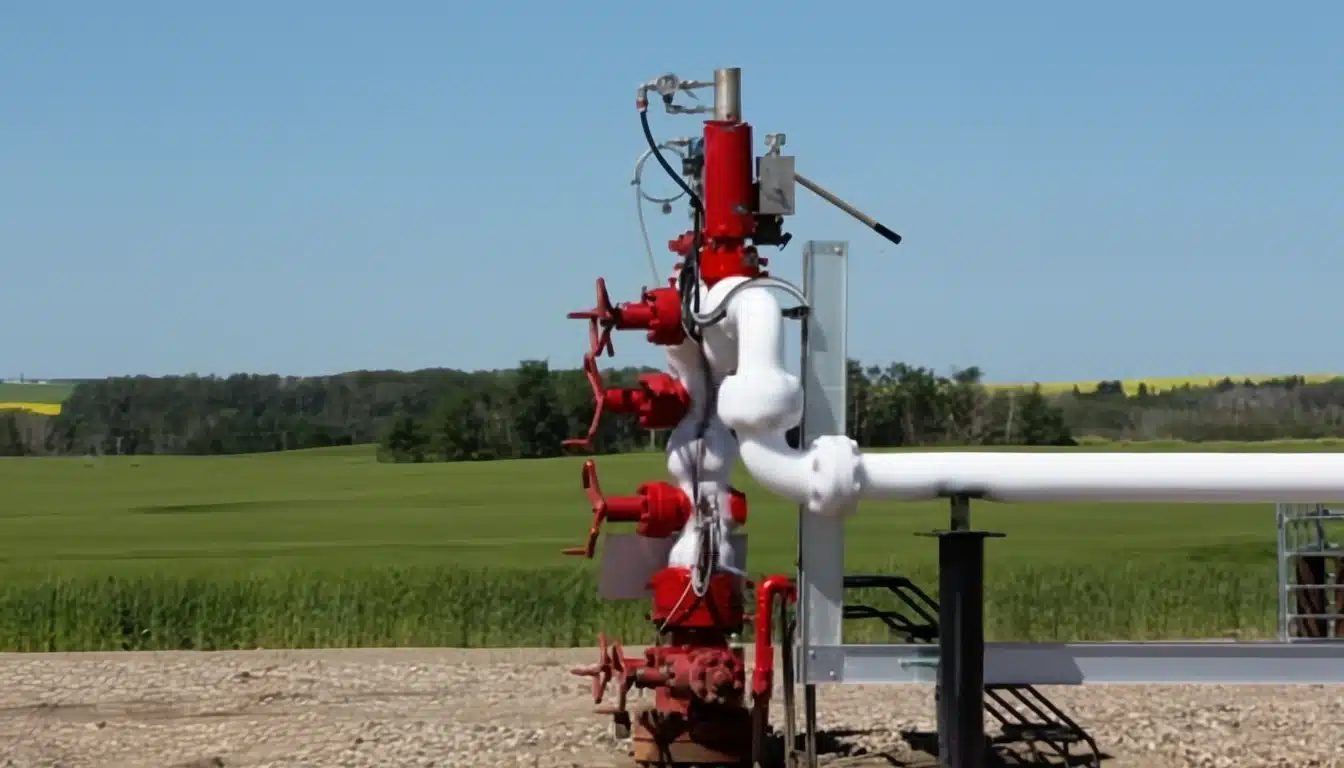
Federal and Alberta officials joined Enhance Energy to start construction of the Origins hub near Clive. It should store up to 1.5 million tonnes of CO2 a year once operations begin in January 2027.
Construction began this week at Clive, roughly 140 kilometres south of Edmonton. Natural Resources Canada says commercial operations start in January 2027. On the figures announced, Origins would then be the largest operating carbon sequestration facility in the country.
Initial capacity is up to 1.5 million tonnes of CO2 a year. That is roughly the annual emissions of more than 500,000 cars. The design also allows for expansion later.
Who will send the CO2
The hub connects into Alberta’s existing CO2 pipeline network. That gives it access to emitters across the province’s Industrial Heartland. Oil and gas refining, petrochemicals, cement and power generation are all named as target sources.
Enhance Energy already runs a carbon storage operation at Clive. Since 2020 it has permanently stored more than nine million tonnes of CO2 there. The company puts the associated regional economic activity above $600 million.
Federal and provincial backing
Support came from both governments, which is less common than it sounds in Canadian energy policy. Tim Hodgson, Canada’s Minister of Energy and Natural Resources, said the joint funding showed how public and private money can build large transition infrastructure together.
Brian Jean, Alberta’s Minister of Energy and Minerals, framed the expansion around lower-emission production, job creation and rural investment. Candice Paton, Vice President at Enhance Energy, said the hub shows carbon capture is commercially workable for heavy industry now. Both governments have reasons to want that argument to hold.
What Origins actually tests
Most Canadian attention on carbon capture has gone to the Pathways proposal in the oil sands, which still lacks a final investment decision. Origins is smaller, yet it is being built. Its pipeline links and existing storage record explain why.
The harder question is throughput. Capacity of 1.5 million tonnes a year depends on emitters signing up and capture equipment running as designed. Reported storage volumes after the first full year will show whether the hub fills.