
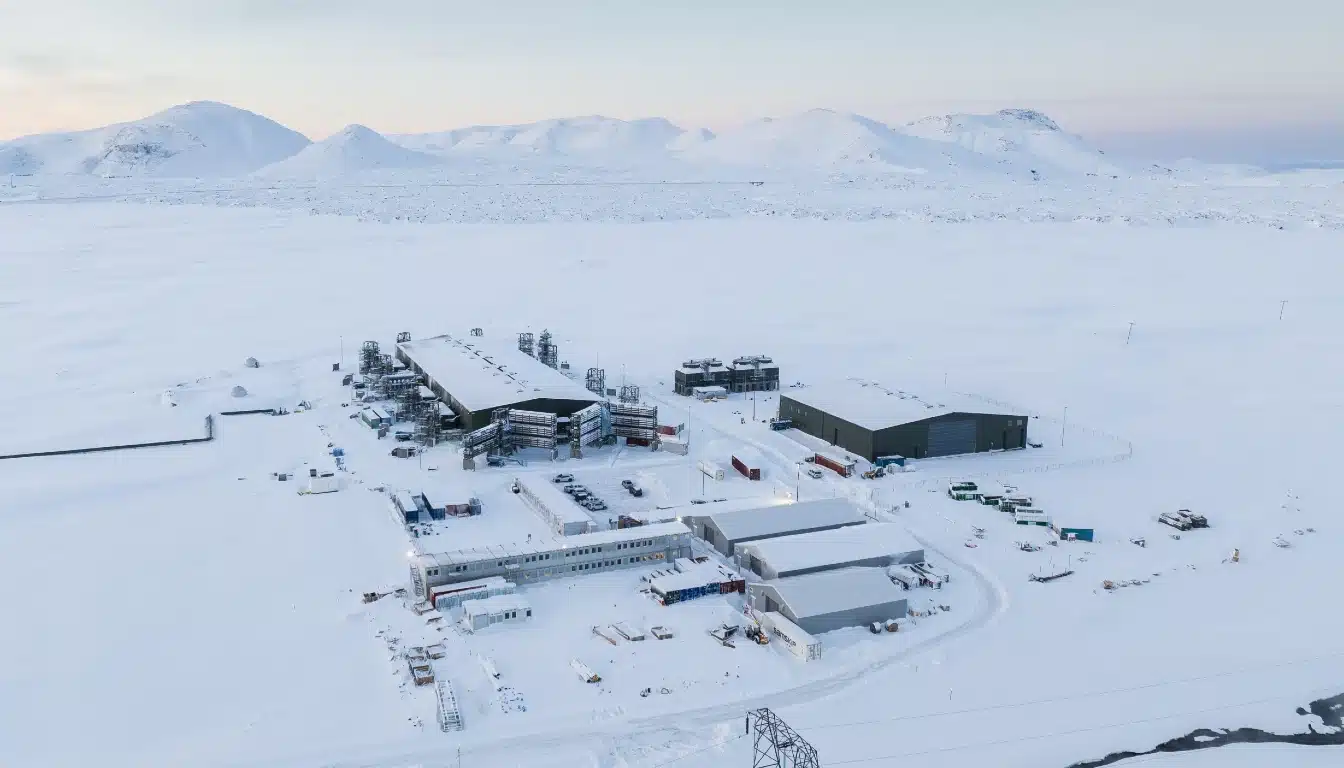
The Swiss company says upgrades at Mammoth have more than doubled CO2 capture and halved operating costs per tonne, giving the first hard evidence from a commercial plant that the cost curve is bending.
Climeworks announced the results on 10 September. They cover eighteen months of operation at Mammoth, the direct air capture and storage plant it runs in Iceland. Capture throughput has more than doubled over that period, while operating cost per tonne has halved.
Direct air capture pulls CO2 straight out of the atmosphere. The gas can then be sold as a feedstock or, when paired with geological storage, removed permanently. Cost has always been the obstacle.
Where the gains came from
Two areas of work delivered the improvement. The first was the sorbent, the filter material that binds CO2 as air passes through it. Climeworks refined both its formulation and its production process to raise capacity.
The second was the plant itself. Engineers upgraded equipment and reworked operating procedures. As a result, the first upgraded collector containers now run at the rates the original design promised.
A longer sorbent life comes next
Climeworks plans to begin testing its next generation of capture technology at Mammoth at the start of 2027. In the laboratory, that technology has shown a tenfold improvement in sorbent lifetime. Longer-lived sorbent means fewer replacements and lower running costs.
The company also reports a fourfold gain in process densification. In practice, fewer collector containers would then deliver the same net removal. So capital cost per tonne would fall alongside operating cost.
Why these numbers are watched closely
Christoph Gebald and Jan Wurzbacher founded Climeworks in 2009. The company opened Orca, the first commercial DAC plant, in 2021, and Mammoth followed in 2024. Few operators anywhere hold comparable running data.
Jan Wurzbacher, co-founder and co-chief executive at Climeworks, said: “Climeworks is the only company worldwide that has been delivering direct air capture-based carbon removal to customers for several years. Mammoth is enabling us to maintain that leading position, while at the same time providing a platform for the accelerated deployment and validation of future step changes in technology, cost, and performance.”
Buyers of engineered removals have grown wary of projected cost curves. Measured results from an operating plant therefore carry more weight. Whether the next generation repeats its laboratory gains at scale is the open question.