Google will buy methane cuts from Brazilian rice farms by 2030 and durable carbon removal by 2040, in its largest removal purchase yet and the biggest enhanced rock weathering project so far.
Google and Terradot announced a megaton-scale deal on 16 September that pairs methane cuts with enhanced rock weathering. Google will buy 1 million tonnes of near-term methane impact by 2030. It will also buy 1 million tonnes of carbon removal impact by 2040.
The purchase is Google’s largest carbon removal deal to date. The companies also call it the largest enhanced rock weathering project ever undertaken. In addition, they say it is the first project of any kind to combine near-term methane cuts with durable removal at this scale.
Two timelines in one project
The deal targets two warming problems at once. Methane causes roughly a third of human-caused warming to date, according to the companies. However, it clears from the atmosphere within about a decade. Carbon dioxide, by contrast, keeps heating the planet for centuries.
Most climate solutions tackle one of those problems or the other. This project tries to address both on the same farmland. By the time the short-lived methane benefit fades, the longer-lived carbon removal should be in place.
Randy Spock, head of carbon removal at Google, said the partners designed the agreement “to be a template, not a one-off”. James Kanoff, chief executive of Terradot, said climate action has long been framed as a choice between fast and permanent action. “Our project with Google eliminates that trade-off,” he said.
Rice paddies and crushed rock
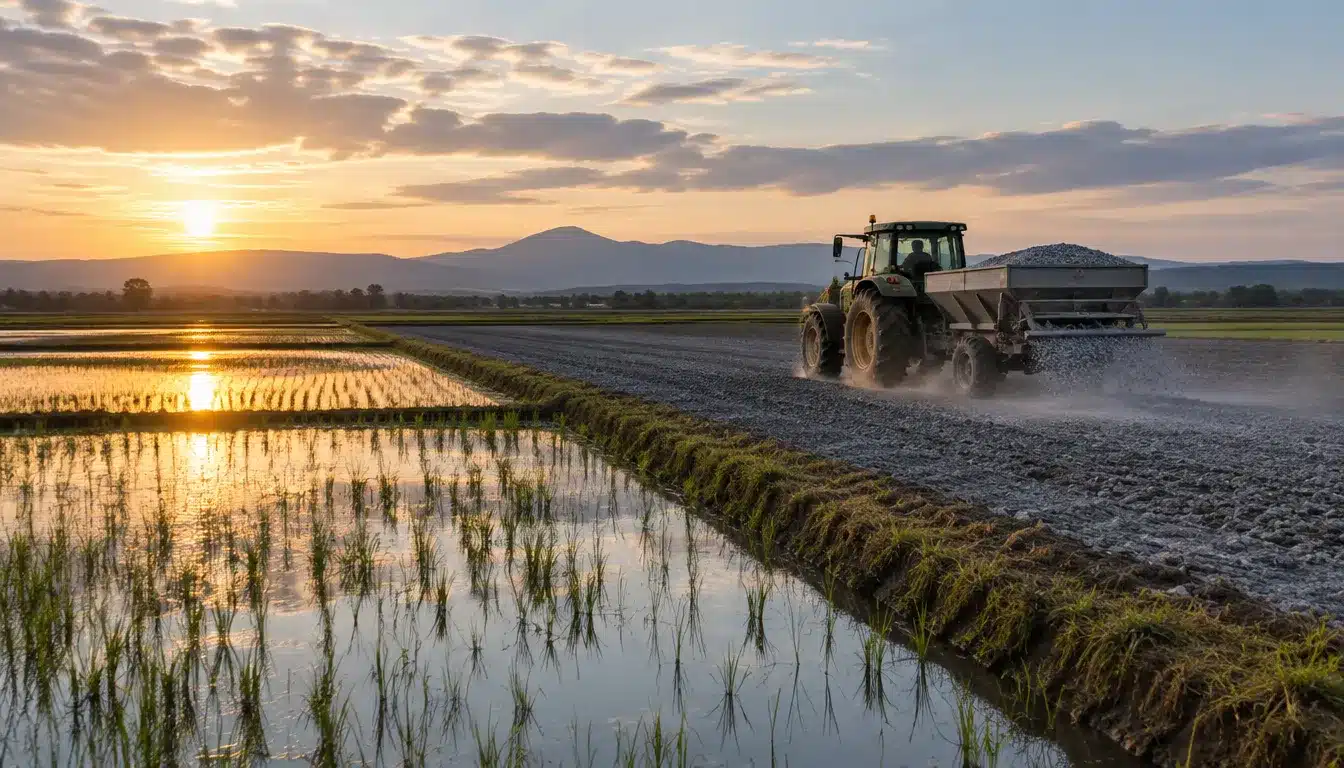
The work starts in Rio Grande do Sul, in southern Brazil. There, Terradot will help rice farmers across more than 200,000 hectares adopt alternate wetting and drying. This irrigation method drains flooded paddies from time to time. As a result, it cuts water use and sharply reduces methane release.
At the same time, Terradot will spread crushed volcanic rock on the farmland. As the rock weathers, it locks away carbon dioxide for the long term. The rock also improves soil health, while the new irrigation method could lower water and input costs for farmers.
Southern Brazil suits the approach, the companies say. Its warm, wet climate, tropical soils and flooded rice systems all speed up weathering. In addition, basalt quarries sit close to the farms. Brazil has more than 1.5 million hectares of rice under cultivation, and the partners want the model copied across them.
Handling the weathering delay
Enhanced rock weathering has a built-in lag. The rock takes time to dissolve, and the resulting alkalinity takes time to store durably. Today, projects manage that delay with frequent measurement, cautious discounts and project finance, which all add cost.
This deal takes a different route. Terradot will wait longer before crediting the removal, which cuts measurement costs and uncertainty. Meanwhile, the paired methane credits bring climate impact forward. On a temperature-over-time basis, the partners say the combined effect lowers warming.
Terradot builds its track record
Stanford scientists and entrepreneurs founded Terradot in 2022. It has raised $58m from investors including Google and Microsoft, and it bought Eion in February 2026. The company says it has spread more than 500,000 tonnes of rock across 20,000 hectares. It targets 1 million tonnes of carbon removal a year by 2035.
For Google, the project puts into practice the approach set out in its 2026 environmental report. That approach pairs fast-acting cuts in superpollutants with durable removal that phases in later. In May, Google also published a paper with guidelines on combining the two.
Terradot already has offtake agreements with buyers including Google, Frontier, Microsoft and JP Morgan. It issues credits certified by Isometric and, since the Eion deal, by Puro.
Google is also funding research. It will give R&D grants to Terradot and to the Soil & Environmental Biogeochemistry Lab at Stanford’s Doerr School. The work will test alternate wetting and drying as a methane strategy, and the partners will publish the findings. Better evidence could also ease the money problem holding back carbon removal.