Amazon has opened a single route for climate technology companies to win business across its Devices, AWS and Private Brands teams, with applications due to open in January.
Amazonは持って 打ち上げ the Amazon Sustainability Deep Tech Accelerator, a global scheme for companies working on materials, manufacturing and energy systems. The deep tech accelerator brings Amazon Devices, Amazon Web Services (AWS) and Amazon Private Brands together in one scheme for the first time. As a result, start-ups can pitch to several Amazon teams in one go.
The company announced the programme in Seattle on 3 November. Applications open in January 2027, and firms can join an interest list to hear when the portal goes live. Amazon says it doesn’t take equity stakes as a condition of taking part.
3つのテーマ
The programme covers three themes. Low-carbon materials and advanced manufacturing come first, spanning semiconductors, circuit boards, batteries, displays, accessories and packaging. Energy efficiency is the second, with a focus on managing power and heat to cut emissions from day-to-day use.
Circularity, the third theme, covers cutting the carbon built into products and getting more parts and materials back for reuse. Within those themes, Amazon wants new ways to shrink the carbon cost of displays, chips, batteries and packaging. It also wants lower-carbon options for plastics, polymers and textiles.
AWS brings data centre hardware into scope as well. Amazon lists cloud hardware that is designed, used and retired in ways that reuse more critical parts and materials. That gives start-ups working on server recovery or metal recycling a route into one of the world’s largest cloud businesses.
How start-ups win a contract
The process centres on an integration proposal. Applicants shape it around Amazon’s product plans and how ready its factories are for a change. They then present it directly to senior leaders who can approve it.
If Amazon approves a technology, the result could be a licence, a supply deal, a joint project or an investment. The company says the outcome will depend on fit and business goals. It may also refer promising technologies to other Amazon business units.
Maiken Moeller-Hansen is director of energy and sustainability for Amazon Devices and Services. “Across industry, new technologies are needed to reduce carbon emissions and increase the use of recycled materials,” she said. However, Amazon hasn’t stated how much capital sits behind the programme or how many companies it will take. Eligibility criteria and application details are due on the programme’s own website.
Support, credits and judging
Amazon runs the programme with Plug and Play, the start-up platform, through a screening, review and judging process. Judges will look at whether a company can scale and whether its plans stack up on cost and engineering. They will also weigh its carbon impact, how well it fits Amazon’s products and how new its approach is.
Selected companies get mentoring from Amazon’s engineers and its manufacturing and climate experts. They also work with Amazon staff on a formal assessment of how the technology would fit. It covers the engineering, the carbon impact, the costs and benefits, and whether the deal makes commercial sense. In addition, they can receive up to $100,000 in AWS Activate credits, subject to eligibility.
Taking part doesn’t guarantee a contract. Successful companies still need to agree commercial terms and meet Amazon’s technical requirements.
Building on the Devices programme
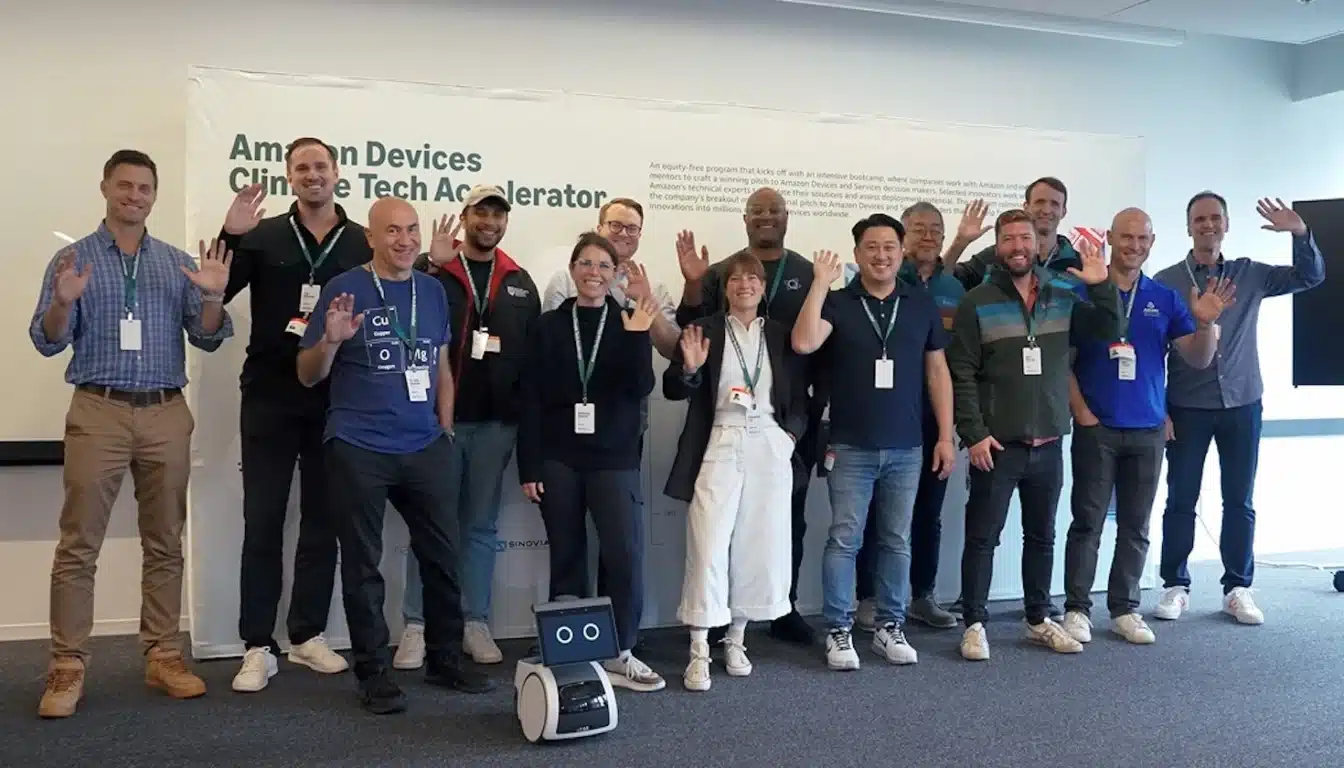
The new scheme grows out of the Devices Climate Tech Accelerator, which Amazon Devices launched in 2025. That scheme put young climate companies through a six-month review. In total, it worked with 28 companies across its first two cohorts, from countries including the US, Canada, the UK, Germany, Israel, Japan and Singapore.
Finalists in that scheme pitched their proposals to Amazon senior leaders, who could approve them for use in products. Amazon says the earlier programme showed the model works. The new version widens it from one business unit to three.
Big tech and climate start-ups
Other large technology companies also run their own climate schemes. Google, for instance, opened a $6m research call for carbon removal and superpollutants in September. Such schemes give start-ups an early customer or funder with global reach.
Amazon ties its deep tech accelerator to its own climate goal. The company co-founded The Climate Pledge in 2019, which commits signatories to net-zero carbon emissions by 2040. Amazon says the new programme is one way it plans to reach net zero across its global operations by that date.