Holcim has invested in Oman-founded 44.01, deepening a partnership that already turns carbon dioxide from its Fujairah cement plant into rock deep underground, as Japan’s JERA also joins the company’s investors.
Building materials group Holcim has invested in 44.01, an Oman-based company that stores carbon dioxide by turning it into rock. The deal extends a commercial relationship between the two companies, and it supports the CO2 mineralisation company’s international growth. The investment amounts weren’t disclosed.
JERA, Japan’s largest power generation company, invested alongside Holcim. It’s the first backing for 44.01 from the power sector. Meanwhile, existing investors ALIAD, the venture capital arm of Air Liquide, and Climate Investment provided further funding.
How the rock storage works
44.01, founded in 2020, takes CO2 captured from the air or from hard-to-abate industrial processes and dissolves it in water. That forms an acidic solution, which releases cations from the surrounding rock. Those cations then react with the carbon dioxide and mineralise it.
The company injects the fluid deep underground, where high pressure, high temperature and high CO2 concentration speed up the reaction. As a result, the method depends on suitable geology. It does, however, give a cement producer a possible storage route close to its plants.
Ram Muthu, head of operational excellence at Holcim, said: “44.01’s breakthrough technology enables storage close to production given the right geological conditions.” He added: “This pathway can help us manage captured carbon at inland sites across our operations.”
A pilot at Fujairah
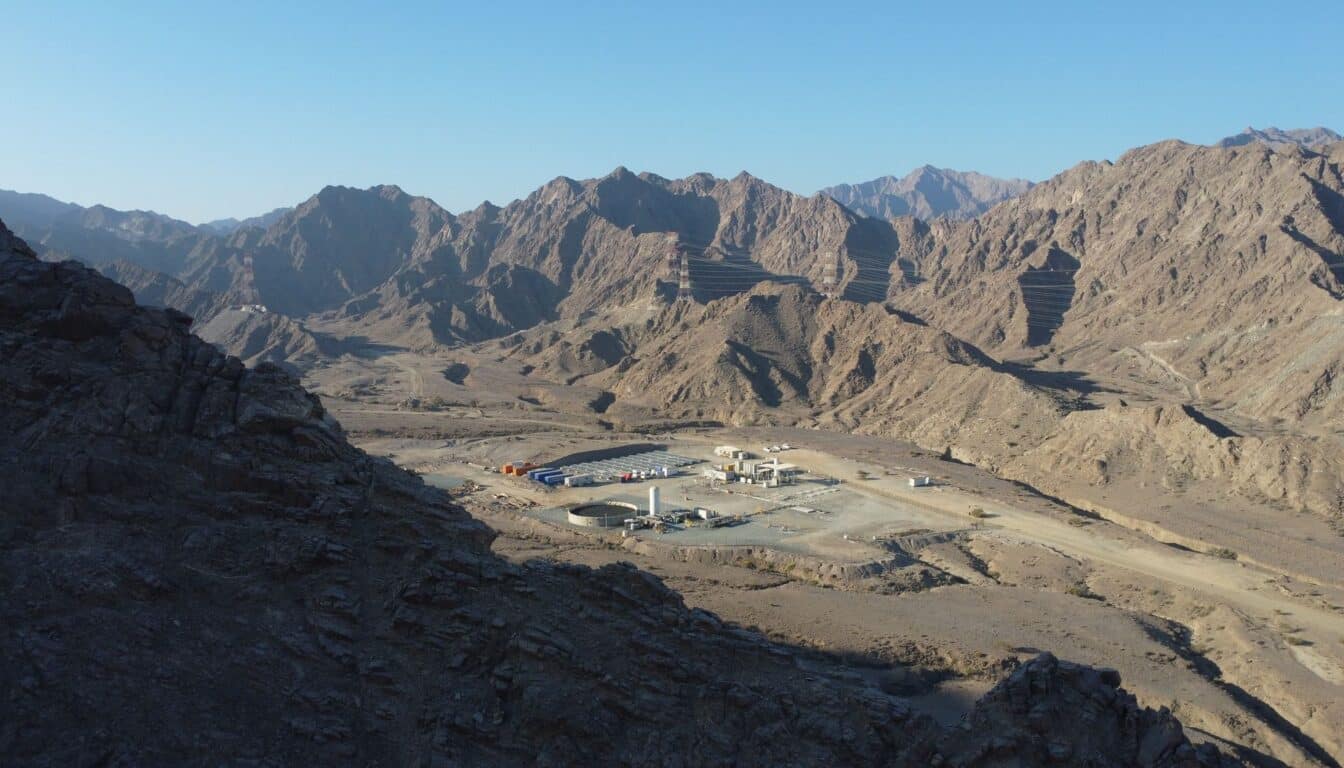
The two companies already work together at Holcim’s cement plant in Fujairah in the UAE. They first announced that pilot project in December 2025. It runs under live industrial conditions, capturing CO2 from cement production for permanent storage underground through mineralisation.
The pilot plans to capture five tonnes of CO2 a day, using Shell’s CANSOLV system, which NT Energies deploys at the site. Fujairah Natural Resources Corporation supports the project. The partners describe it as the first effort globally to combine cement-derived CO2 with in-situ mineralisation at an industrial site. It’s also 44.01’s first collaboration with an industrial customer.
Five tonnes a day is small for a cement plant, so the pilot tests the process and doesn’t yet decarbonise the site. Holcim says the investment supports its NextGen Growth 2030 strategy for scaling low-carbon construction technologies. It also links the deal to the UAE’s Net Zero 2050 pathway.
Other companies in the sector are testing different routes, including low-carbon cement from demolition waste. Holcim’s stake instead backs storage for the CO2 that a plant still produces.
Buyers and backers gather
The investment follows an $11.7m carbon removal offtake deal that 44.01 signed in October. Frontier buyers Google, H&M, Shopify and Stripe agreed that deal, which covers a different revenue stream from the industrial work with Holcim. So the company now has both voluntary carbon removal buyers and a heavy industrial partner.
Talal Hasan, chief executive of 44.01, said: “We’re delighted to have Holcim and JERA backing 44.01.” He added: “Their investment is a strong endorsement as we move towards commercial-scale operations.”
Investors have followed the company for some time. CSN reported a $37m funding round for 44.01 in August 2024, when the business was still at an earlier stage.
What comes next
JERA’s involvement extends the company’s reach beyond cement and carbon removal buyers. 44.01 has also signed a memorandum with Sumitomo Corporation and ENEOS Xplora to test mineralisation in igneous rock, with Japan among the planned locations. Power generators also produce large volumes of CO2, although neither company has announced a project together in this round. Likewise, the announcement gives no timetable for commercial-scale operations.
Holcim’s stake therefore leaves the main questions open. The Fujairah pilot will show how the process performs at a working plant. Meanwhile, Muthu’s reference to inland sites points to where the group sees a use for it. Geology will still decide how far CO2 mineralisation can spread across Holcim’s operations, since the method only works where the rock is right.