Zurich start-up UniSieve has raised $9m to take its high-precision membranes from validation to wider commercial use. It targets olefins production and point-source carbon capture, where heat-hungry processes still dominate.
UniSieve, a Zurich-based maker of membranes for industrial gas separation, has raised $9m in a Series A round. It announced the deal on 8 October, taking its total funding to $25m. Founded in 2018, the firm designs membranes for chemical plants and other heavy industrial sites.
Supernova Invest, through the Orano Venture Fund it manages, led the round. The Amadeus APEX Technology Fund, Founderful, Zürcher Kantonalbank and Guenat Holding also took part. The group mixes new backers with investors who have supported the company before.
What the money will fund
UniSieve plans to use the cash on three fronts. First, it will scale its technology in the markets it already serves. Next, it will move into more industrial uses. Finally, it wants to shift from validation projects to a wider commercial rollout.
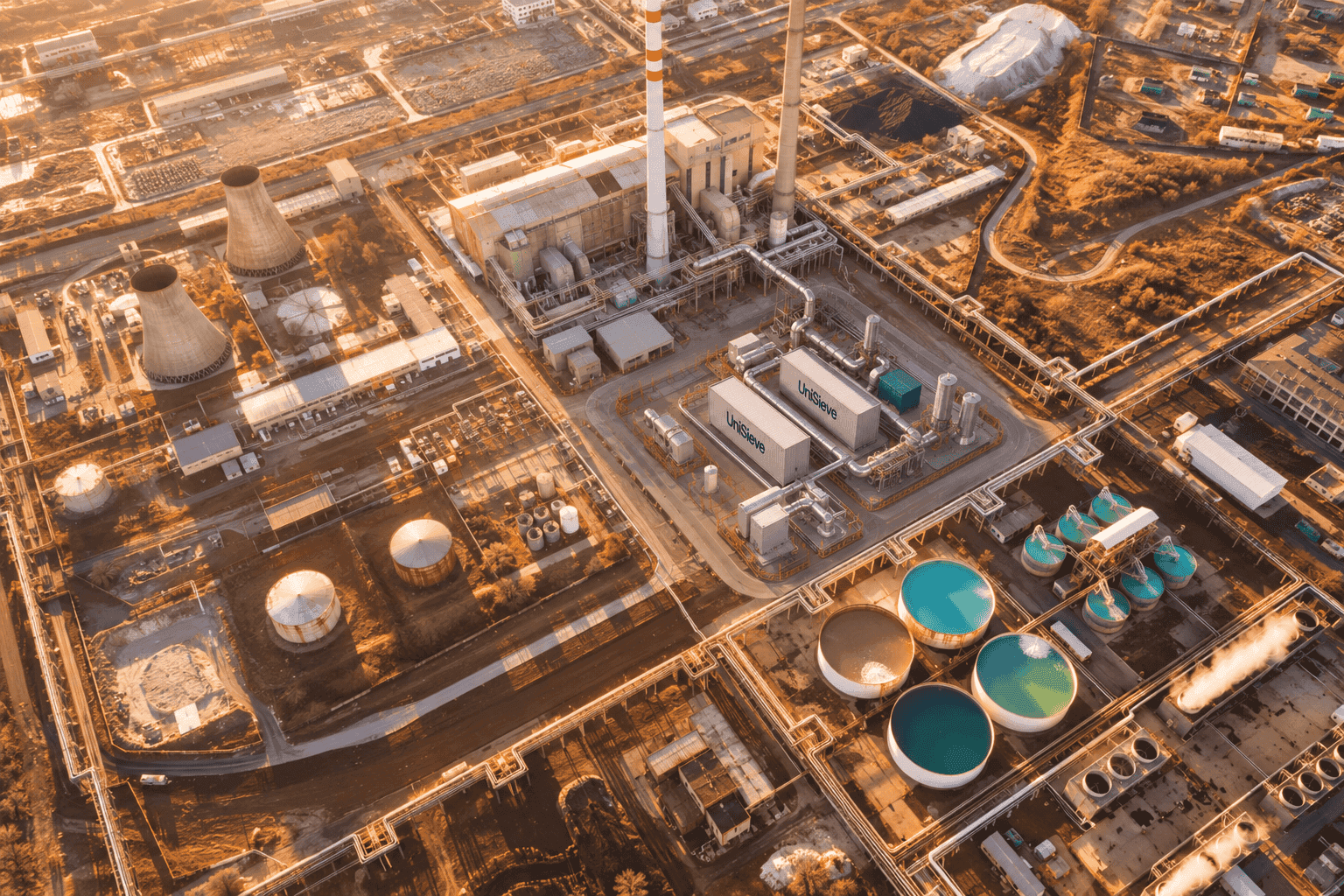
UniSieve says its membranes have reached pre-commercial maturity in two areas. The first is olefins, the building blocks for many plastics and chemicals. The second is point-source carbon capture, which traps carbon dioxide at the chimney of a plant or factory.
It also lists hydrocarbon separation, speciality gases and emission control among its target uses. Each one depends on pulling one gas out of a mixed stream. In every case, a sharper filter means a purer product and less wasted energy for the plant.
Replacing heat with filters
Many plants still split gases with thermal methods such as distillation. These processes heat and cool large volumes of material, so they use a lot of energy. Membranes, by contrast, act as fine filters that let some molecules pass and hold others back.
UniSieve makes hybrid membranes that it describes as high precision. The aim is to split molecules that differ only slightly in size. That is hard to do with heat alone, because such gases often boil at similar temperatures. If a membrane can do that reliably, industrial gas separation could need far less heat.
Samuel Hess, chief executive of UniSieve, said the membranes make it possible to replace energy-intensive thermal processes. That pitch suits heavy industry, where energy is a large share of running costs and a major source of emissions.
Investors back the next stage
Jonathan Grosskopf, investment director at Supernova Invest, said the investor was backing the firm for its next stage. “We are proud to support the team as it enters its next phase of commercial and industrial scale-up,” he said.
Supernova Invest manages around EUR 800m and has more than 80 companies in its portfolio. Its Orano fund takes its name from Orano, the French nuclear fuel group. Its lead role therefore gives UniSieve an industrial backer as well as capital.
APEX Ventures returned for this round too. Wolfgang Neubert, a general partner at the firm, said it was reinvesting because it sees a clear path from proven technology to commercial use. He added that this progress, more than any single technical milestone, gave the firm conviction to back the team again.
Carbon capture in a crowded field
Carbon capture is a busy space, and many teams are testing new ways to trap emissions. In Sheffield, for instance, a recent trial tested non-amine carbon capture at an industrial site. Most existing systems use amine solvents, which need heat to release the captured carbon dioxide.
Membranes offer another route, since they can work without that heat step. However, UniSieve still has to prove its units at full commercial scale. The new funding gives it the means to do so in both olefins and carbon capture.
The company now has $25m behind it and a group of returning investors. Its next test is to turn pilot results into orders from plant operators. Success there would put industrial gas separation by membrane on a firmer commercial footing.