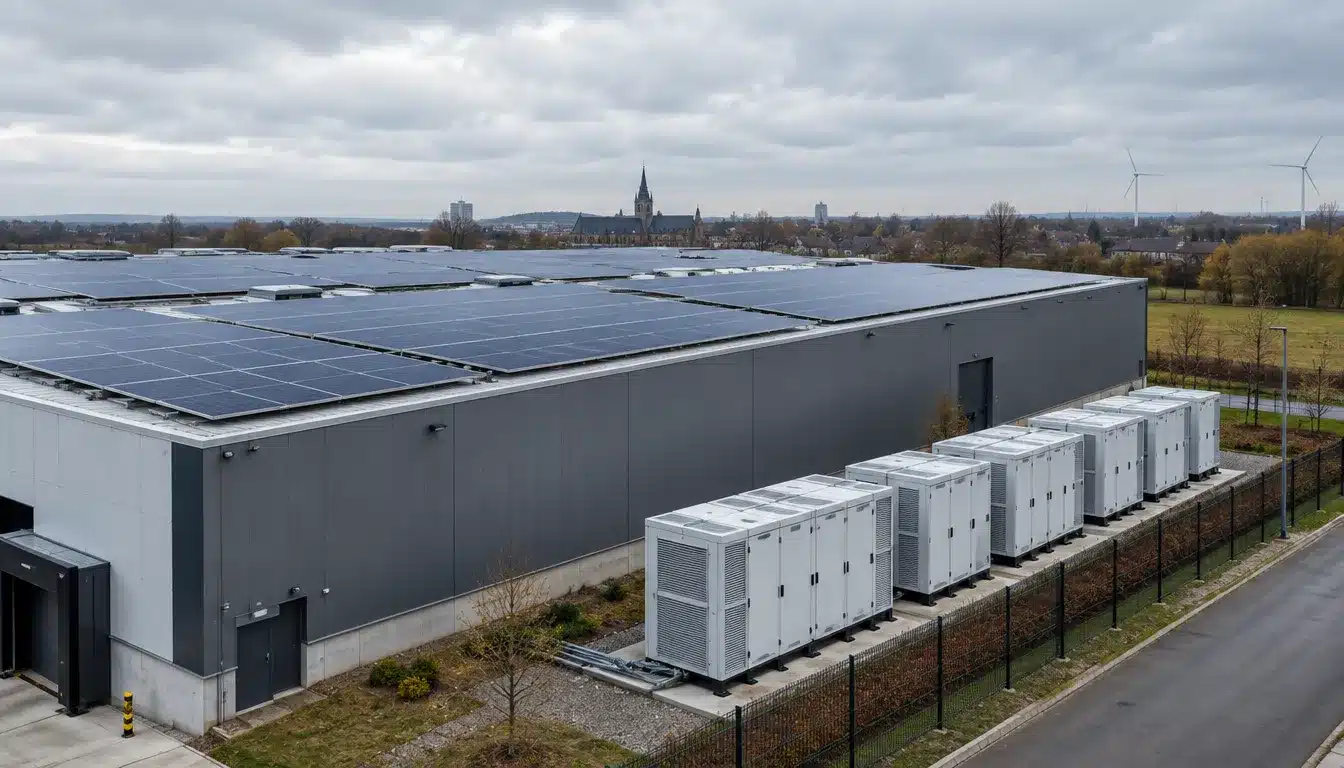
The Belgian company runs solar panels, batteries and chargers for over 100 business sites and will use the money to trade power directly in Belgium, the Netherlands, Germany and Romania.
Belgian battery optimisation company CIOC Energy has raised €3 million from renewable energy developer CleverNett. CleverNett takes a minority stake, while CIOC Energy stays independent.
The funding will grow the company’s commercial and technical teams. It will also pay for direct market access, so CIOC Energy can trade power itself in Belgium, the Netherlands, Germany and Romania.
One platform for three jobs
Founded in September 2023, CIOC Energy gives businesses a single platform to monitor, control and trade energy from their solar panels and batteries. That targets a split market. Today, one firm often installs the kit, another controls the battery and a third trades the power. As a result, nobody takes full charge of how the system performs.
Alexander De Bièvre, chief executive of CIOC Energy, knows the problem first-hand. “We sold batteries ourselves for years, so we know exactly how fast things can go wrong when nobody’s keeping watch,” he said. “Without constant follow-up, faults simply go unnoticed.”
He added that blame often gets passed around. When something breaks down, he said, “everyone points at someone else.” The installer doesn’t know the software, and the control system simply follows the energy trader’s orders.
How the control module works
To close that gap, CIOC Energy built its own control module for electricity cabinets. It manages solar panels, batteries and charging points through one system.
The platform can send solar power into batteries. It can also smooth demand peaks when machines and chargers run at the same time. Then, when prices are right, it trades stored energy on the market.
Customers can also pick energy contracts with direct exposure to the imbalance market. In that set-up, control of the assets stays separate from the energy supplier. The imbalance market settles the gap between forecast and actual demand on the grid, and its prices can swing sharply within a day. For a well-run battery, those swings are a source of income.
Paid only when it earns
The fee model ties CIOC Energy’s income to results. The company compares returns without its platform against those it achieves. It then charges an agreed share of the difference, after distribution and supply costs.
If the platform adds no extra return, the customer pays no fee. That lowers the risk for businesses that are unsure how much a battery can earn. It also means CIOC Energy only profits from battery optimisation that lifts a customer’s earnings.
Scale so far
CIOC Energy now manages more than 100 business sites. Through CleverNett, it also runs about 2,000 home batteries for private households.
In total, the company oversees more than 100 megawatt-hours of battery capacity. It also manages 200 megawatt-peak of solar panels, spread across commercial and household sites.
The CleverNett link gives CIOC Energy a route to more assets. CleverNett develops renewable projects, so each new site could bring solar and storage onto the platform. Meanwhile, direct market access means CIOC Energy won’t need a third party to place its trades.
Why battery optimisation is growing
Batteries at business sites earn money in several ways at once. They store cheap solar, cut costly demand peaks and sell power when prices spike. However, each use needs active control, and the best choice changes by the hour. No one can run that well by hand.
That is why battery optimisation has become a business in its own right. Investment in solar-plus-storage projects hit a record in the first half of 2026. Still, the returns on those assets depend on software that keeps them working and trading well.
CIOC Energy’s pitch is that one party should own that job from end to end. With four markets in its sights, the next step is to prove it can trade at scale beyond Belgium.