A Seattle start-up has run a power plant on the seabed, showing the idea can work while exposing how far subsea geothermal has to go.
Seattle start-up Endurance Energy has generated electricity from a geothermal power plant on the deep seabed. The company revealed the results on 19 October, after a three-week test in September. Its subsea geothermal unit made more power than it used for just under nine seconds.
That’s a small output by any measure. Still, it was the company’s first end-to-end trial of drilling for heat on the ocean floor and turning it into power on the spot. Back in 2016, a Chinese team drew a few watts of steady power from a vent in the Indian Ocean.
A power plant a mile down
The test took place near Axial Seamount, an active underwater volcano on the Juan de Fuca Ridge. The site lies about 300 miles west of Oregon, in roughly 1,500 metres of water.
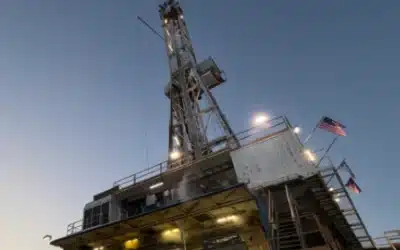
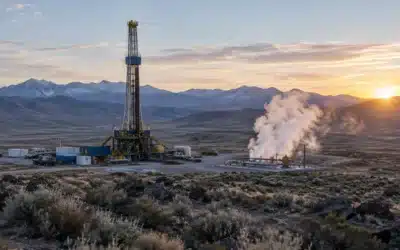
First, a remote-controlled drill working from a support ship bored a geothermal well 16 metres into the seabed. The well produced fluid at around 260C. However, it didn’t flow strongly enough to run the plant, so the team moved to a natural hot-water vent nearby, where fluid reached about 281C.
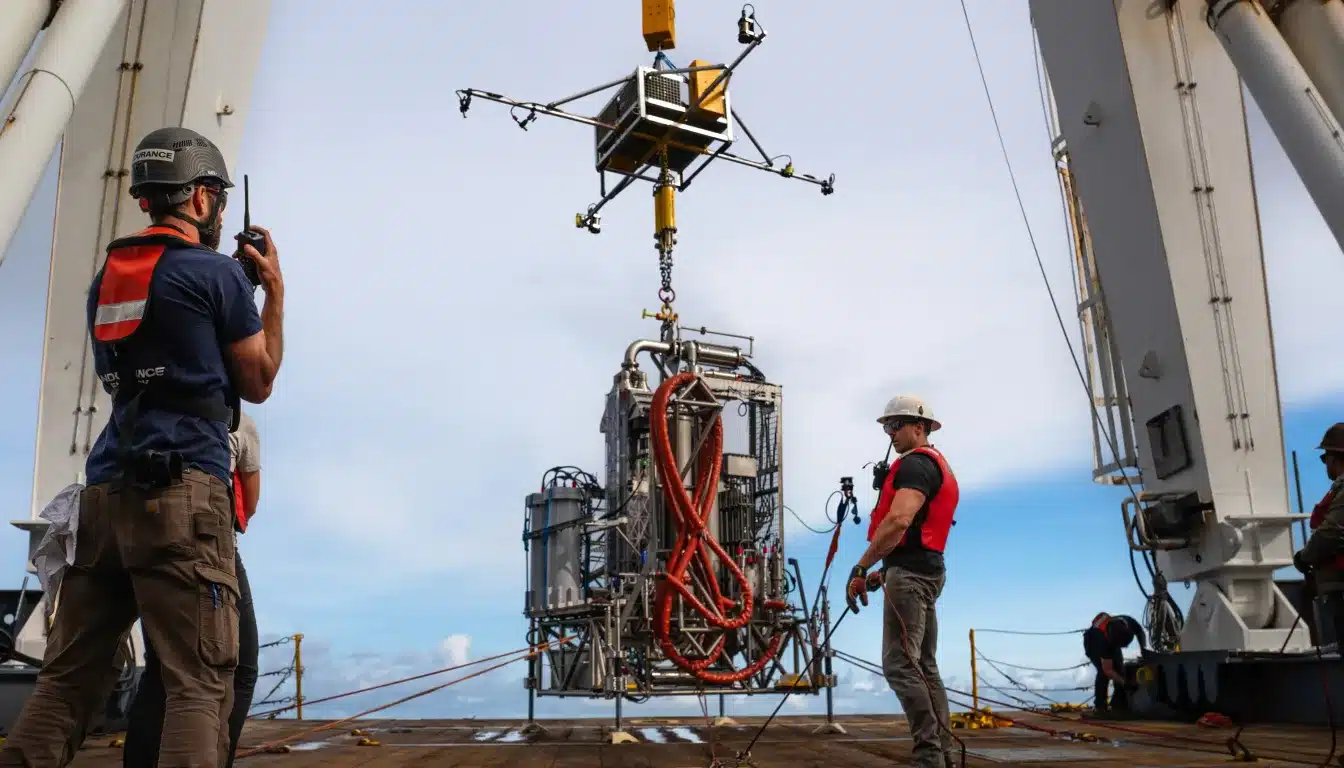
Next, a robot submarine set down Adélie, the company’s 3-tonne power unit, beside the vent. The unit uses an organic Rankine cycle. Heat from the vent boils a second fluid, and its vapour spins a turbine. Engineers ran it from Seattle.
Nine seconds of net power
On 27 September, Adélie generated about 60 watt-hours of electricity over roughly 29 seconds. For 8.7 of those seconds, it produced more power than it consumed, with a peak net output of 16.5 kW. Its median net output was about 2 kW.
Then the battery’s overcurrent protection tripped and cut the run short. A power cable failed soon after, during an attempt to restart, and that ended the dive.
“Adélie made it exist, and now we know it’s possible,” said Andrew Redd, founder and chief executive of Endurance Energy. He described the test as “our first end-to-end demonstration of subsea geothermal as a concept”.
Fast turnarounds at sea
Adélie was the company’s fifth deep-sea deployment. It was also the first to combine drilling, a seabed power plant and data links back to shore. During the trip, the team recovered, modified, recharged and redeployed the unit in under 16 hours, according to Redd. “The biggest lesson is that every step of subsea geothermal power can be done at depth,” he said.
The company has raised $63m so far, including a $54m Series A led by Founders Fund. It launched in January 2025.
Tonga and the next well
Endurance plans to send down a refurbished and redesigned Adélie this winter. It wants more power and longer runs from that deployment. In parallel, it is building Leopard, a 2 MW commercial generator meant to underpin future sites.
Its first commercial project will be in Tonga. The company has signed a memorandum of understanding with the Tongan government to explore supplying Tongatapu, the main island. It is targeting first power in 2027.
“Like many island nations, the Kingdom of Tonga relies on imported diesel for most of its electricity,” Redd said. He added that the company’s power would replace those imports with “around-the-clock baseload electricity”.
Doubts over the economics
Emily Pope, a geologist and senior fellow at the Center for Climate and Energy Solutions, is sceptical. “It’s an eyebrow-raising approach,” she said.
Pope finds offshore geothermal scientifically interesting but doubts it can be economically viable. Salt water makes operations costly and complex, and power must travel long distances to customers. “It is adding so much technological challenge to an energy production technology,” she said. She also argues that remote islands could meet their needs more easily with solar and batteries.
Meanwhile, other start-ups are drilling deeper on land, including into super-hot-rock geothermal resources. Endurance has chosen the seabed instead, and its next deployment this winter will show whether Adélie can run for longer than a few seconds.