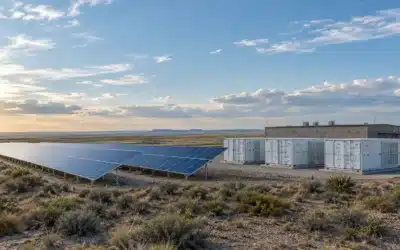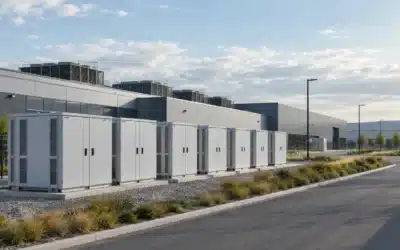
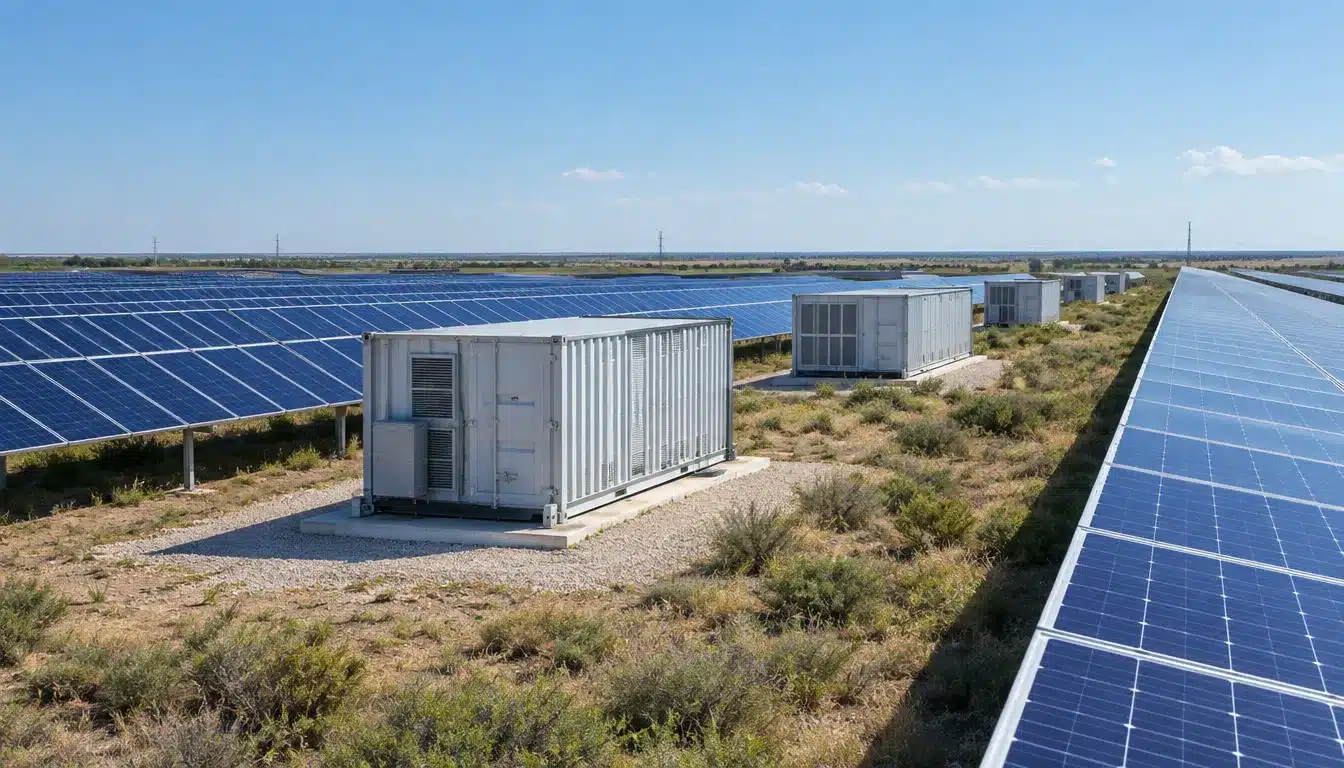
The US start-up plugs compact compute units straight into operating solar plants, using power that would otherwise go to waste and sidestepping the long wait for a grid connection.
Rune, a US start-up building modular data centres at solar farms, has raised $40 million in a Series A round led by Spark Capital. The company announced on 16 September that the round takes its total funding to $53.5 million.
Union Square Ventures, Lowercarbon Capital, Activate Capital, Committed Capital, Timeless Partners and Logos Fund also took part. Rune will use the money to scale its compute system, which it calls RELIC. The name is short for Renewable Energy Linked Intelligent Compute.
Compute behind the inverter
RELIC units sit at operating solar plants and connect behind the plant’s inverters. As a result, they bypass the substations and transformers that normally link a solar farm to the grid. The system runs off-grid on direct current, which avoids losses from converting to alternating current.
Rune says a unit installs in 60 minutes and that compute can go live in as little as six weeks. By contrast, grid-connected data centres often wait years for a connection. The company also says the units need no heavy site work, leave no visible footprint and use no water.
The first live deployment sits at a 200MW solar facility in Texas. Rune runs about one megawatt of compute across Texas, California and Massachusetts. Chief executive William Layden has said the pipeline runs to hundreds of megawatts with large power partners.
Selling spare solar as compute
Rune focuses on AI inference, which is the work of running trained models to answer queries. That work suits smaller sites spread across many places. So it fits modular data centres better than model training does, which needs huge clusters in one place.
The business model is simple, too. Rune buys power from the owners of renewable projects and then sells computing capacity to AI labs and start-ups. It uses 128-GPU clusters today and plans to scale to 1,024-GPU set-ups.
The pitch rests on energy that solar plants can’t sell. Rune says solar facilities waste up to 20% of the energy they generate. It puts the total in the US at more than 50 terawatt-hours a year.
“Every solar plant is a latent data center,” said William Layden, co-founder and chief executive of Rune. “The power is already there, sitting idle while AI labs wait years for grid connections that may never come.”
Cost claims and investor view
Rune also claims large savings on the building side. It says RELIC cuts non-compute infrastructure costs by 85% compared with a traditional data centre. On a 100MW deployment, the company puts the saving at $620 million. Those figures are Rune’s own estimates for a site of that size.
Spark Capital sees speed of delivery as the main draw. “Demand for AI infrastructure is growing faster than it can be delivered,” said Santo Politi, founder and general partner at Spark Capital. “Rune deploys compute directly behind the meter at operating solar farms.”
A race for power that is ready now
Rune started in late 2022. Layden previously worked at SoftBank Energy and Cube Hydro. Meanwhile, co-founder and chief technology officer Varun Palivela worked on chip design at NUVIA and Qualcomm.
Palivela frames the problem as one of timing and place. “AI’s power constraint isn’t generation, it’s resource allocation,” he said. In other words, clean power often exists where and when the grid can’t take it.
Several companies now chase the same gap. For instance, TAR recently raised money to build off-grid data centre power in six months. Both firms are betting that fast access to power will win customers.
Rune’s installed base is still small, at about one megawatt. Even so, modular data centres at solar farms give plant owners a second buyer for power the grid can’t absorb. The next test is whether the pipeline turns into hundreds of megawatts of working compute.