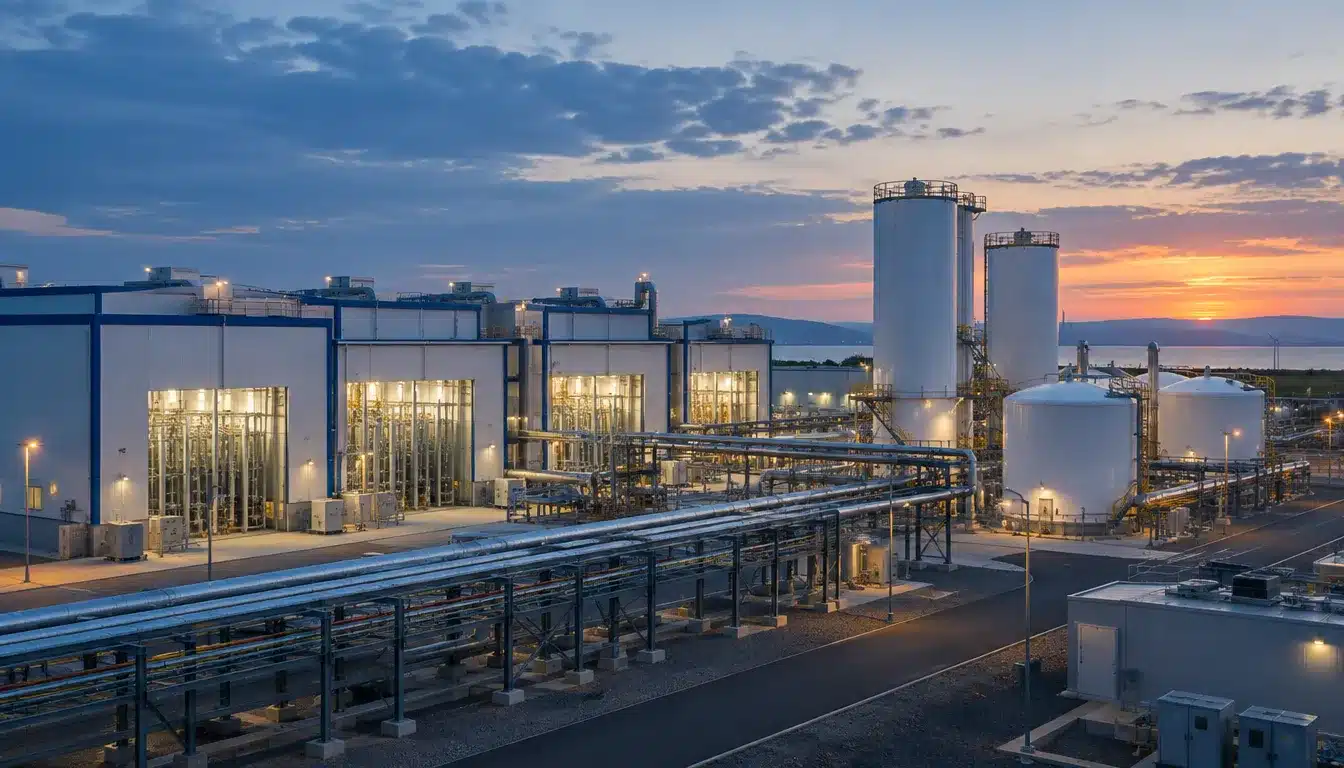
The Hydrogen Council counts more than $130 billion of committed investment across over 570 projects, with nine in ten of them either under construction or already running.
The Global Hydrogen Compass 2026 was published on 10 September. Committed investment has passed $130 billion, corresponding to 6.9 million tonnes a year of committed capacity. Around 570 projects make up that total.
The share already built is the more useful figure. Nine in ten of those projects are under construction or operating. Global operational capacity has nearly doubled over the past year, and the Council expects it to double again next year as sites come online.
Where the capacity sits
China holds more than half of global committed renewable hydrogen capacity. It also accounts for 90 per cent of new operational capacity added since 2025. Europe comes second, leading on project count and on relative investment growth, up 35 per cent since 2025.
The United States leads a different category. It holds roughly 75 per cent of global committed low-carbon hydrogen and ammonia capacity. So the split between electrolytic and gas-derived routes is also a geographic split.
Policy decides where projects land
The report puts potential 2030 demand that existing policy could unlock at 11 million tonnes a year. Only about 6 million tonnes is firmed by policies actually enacted and enforced. The remaining 5 million tonnes depends on governments delivering what they have already promised.
For policymakers, the Council asks for incentives, mandates and carbon pricing that create a demand signal. For companies, the task is serving that demand at a cost buyers will accept. Infrastructure sits between the two.
Jaehoon Chang, Vice-Chair of Hyundai Motor Group and Co-Chair of the Hydrogen Council, said: “The debate has shifted from whether hydrogen can deliver to how fast countries choose to build. While the pace varies by market, the principle is the same: identify where hydrogen creates the most value, build the ecosystem around it and prove it works.”
How to read the numbers
The Compass was written with McKinsey and Company and draws on the views of about 70 chief executives. It is an industry publication, so its framing favours deployment. Even so, the project-level data is the clearest available picture of what has reached construction.
Ivana Jemelkova, CEO of the Hydrogen Council, said: “Decision-makers need both robust market data and practical experience from those delivering projects on the ground. Global Hydrogen Compass 2026 complements the IEA’s Global Hydrogen Review by bringing together the collective perspective of industry leaders.”
Cancellations have been a steady feature of hydrogen news for two years. Counting only committed projects removes much of that noise. The test now is whether the second doubling arrives on schedule.