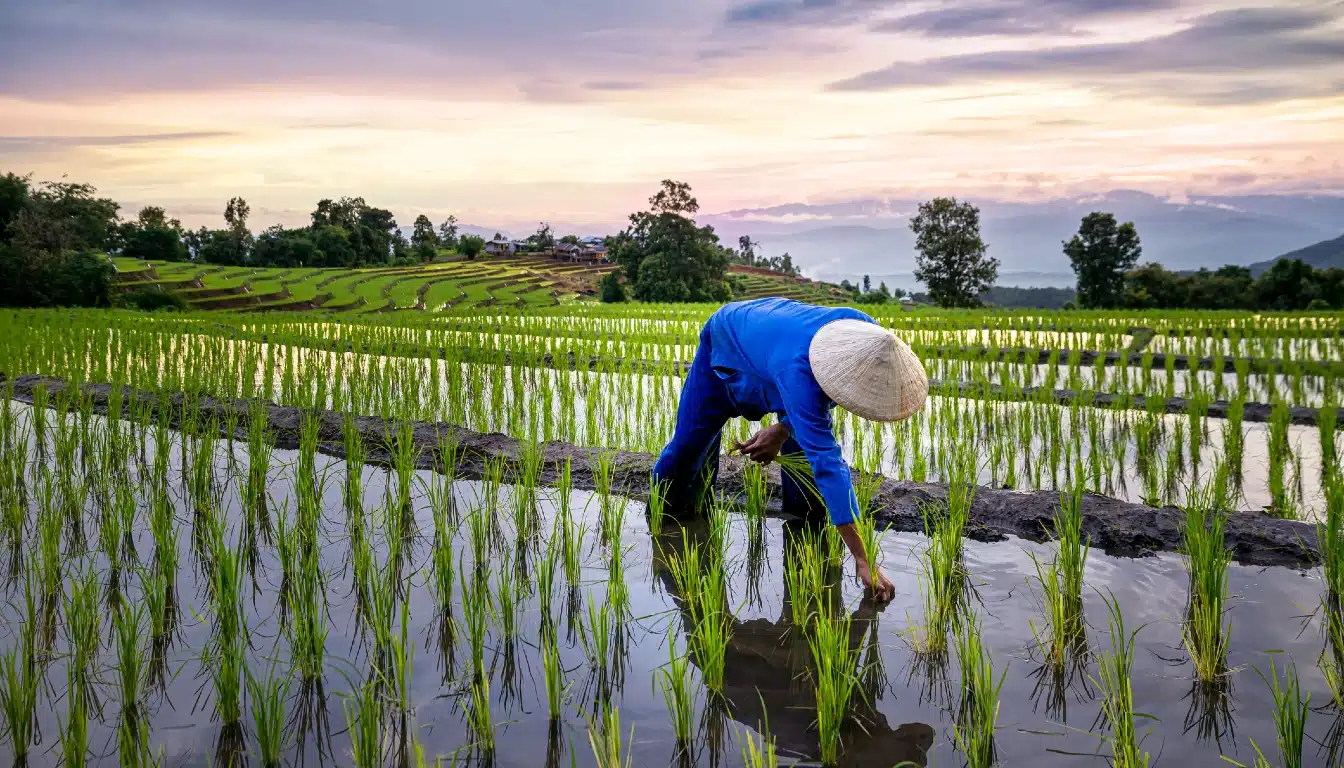
The Japanese climate tech company and the nature capital investment manager have signed a memorandum of understanding to test whether rice methane projects can scale across Vietnam’s paddy regions.
Green Carbon has signed a memorandum of understanding with New Forests Asia to assess whether carbon credit projects can be expanded across Vietnam’s rice-growing regions. The projects would cut methane emissions by changing how paddy fields are watered.
Under the agreement, Green Carbon brings project development capability in Vietnam while New Forests assesses the investment case using its nature capital expertise. The two will jointly evaluate potential sites, business models and the prospects for scaling. The area under consideration ranges from roughly 50,000 to 180,000 hectares.
How alternate wetting and drying works
Rice paddies are usually kept flooded through the growing season. Waterlogged soil starves microbes of oxygen, and the ones that thrive in those conditions produce methane. Alternate wetting and drying lets fields dry down to a set water level before they’re flooded again, which interrupts the process.
Green Carbon says the method can cut water consumption by as much as 30%, and is expected to reduce methane emissions from paddies by between 30% and 70% while holding yields steady. So the agronomy is reasonably well understood. The harder questions are measurement, monitoring cost and farmer uptake across a large area.
The crediting route is still open
Neither company has picked a crediting scheme yet. The options under consideration include Japan’s Joint Crediting Mechanism, an approach aligned with Article 6.2 of the Paris Agreement, and the voluntary carbon market. That decision will shape who can buy the credits and what price they command.
A sovereign-to-sovereign route under Article 6.2 or the Joint Crediting Mechanism would put the credits into compliance accounting, where demand is set by government targets. The voluntary market is faster to reach but has been paying less for agricultural methodologies, so the choice carries real commercial weight.
What happens next
Green Carbon is already developing projects covering roughly 8,000 hectares in Can Tho City and another 2,000 hectares in Phu Tho Province. The pair will look at further opportunities, particularly in the Mekong Delta.
The memorandum remains at the evaluation stage. If feasibility studies, due diligence and other pre-project assessments go well, the companies will consider deploying capital from 2027 onwards. Until then the headline hectare range is a statement of ambition rather than a committed pipeline.