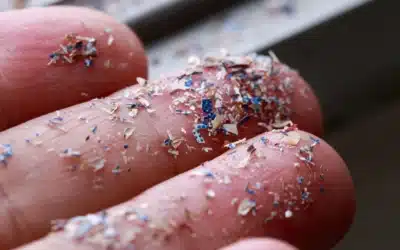

Researchers at the Shenzhen Institutes of Advanced Technology have developed a plastic that carries living bacteria inside it. When triggered, those bacteria wake up and consume the material from within. The result is complete degradation, with no microplastic residue left behind.
The study appears in ACS Applied Polymer Materials. It describes a polycaprolactone matrix embedded with dormant spores of engineered Bacillus subtilis. Under normal conditions, the material behaves like standard plastic. Apply a trigger, and the spores activate.
How the Bacterial System Works
The design relies on two bacterial strains working in sequence. The first produces an enzyme that cuts long polymer chains into shorter fragments. This creates new entry points throughout the material. A second enzyme then attacks those fragments from their ends. Together, the two strains accelerate breakdown until only small molecules remain.
This two-stage mechanism addresses a well-documented problem with many biodegradable plastics. Standard biodegradables often fragment before fully disappearing. Those fragments persist in soil and water as microplastics. The Shenzhen material, according to the research team, degraded completely without leaving such residues.
Polycaprolactone is a relatively easy-to-degrade polyester. It already appears in 3D-printing filaments and dissolvable surgical sutures. It is some distance from the polyethylene, polypropylene, and PET that dominate global plastic waste. Even so, the experiment produced a useful baseline result. The spore-embedded film retained mechanical properties comparable to standard polycaprolactone. Adding living bacteria did not weaken the material during its active life.
Activation Still Requires Laboratory Conditions
The trigger conditions remain tightly controlled. In the experiment, researchers placed the plastic in warm nutrient broth at approximately 50 degrees Celsius. The spores then activated, and the film fully broke down within six days.
Those conditions are far from anything encountered in the natural environment. A discarded piece of living plastic would not degrade in a landfill, a river, or a compost bin. Activation requires deliberate intervention. That constraint limits near-term applications but also reduces one concern: premature degradation during use or storage.
The team also produced a wearable electrode from the living plastic. It detected muscle signals from a human arm. When triggered, the electrode degraded in approximately two weeks. The copper circuitry remained intact. That separation of degradable polymer from recoverable metal points to a potential approach for handling disposable electronics, where mixed materials currently complicate recycling.
Where This Sits in the Wider Research Field
The Shenzhen work draws on a growing body of synthetic biology research. A 2019 study in Nature Chemical Biology showed that Bacillus subtilis spores could survive inside 3D-printed materials and respond to surface changes such as cracks. More recent research in Nature Chemical Engineering found that spore-based living plastics can endure high temperatures and organic solvents. That finding is relevant for industrial processing environments, where standard biodegradable materials often fail.
The Shenzhen prototype is a proof of concept. It does not yet address the plastics that make up the largest share of global waste. Scaling the approach to commodity polymers, and developing practical activation systems outside the laboratory, will require substantial further work.
For investors and policymakers tracking plastic pollution, the relevant question is whether on-command degradation can eventually integrate into product design at scale. Short-lived products are a major source of environmental contamination. These include medical devices, wearable sensors, agricultural films, and single-use packaging. A material that remains stable during use and then degrades completely on instruction could reduce end-of-life disposal costs and regulatory liability.
The research does not yet provide an answer to that question. What it does provide is evidence that living materials can degrade completely, retain functional properties during use, and be built into electronics applications. Each of those results was previously uncertain.
Climate and biodiversity specialists have long identified microplastic contamination as a compounding environmental risk. Polymer fragments accumulate in marine ecosystems, agricultural soils, and human tissue. Complete degradation, rather than fragmentation, is the standard that regulators and researchers increasingly demand. The Shenzhen study shows one credible path toward meeting it, even if the distance to commercial application remains considerable.