The Haber-Bosch process, developed in 1914, is one of the most consequential inventions in human history. By enabling the large-scale synthesis of ammonia from nitrogen and hydrogen, it made modern agriculture possible.
Today, ammonia-derived fertilisers feed roughly half the world’s population. But ammonia’s strategic importance is no longer confined to food production. It is emerging as a leading candidate for zero-carbon maritime fuel, a viable carrier for transporting hydrogen across long distances, and a potential energy storage medium for renewable power systems. Each of those roles has gained urgency as repeated fuel supply shocks, driven by geopolitical disruption across critical energy corridors, have exposed the fragility of fossil-fuel dependence in global supply chains.
Against that backdrop, the fact that ammonia production itself accounts for close to 2% of global greenhouse gas emissions and has seen little fundamental change in a century presents both a problem and an opportunity of considerable scale.
Karen Baert, chief executive and co-founder of San Francisco-based Ammobia, believes the solution lies not in replacing Haber-Bosch but in reinventing it. The company calls its approach Haber-Bosch 2.0. In January, it closed a $7.5 million seed round backed by Shell Ventures, ALIAD (Air Liquide’s venture arm), Chevron Technology Ventures, and MOL Switch, the venture capital arm of Japanese shipping group Mitsui OSK Lines.
The ammonia opportunity
Ammonia is the second most-produced chemical on Earth. Its established market, centred on nitrogen fertiliser, is valued at around $100 billion annually. But the emerging applications are driving projections of substantial growth. Ammobia’s investor materials place the addressable market at $400 billion as ammonia expands into clean fuel and energy carrier roles. The International Energy Agency projects that ammonia could account for 8% of marine fuel demand by 2030 and as much as 46% by 2050, as the shipping industry works to meet the International Maritime Organisation’s net-zero target for the global fleet.
The case for ammonia as a maritime fuel rests on a practical advantage: unlike hydrogen, it can be stored and transported in liquid form at relatively modest pressures, using infrastructure that partially overlaps with existing LPG and chemical logistics networks. As a hydrogen carrier, it offers a route to moving green hydrogen produced in regions with abundant renewable resources to industrial centres far from those sources. Both functions depend on the same underlying condition: that ammonia can be produced at competitive cost and with substantially lower emissions than today’s standard process allows. That is the gap Ammobia is trying to close.
Why conventional ammonia is so hard to decarbonise
The conventional Haber-Bosch process runs at around 200 bar of pressure and temperatures between 500 and 600 degrees Celsius. Those extreme conditions demand enormous capital expenditure, centralised production at scale, and feedstocks tied almost entirely to natural gas or coal. “Building a new ammonia plant is around a billion dollar plus investment,” Baert told Climate Solutions News. “An ammonia complex is a type of complex that takes you a few minutes to drive around it.”
That physical and economic scale has made meaningful innovation difficult. The industry has spent a century optimising around the same basic chemistry rather than questioning it. When Ammobia was founded four years ago, Baert says there was only one other startup globally working on new approaches to ammonia production. The field has since grown, with some companies pursuing electrochemical routes better suited to small-scale applications. But Ammobia’s thermochemical path, with its sharp reduction in operating conditions, remains largely uncontested territory.

Ammobia co-founders Karen Baert (right) and Tristan Gilbert.
What Ammobia actually does differently
Ammobia’s innovation centres on new materials added to the ammonia reactor. Those materials allow the synthesis to proceed at pressures between 20 and 60 bar rather than the conventional 200 bar, and at temperatures around 150 degrees Celsius lower than today’s standard.
The result is a production unit that Ammobia estimates can be built at roughly half the capital cost of a conventional facility. “Simply because of the lower temperatures and pressures, you can use less materials, cheaper materials, less compressors, cheaper compressors,” Baert said.
The technology is also designed to be modular. Where today’s ammonia plants require vast centralised sites, Ammobia’s system is built in standardised skids that can be transported, stacked, and deployed close to the point of demand. That modularity is not merely a logistical convenience. It addresses one of the less visible inefficiencies of the current supply chain: by the time ammonia produced at a centralised facility reaches an end customer via ship or truck, its effective cost can be two to three times the production price. Smaller plants sited near demand cut that burden substantially.
Cost is winning the argument
Asked whether cost reduction or emissions reduction is the more compelling case to potential customers, Baert was direct. “In the current macro environment, cost is certainly the first thing that people care about.” That is consistent with a broader pattern in industrial decarbonisation: clean technologies that cannot compete on price face an uphill commercial battle regardless of their environmental credentials.
Ammobia’s argument is that the two goals are not in conflict. Proximity to demand already makes its process cost-competitive in many scenarios. Beyond that, recent volatility in fossil fuel markets has shifted the calculation further. Supply disruptions driven by geopolitical instability have pushed conventional ammonia prices upward while projections for the cost of clean ammonia production have continued to fall. “For the first time in history,” Baert noted, “the traditional ammonia produced from natural gas or coal in many places in the world is more expensive than the clean ammonia projections for some of the first large clean ammonia plants in China, the Middle East, and elsewhere.”
The company’s first commercial system, targeting revenue-generating deployment with a customer, is scheduled for 2028. A pilot facility at TRL 6, the technology readiness level for full-scale prototype demonstration, is expected to be operational this summer.
A market on the verge of expansion
The maritime transition from fossil fuels is moving faster than sceptics predicted a decade ago. Baert points to tangible evidence. Belgian shipping company Exmar named the world’s first ocean-going ammonia dual-fuel vessels, Antwerpen and Arlon, at HD Hyundai’s Ulsan shipyard in April, with delivery scheduled for later this year. HD Hyundai has secured orders for eight ammonia-fuelled ships in total. The two Exmar vessels are the first of a four-ship series and mark the culmination of a joint development programme launched more than three and a half years ago.
“There’s something about the maritime industry,” Baert said. “We need to decarbonise by 2050, and 2050 is one ship lifetime away. It’s literally around the corner.” The pace of ordering suggests the industry has absorbed that logic. With established fertiliser demand providing a stable commercial base and energy applications accelerating, the structural case for low-cost, low-carbon production grows stronger by the year.
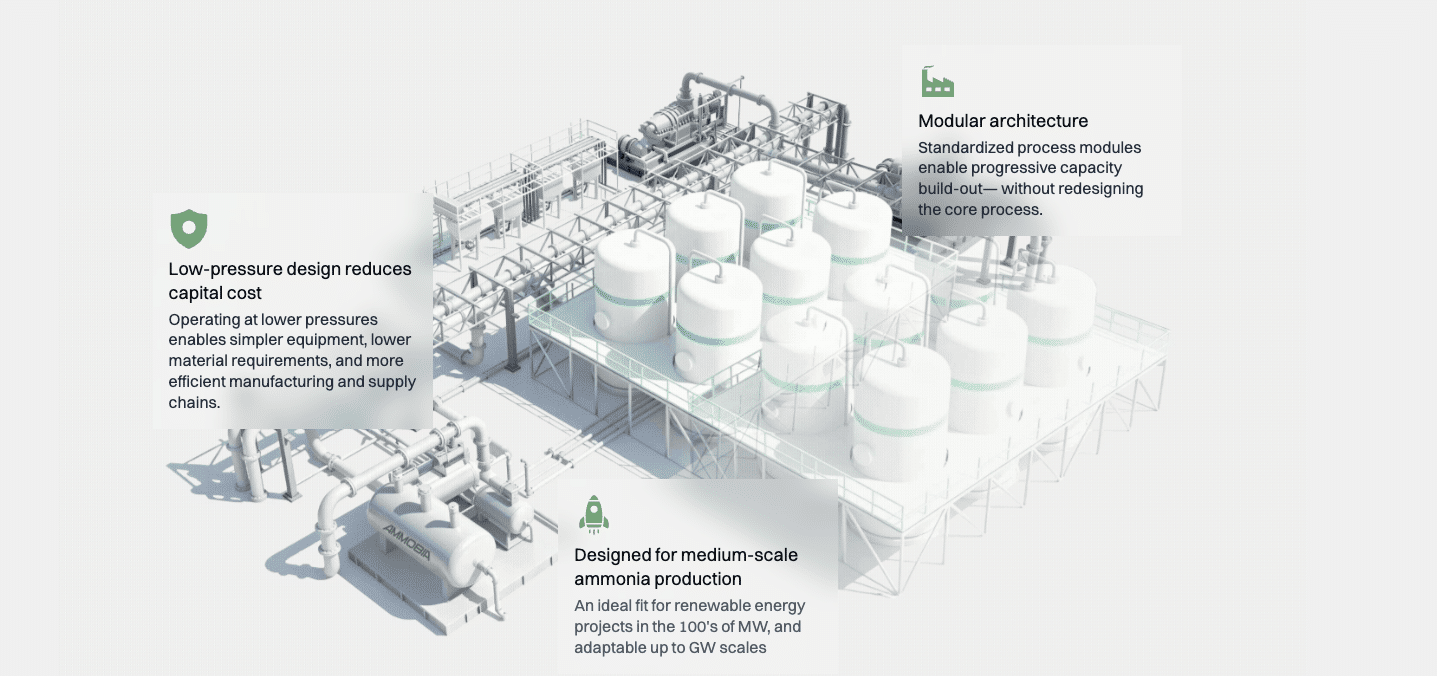
Ammobia’s process is modular by design and scalable by demand.
Why the investor mix matters
The strategic composition of Ammobia’s seed round reflects the company’s position across several converging industries. ALIAD, as a major industrial gas supplier, is a potential hydrogen feedstock provider and eventual off-taker. Shell and Chevron bring experience operating thermochemical plants and are positioning for a role in the ammonia sector as it scales. MOL Switch’s interest is explicit: its parent company Mitsui OSK Lines is preparing for a future in which ammonia is a primary bunker fuel. “They want to play a role in that industry,” Baert said. “And they see it as a competitive advantage to have access to a technology like Ammobia’s.”
That alignment of commercial interest is, she argues, a feature rather than a coincidence. For a startup operating at the intersection of chemicals, energy, and logistics, incumbents are not obstacles to be disrupted but partners whose participation accelerates market adoption and reduces deployment risk.
From Belgium to Stanford to the lab
Baert grew up in Belgium and describes her early ambition as straightforward: she wanted to preserve the ocean. A competitive sailor, she had a visceral sense of what was at stake environmentally. It was at Stanford, where she completed an MBA while her co-founder was finishing a PhD, that the professional path crystallised. The two met through the university’s hydrogen student club and, in Baert’s telling, recognised both shared objectives and complementary skill sets immediately.
Ammobia was named a 2025 World Economic Forum Technology Pioneer. Baert and co-founder Tristan Gilbert were included in the Forbes 30 Under 30 Manufacturing and Industry 2024 list. In 2025, Baert won Scientist of the Year at the Women in Energy Transition Awards and first place in the Women in Clean Tech and Sustainability Pitch Competition, recognition she was quick to redirect. “The scientist award is really a tribute to the entire Ammobia team,” she said, “and all the scientists and engineers working hard in the lab every day to advance our technology.”
The longer arc
Ammobia’s goal is to have multiple commercial projects running from different feedstocks and in different geographies by 2030. The ambition is to prove that low-cost, low-carbon ammonia is achievable not as a niche premium product but as a mainstream industrial input, available at any scale and independent of volatile fossil fuel supply chains.
The Haber-Bosch process earned its inventors Nobel Prizes because it solved a problem that had constrained human civilisation for millennia. The pressure to solve its successor problem, what to do about the emissions that process now generates, is building with comparable urgency. Whether material science and modular engineering can answer it at the pace and scale required remains to be seen. But the investor backing Ammobia has assembled suggests the industry is beginning to treat the question as urgent rather than theoretical.