The Sherbrooke start-up has shipped its first batch of carbon dioxide pulled from the air to a local fuels developer, testing whether direct air capture can supply feedstock as well as storage.
Skyrenu Technologies has delivered its first batch of carbon dioxide from its direct air capture technology to Secant Fuel. Secant makes synthetic fuels and low-carbon chemicals. Both companies are based in Sherbrooke, in Quebec’s Eastern Townships, and grew out of research at the Université de Sherbrooke.
The delivery deepens an existing working relationship between the two firms. It also points to a use for captured carbon other than storing it underground. Secant Fuel will use the gas as a feedstock for its conversion process.
A demonstration backed by Sherbrooke Innovante
The shipment came out of a technology demonstration. Skyrenu demonstrated its modular, low-energy systems for capturing carbon dioxide from the air. Meanwhile, Secant Fuel ran its own technology to convert that carbon into products.
Sherbrooke Innovante funded the demonstration through its Vitrine technologique stream. The programme supports businesses in the industrial and technology sectors. Together, the partners want to show how captured carbon dioxide can feed technologies that turn carbon into fuels and chemicals.
Built for low concentrations
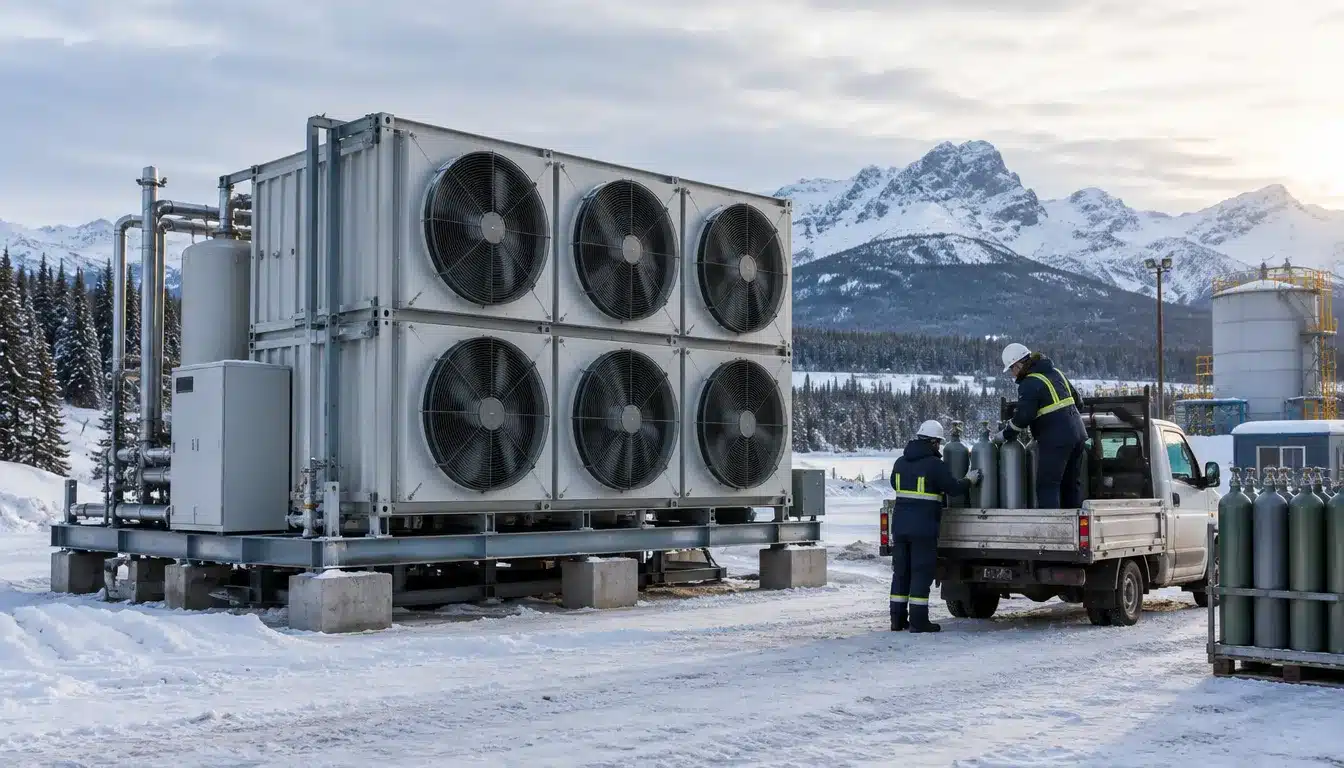
Skyrenu designs its direct air capture technology for places where carbon dioxide is dilute. So the units can pull the gas straight from the air or from dilute industrial emissions. The output is concentrated, high-purity carbon dioxide. Because the units are modular, operators can add capacity in steps.
That purity gives buyers options. The gas can go into products, as with Secant Fuel, or into permanent storage away from the atmosphere.
Skyrenu already runs its first unit at Deep Sky Alpha in Innisfail, Alberta. Deep Sky, a Montreal-based carbon removal developer, calls the site Canada’s first carbon removal commercialisation centre. In August 2025, the two companies stored carbon dioxide from direct air capture underground. They described it as a first for North America.
Gabriel Vézina, Skyrenu’s co-founder and chief executive, marked that moment at the time. He said the firm was proud to be “the first Quebec-based DAC technology to capture CO₂ for permanent storage in North America”. By then, Deep Sky had raised $130m from backers including Investissement Québec, Breakthrough Energy Catalyst and BMO.
The company is now working on a larger system. That unit should be able to capture up to 125 tonnes of carbon dioxide a year.
From captured air to fuel
For Vézina, the new delivery shows what captured carbon can become. He said “carbon pulled directly from the air can become the raw material for tomorrow’s fuels and chemicals”. He added that bringing two complementary technologies together “accelerates the transition to a low-carbon economy”.
Jochem Kamstra, chief executive of Secant Fuel, struck a more measured tone. He said partnerships like this help explore how “complementary technologies could fit into the broader carbon value chain”. Secant is still working towards commercial deployment.
Small volumes in an early market
The announcement didn’t say how much carbon dioxide changed hands. Even so, the delivery links capture and use in a working supply chain.
Direct air capture remains costly and small in scale. Much of the demand so far has come from buyers of carbon removal. Supplying fuel makers gives developers a second possible market. However, fuels made this way release the carbon again when burned, so they cut emissions without removing carbon for good.
That makes the climate case for such fuels depend on what they replace. Synthetic fuels made with air-captured carbon can stand in for fossil fuels in sectors that are hard to electrify. As a result, early supply deals like this one help test demand before larger plants come online.
Skyrenu’s roots lie in student work. In 2021, it won the student competition of the XPRIZE Carbon Removal contest. It also reached the top 20 finalists in the main competition. For wider context, see how direct air capture moved from the margins to the main stage.