Researchers at Nanyang Technological University have built a solar-powered artificial leaf that produces hydrogen from seawater while breaking down hydrazine, a toxic pollutant found in industrial wastewater.
A team at Nanyang Technological University (NTU) in Singapore has presented an artificial leaf that makes hydrogen from seawater using only sunlight. The device also destroys hydrazine, a highly toxic chemical found in some industrial wastewater. So it tackles clean fuel production and pollution clean-up in one step.
The researchers published the work in Nature Communications. Professor Lydia H. Wong of NTU’s School of Materials Science and Engineering led the team.
Why seawater is hard
Most electrolysers split fresh, purified water. Seawater is far more plentiful, but its salt causes trouble. When an electric current runs through it, chloride ions tend to form chlorine compounds that are corrosive and toxic.
Those compounds eat away at electrodes and create a waste problem of their own. As a result, producing hydrogen from seawater usually needs expensive desalination first, or electrodes that resist corrosion.
Freshwater supply is already a concern for planned hydrogen hubs in dry coastal regions, including parts of Australia, the Middle East and North Africa. Using seawater directly would ease that pressure. It would also suit island states such as Singapore, which has a national hydrogen strategy but limited fresh water.
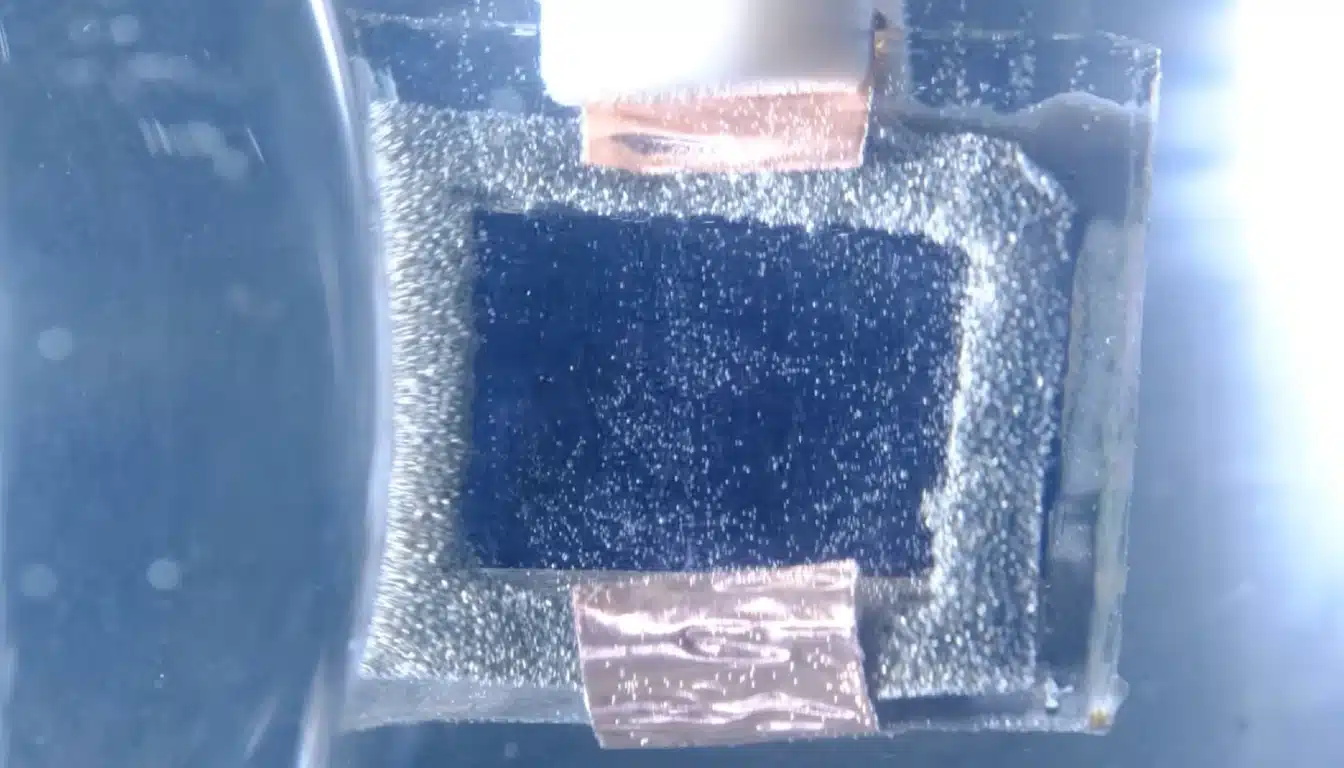
The NTU design sidesteps much of this. The team fitted the anode with a catalyst that breaks hydrazine down into hydrogen and nitrogen. At the same time, the reaction suppresses the formation of chlorine compounds.
A perovskite cathode
On the other side of the device, the researchers built the cathode from lead halide perovskites. These crystalline materials absorb light well and turn it into electricity cheaply. They have drawn huge interest in solar research over the past decade. Manufacturers can also process them from solution at low temperatures, which keeps costs down.
Here, the perovskite photocathode reached a photocurrent density of 25 milliamps per square centimetre. Photocurrent density measures how much current the device produces per illuminated area. The team says the figure is one of the highest reported for lead-based perovskite cathodes.
The device also held stable output for more than 72 hours under light equal to full sunlight on a clear day. Meanwhile, it produced hydrogen at a rate comparable to similar solar-powered devices.
Cleaning water as it works
Because the leaf runs without an external voltage, it is self-powered. Put simply, sunlight alone drives both reactions, with no electricity drawn from the grid or a battery. In tests, it degraded hydrazine to below one part per billion within about 30 hours. In effect, the device removed almost all of the pollutant from the test solution.
Hydrazine is used in industrial processes, including chemical manufacturing, and as a rocket propellant. It is toxic to people and aquatic life, so wastewater containing it needs careful treatment. A device that removes it while making fuel could turn a disposal cost into a small source of value.
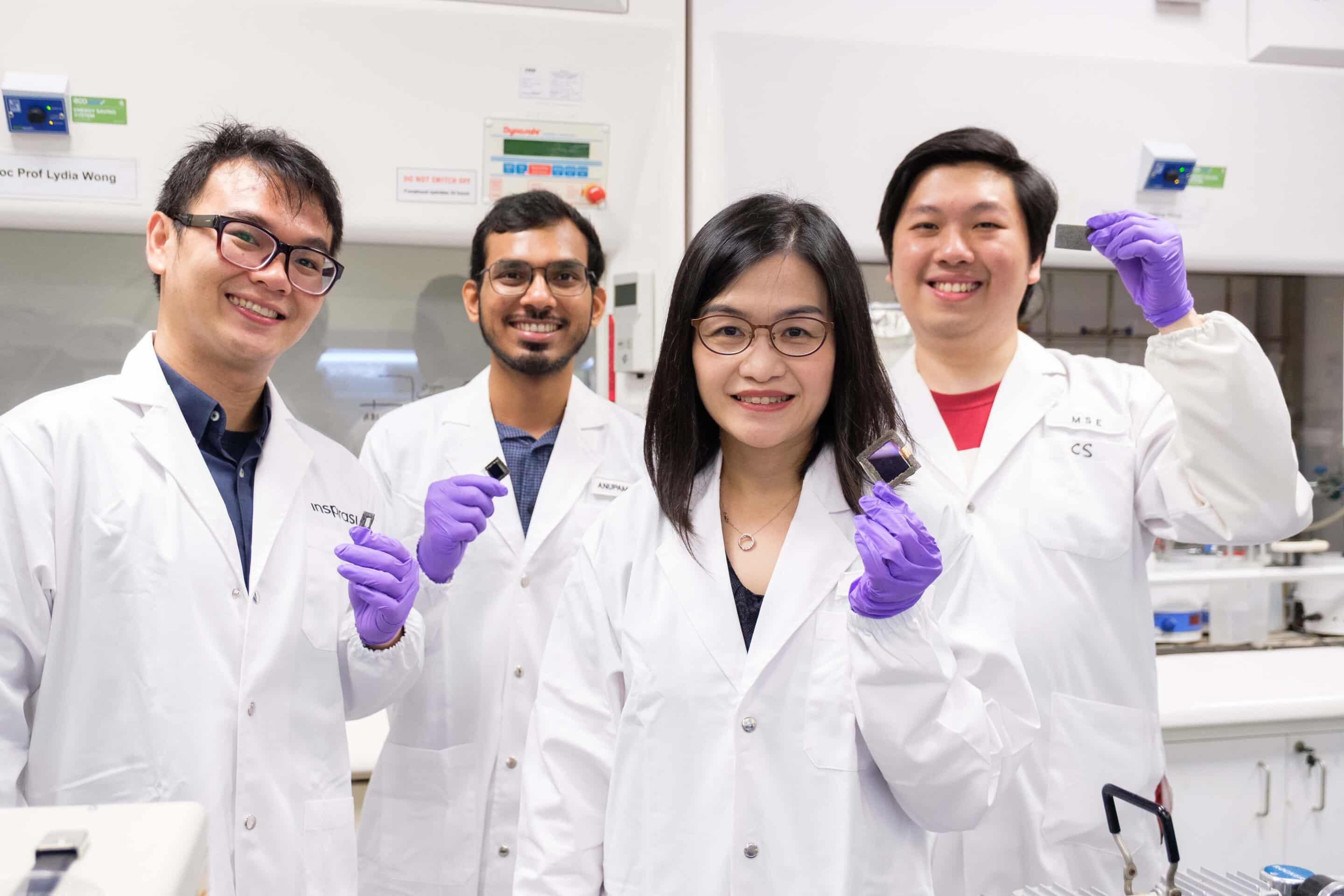
The researchers behind the innovation. From left: Dr. Stener Lie, Dr. Anupam Sadhu, Prof Lydia H. Wong and Dr. Hao Zhe Chun of NTU’s School of Materials Science and Engineering. Credit: NTU Singapore
Hurdles before scale-up
The results are laboratory-scale, and several big questions remain open. Perovskites have a known weakness: they degrade when exposed to moisture, heat and long periods of light. Three days of stable operation is a strong result for this class of material, although commercial systems need to run for years.
The use of lead also raises questions for any device designed to sit in water. Engineers would need to show that the material stays sealed over long periods. In addition, scaling small lab cells to large panels usually cuts efficiency.
Still, the work adds to a growing set of approaches to direct solar hydrogen production, including layered solar materials that speed up water splitting. For coastal industrial sites, making hydrogen from seawater while treating polluted water is an attractive combination. The next step is to prove that the concept can survive real conditions outside the lab.