Researchers in the US and Israel have shown a battery-style carbon capture cell that ran for 5,000 hours and scaled to a nine-cell stack, bringing electrochemical capture closer to real-world use.
A battery-style device for electrochemical direct air capture has run for 5,000 hours in the lab, a new study shows. Researchers at the University of Delaware and Israeli start-up RepAir DAC published their results in Nature Energy on 22 September. Four of the nine authors work at RepAir, which is based in Zichron Ya’akov, Israel. Five others, including chemical engineer Yushan Yan, are at Delaware.
The team used cells built around nickel hydroxide electrodes and a hydroxide exchange membrane. The device pulls carbon dioxide from the air and runs on electricity alone. By contrast, most large capture plants today use heat to release the carbon dioxide they trap.
How the cell works
The device is a symmetric cell, which means both electrodes use the same material. At one electrode, nickel oxyhydroxide turns into nickel hydroxide. At the other, the reverse reaction takes place.
Those reactions create hydroxide at one side of the cell and consume it at the other. As a result, the cell sets up a pH gradient across the membrane. Air flows past the alkaline side, where carbon dioxide reacts and dissolves. The cell then releases the gas on the other side as a concentrated stream.
Because both electrodes share the same chemistry, the cell’s resting voltage is zero. In an earlier preprint, the team explained that most of the voltage goes into building the pH gradient. The rest drives the electrode reactions.
From one small cell to a stack
The study first tested a small lab device with an area of 25 square centimetres, a square five centimetres on each side. It ran for 5,000 hours, which gives an early read on how long the electrodes and membrane last. Durability is often where new capture chemistries fall down.
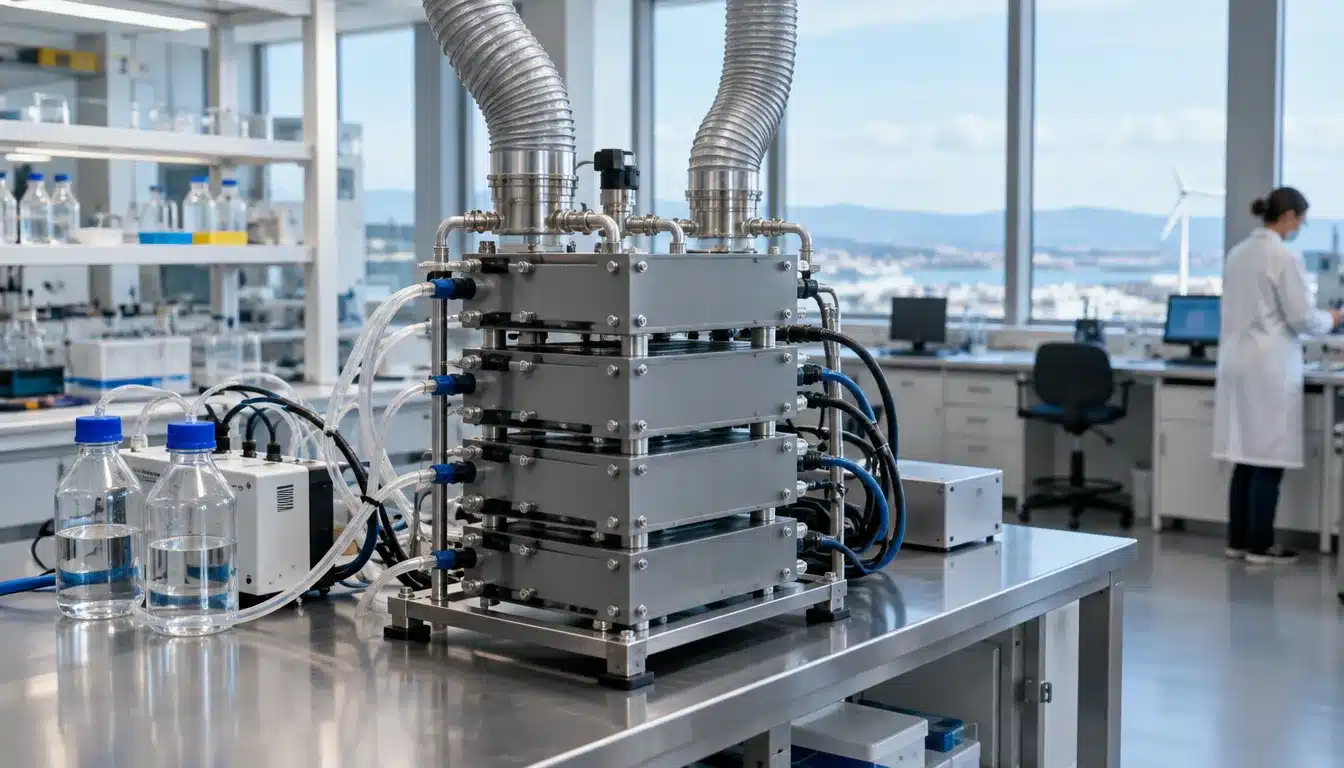
The team then scaled up to a stack of nine cells, each 300 square centimetres. That stack captured carbon dioxide at an energy cost of 132 kilojoules per mole. That works out at roughly 0.83 megawatt-hours per tonne. The stack’s capture rate reached 0.19 moles of carbon dioxide per square metre per hour.
Crucially for real plants, the stack met the pressure requirements for moving large volumes of air. Fans that push air through a capture unit use energy, so a low pressure drop keeps running costs down. The preprint put the scaled system’s pressure drop below 300 pascals, ten times lower than the lab cells.
A path below $100 a tonne
The authors say the design points to costs below $100 per tonne of carbon dioxide removed. That figure has long served as an industry benchmark for direct air capture at scale. However, the paper sets out a pathway, and a working plant has yet to prove it.
The preprint also compared energy use with an incumbent design from Carbon Engineering. It cited 1.47 megawatt-hours per tonne for that process. The published stack result sits well below that figure, although the two systems differ in maturity and scale.
What electrochemical direct air capture still needs
Energy is one of the biggest running costs for any capture plant. That is why electrochemical direct air capture draws interest. A device that runs on clean electricity, without high-temperature heat, could sit next to wind or solar farms. It could also switch on when power is cheap and idle when it is not.
Still, 5,000 hours is less than seven months of continuous running. A commercial plant would need its cells to last for years. The nine-cell stack is also far smaller than the modules a plant would use.
Even so, the result adds to a growing field. The wider direct air capture sector is moving from pilots towards larger plants. For electrochemical direct air capture, the next test is a larger pilot that runs for months outside the lab.