
Holly Turner and Duncan Hale from Schroders Capital spoke to Climate Solutions News ahead of Reset Connect London 2026, at Excel London on 23 and 24 June. The conversation ranged across the firm’s contrarian bet on green hydrogen, the funds that channel pension and wealth money into the energy transition, the rising priority of climate adaptation, and how shifting European regulation will test what counts as a sustainable investment.
Green hydrogen has had a punishing few years. Project cancellations, cost overruns, and demand that failed to arrive on schedule have cooled much of the early enthusiasm. Investors who piled in during the hype have since pulled back. So it is striking to find one of the larger institutional players in the energy transition treating the dip as a reason to commit, not retreat.
Schroders Greencoat is the energy transition infrastructure arm of Schroders Capital, the private markets business of the FTSE 100 asset manager. Duncan Hale, a portfolio manager there, takes a deliberately unexcitable view of an asset class that has swung between extremes. “Hydrogen’s obviously a very interesting and in some ways emotive topic,” he says. “Over the last three or four years it’s been through real waves of euphoria and then…. what’s the opposite of euphoria…..?” Through all of it, he argues, the firm’s approach has remained consistent.
Building Close To The Customer
That approach starts with a physical fact. Hydrogen is, in Hale’s words, “a molecule and in many cases it’s a hard molecule to move around a system.” Transport and storage are where the economics often break. So the firm builds production close to where the hydrogen gets used, locks in a buyer, and treats the resulting cash flow as the point of the exercise.
The clearest example is in Cumbria. Schroders Greencoat and developer Carlton Power have reached a final investment decision on the Barrow Green Hydrogen Project, a 30MW plant that will supply hydrogen to a nearby Kimberly-Clark factory. The site makes Andrex and Kleenex, and its paper-making needs high-grade heat that has historically come from burning gas. The hydrogen will replace much of that. According to Schroders Greencoat estimates, the plant could cut the factory’s natural gas use by up to 50% and reduce CO2 emissions by around 18,300 tonnes a year.
Hale describes the logic. “We’re building a project close to a Kimberly-Clark factory, where they make Kleenex,” he says. “They do need quite high grade heat. And historically that high grade heat has come from burning gas.” The plant pumps hydrogen directly to the factory as a gas substitute. “It’s fantastic from a Kimberly-Clark perspective, in the sense that it allows them to decarbonise parts of their supply chain.”
The Subsidy-To-Parity Bet
Barrow is the first project that the Schroders Greencoat and Carlton Power joint venture, Green Hydrogen Energy Company, has taken into construction. It runs on a Contract for Difference, a government-backed agreement that fixes a price for the hydrogen and so gives investors the contracted revenue they need. Hale frames the subsidy as a temporary scaffold rather than a permanent crutch.
“The government is providing the ability to make that project economical in the short term,” he says, “with the view that that is stimulating the overall supply chain in UK hydrogen, which will hopefully mean that the pricing comes down over time and it becomes more economic to do it with less subsidy.” The model he points to is renewables. “Ten, fifteen years ago it was very, very expensive to build solar and wind,” he says. “But today, in many cases, many places of the world, including in the UK, you are able to build a solar or wind plant without government subsidies.”
For all the conviction, hydrogen remains a small part of the book. Of the products Hale runs on the semi-liquid side, roughly a third of assets sit in wind, a third in solar, and a third in what the firm calls other energy transition assets. Hydrogen is “about a third to a half” of that final slice, so around 10% of the overall portfolio. “It’s a small but growing percentage,” he says, and one “that’s looking to grow over time.”
How The Money Gets Raised
The capital behind those projects comes from funds Hale himself helped set up. In early 2024 Schroders Greencoat launched the Schroders Capital Semi-Liquid Energy Transition Fund, an Article 9 vehicle aimed at defined contribution pension clients that deploys capital across wind, solar, hydrogen and storage in Europe and the US. The semi-liquid structure lets investors put money into otherwise illiquid infrastructure while keeping regular access to their cash. That matters for pension savers who cannot lock up capital for a decade.
A year later the firm added a feeder fund to widen access. The Global Energy Infrastructure Long-Term Asset Fund channels UK wealth clients into the same strategy. “While real assets such as renewables are typically considered illiquid, our semi-liquid and LTAF funds strike a balance by providing regular and transparent access to liquidity,” Hale said at launch. The Drogheda data centre platform sits inside the evergreen Semi-Liquid Global Energy Infrastructure Fund. Through these vehicles, Schroders Greencoat now finances around a third of the projects approved through the UK’s first green hydrogen funding round.
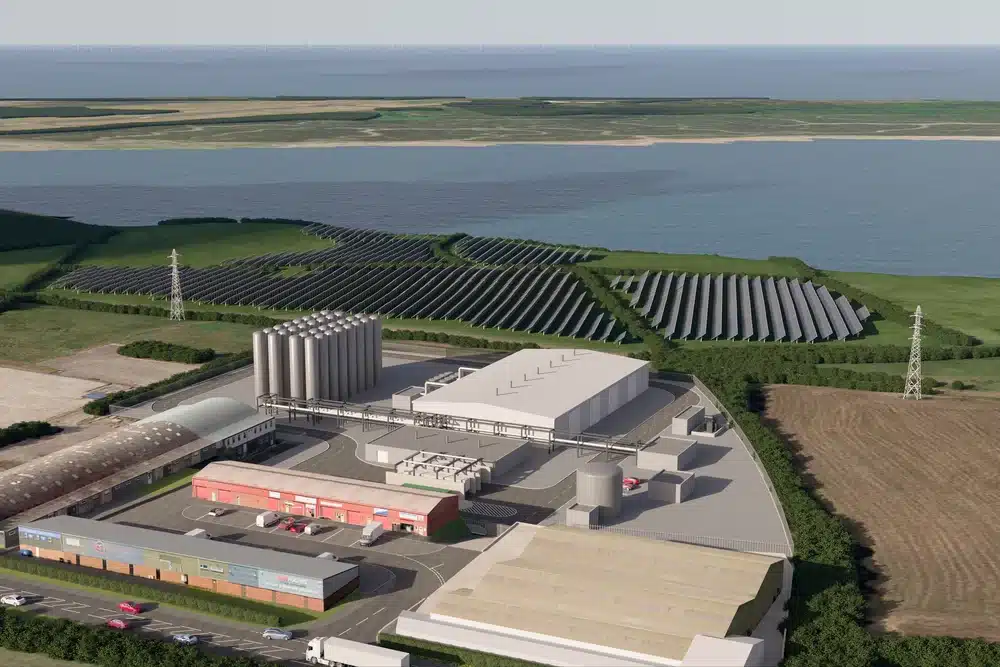
How the Kimberly-Clark facility will look. Picture from Barrow Green Hydrogen.
Where The Capital Goes Next
Hydrogen sits inside a wider map of where climate-aligned money can work. Holly Turner, head of sustainable investments at Schroders Capital, sorts that map into buckets that broadly mirror the EU taxonomy. Low-carbon solutions cover pure-play renewable generation and much of the energy transition infrastructure Hale invests in. Transition covers high-emitting sectors that create value as they decarbonise, financed through the firm’s real estate and infrastructure debt businesses.
The third bucket gets less attention, which is part of why Turner finds it interesting. “Enablers,” she calls them, “financing solutions that enable decarbonisation indirectly” through a product or service. She points to circular economy and efficiency businesses, the kind that “unlock critical bottlenecks within the system.” This is where the firm’s small and mid-market private equity work concentrates. “We can look at professionalising or expanding those businesses to cater for that bottleneck,” she says.
One emerging strand brings hydrogen’s logic full circle, back to electricity demand. Schroders Greencoat has launched a green digital infrastructure platform in Ireland, a 50:50 joint venture with Greencoat Renewables, starting with a site in Drogheda planned for a 36MW data centre. The country is a natural test case. As Hale notes, Ireland is “the data centre capital of Europe,” and around 23% of all Irish electricity goes to data centres, a strain that pushed the government to pause new builds before recently lifting that moratorium. The firm’s pitch is to supply sites with high-quality green electricity so providers can build.
Adaptation Moves Up The Agenda
Turner’s other priority for the year is more sobering. Alongside cutting emissions, the firm is now mapping climate adaptation and resilience as an investable theme, working through its climate insurance and emerging-market private equity portfolios. Those funds look at the protection gap, the difference between insured and uninsured losses from natural catastrophes across developing markets.
“It’s awful having to say it as an opportunity for adaptation and resilience,” she says, “but I do think it’s becoming increasingly critical.” Discussions around physical climate risk have grown, she notes, sending “this bigger signal to the investment community” that adaptation is a space both policy and demand will require more of going forwards.
A More Demanding Definition Of Sustainable
Underneath the deal flow sits a question that has dogged the whole financial sector. How to deal with the fact that ESG labels have been stuck on portfolios that differ only marginally from conventional ones.
Turner’s answer is a tiered internal framework. At one end sits a sustainable “tilt”. Here the sustainability objective applies only to the portfolio as a whole, not to every holding inside it. A fund might aim for a lower average carbon intensity than its benchmark, yet still hold individual companies that would not pass a sustainability test on their own. The target is the overall blend, and individual stocks are judged on how they move that blend rather than on their own merits.
At the other end sits “sustainable driven”, where each individual holding must clear a sustainability threshold before it can go in at all. “You’d have a set of criteria or conditions that then mean that the holding or individual holdings then sit and are qualified under sustainable,” she says. The difference is between a portfolio that looks green on average and one built only from holdings that each qualify in their own right.
She also pushes back on the idea that impact comes at the expense of financial returns. Schroders ran a joint study with Oxford University’s Saïd Business School analysing 257 publicly listed impact companies. “Impact portfolios can generate strong competitive absolute and risk adjusted returns relative to broader unconstrained portfolios,” she says. The firm has since extended that research across private equity and infrastructure debt.
On the political heat around the ESG label itself, her position is that the firm has not retreated. “We haven’t really changed our overall firm position or approach at all,” she says, describing instead a “maturing” that treats sustainability as “a material driver of either value creation or risk management” rather than a moral imperative.
Regulation Tightens The Screws
Europe’s rulebook is shifting under all of this. The current system, set by the EU’s Sustainable Finance Disclosure Regulation, sorts funds using two labels the market treats as shorthand for ambition. Article 8 funds, known as “light green”, promote environmental or social characteristics. Article 9 funds, the “dark green” tier, must have sustainable investment as their core objective. Schroders Greencoat’s flagship energy transition fund sits in the stricter Article 9 category. The Commission now plans to scrap both labels and replace them with new categories, including a dedicated one for transition.
Turner welcomes that move towards more specific product labels, and she is pleased to see the transition category. “We welcome the category generally,” she says. The catch is proof. Transition is hard to evidence because it plays out over time.
“The evidence of transition and over what time scale do you achieve transition is something that will require a very clear articulation and measurement,” she says. It is not, in her words, “a simplistic metric.” Managers will have to show how much transition an asset achieves over the holding period, and what role the manager actually played, whether directly running the asset or merely engaging a company to change. That distinction, between Hale’s hands-on model and lighter-touch engagement, is exactly the kind of detail regulators will want spelled out.

Plenary session of COP30 in Brazil. Picture UN Climate Change. Asset managers need to work together to drive policy change to achieve outcomes on the global stage.
Lobbying By Collective, Not By Megaphone
This leads to questions of macro policy and supra-national momentum and what role asset managers like Schroders Capital can play. Successive COP summits have ended with capital commitments well short of what the transition and adaptation need, and last year’s COP30 in Belém produced no agreed fossil fuel roadmap. Turner is measured about how much any single manager can shift that. “The last couple of COPs have been similar,” she says, continuing to “demonstrate a capital requirement need” centred on the interchange between developed and developing countries.
The firm’s advocacy is targeted rather than noisy. Within Greencoat, she says, “we would identify specific UK policies where we would want to engage on those.” Beyond that, the work runs through membership bodies that “gather a collective response from their set of members”, plus direct feedback to regulators on incoming rules such as SDR and SFDR. “I do think it’s a question that’s coming up a lot more in terms of where to play that role,” she says.
That instinct, to commit early and let the structure do the heavy lifting, runs right back to the Kleenex factory in Cumbria. The market spent three years deciding whether hydrogen was euphoria or disappointment. Schroders Greencoat spent them building a plant with a buyer attached, a contract underneath, and a bet that the subsidy comes off in time. Whether the rest of the sector follows this playbook will determine how the next phase of the transition actually gets funded.