Europe’s vulnerability to disrupted LNG supplies has rarely been clearer. Since late February, Iran’s closure of the Strait of Hormuz has choked off around 20% of global LNG trade. Europe draws roughly 10% of its LNG through the strait, and with gas storage levels across the continent already depleted after a difficult winter, the pressure on policymakers to accelerate domestic renewable gas production is acute.
The EU banned all Russian gas and LNG imports in January 2026, replacing them with global LNG supplies and increased biomethane production. The question is whether that acceleration is happening fast enough, and in the right places.
The French Paradox
France offers a useful case study. It is one of Europe’s leading biomethane producers and has nearly doubled its installed capacity in recent years. In the first quarter of 2026, 818 sites across the country were injecting biomethane into the gas network, with a combined generating capacity of 15.7 TWh per year. Yet the headline figure obscures a structural problem. A peer-reviewed assessment published in Renewable and Sustainable Energy Reviews estimated France’s agricultural biomethane potential at 64.1 TWh per year, predominantly from cattle manure, rising to 108.7 TWh if cover cropping were generalised across arable systems. The gap between actual output and available resource is not primarily a technology problem, but a problem of geography and economics.
The French gas grid, like most European networks, was built to serve population centres. Many farms sit far from the nearest injection point, and the cost of closing that distance is prohibitive.
“Most of the farms are far from the grid,” says Jules Vasse, head of public affairs at French startup SUBLIME Énergie. “It’s like 100,000 euros per kilometre of grid.”
For a farm producing modest volumes of biogas, the arithmetic rarely works. Either the upfront infrastructure investment is too large, or the farm’s output is too small to justify the connection cost once spread over realistic production volumes. The result is that a significant share of France’s agricultural biogas resource goes unused or into cogeneration systems that the French state is now seeking to phase out.
Cogeneration — the combined production of heat and electricity from biogas — was the dominant model for the first generation of on-farm digesters. It was manageable in scale but inefficient in energy terms. “We lost a lot in heat and we don’t use it as much as possible,” Vasse notes.
The European policy direction has shifted firmly towards biomethane, which preserves more energy value. But that shift has created its own access problem: the trend away from combined heat and power towards biomethane production poses particular challenges for smaller installations not located near natural gas pipelines. It currently takes an average of three years from the start of a connection feasibility study to the commissioning of a methanisation unit. And with France’s 2030 target set at 10% renewable gas in national consumption, time is a factor the sector does not have in abundance.
The Milkrun Model
SUBLIME Énergie’s proposed solution sidesteps the grid entirely. Rather than upgrading biogas on-site and injecting it into a pipeline, the company liquefies the raw biogas mixture — biomethane, bioCO2, and a proprietary carrier agent — directly on the farm. Tanker trucks then collect the liquefied gas every few days and transport it to a centralised hub shared across roughly ten farms within a 60-kilometre radius.
At the hub, cryogenic distillation separates the three components into bio-LNG, liquid bioCO2, and the recoverable carrier agent. Neither product enters the gas network. The bio-LNG is sold directly to heavy transport operators, and the liquid bioCO2 goes to industrial buyers such as greenhouse growers. SUBLIME calls the logistics model the “milkman run”, as it operates similarly to milk cooperatives.
The separation of bioCO2 from biomethane is the process that has historically made on-farm upgrading prohibitively expensive. When biomethane is liquefied, the CO2 component crystallises rather than liquefying, making transport impossible. SUBLIME’s patented carrier agent stabilises the mixture at the point of liquefaction, allowing the whole biogas stream to be moved in a single tanker load before separation takes place at scale in the hub. “We can just liquefy on the farm, collect it, and put it on a hub,” Vasse says. “Because of this technology we don’t need the gas network.”
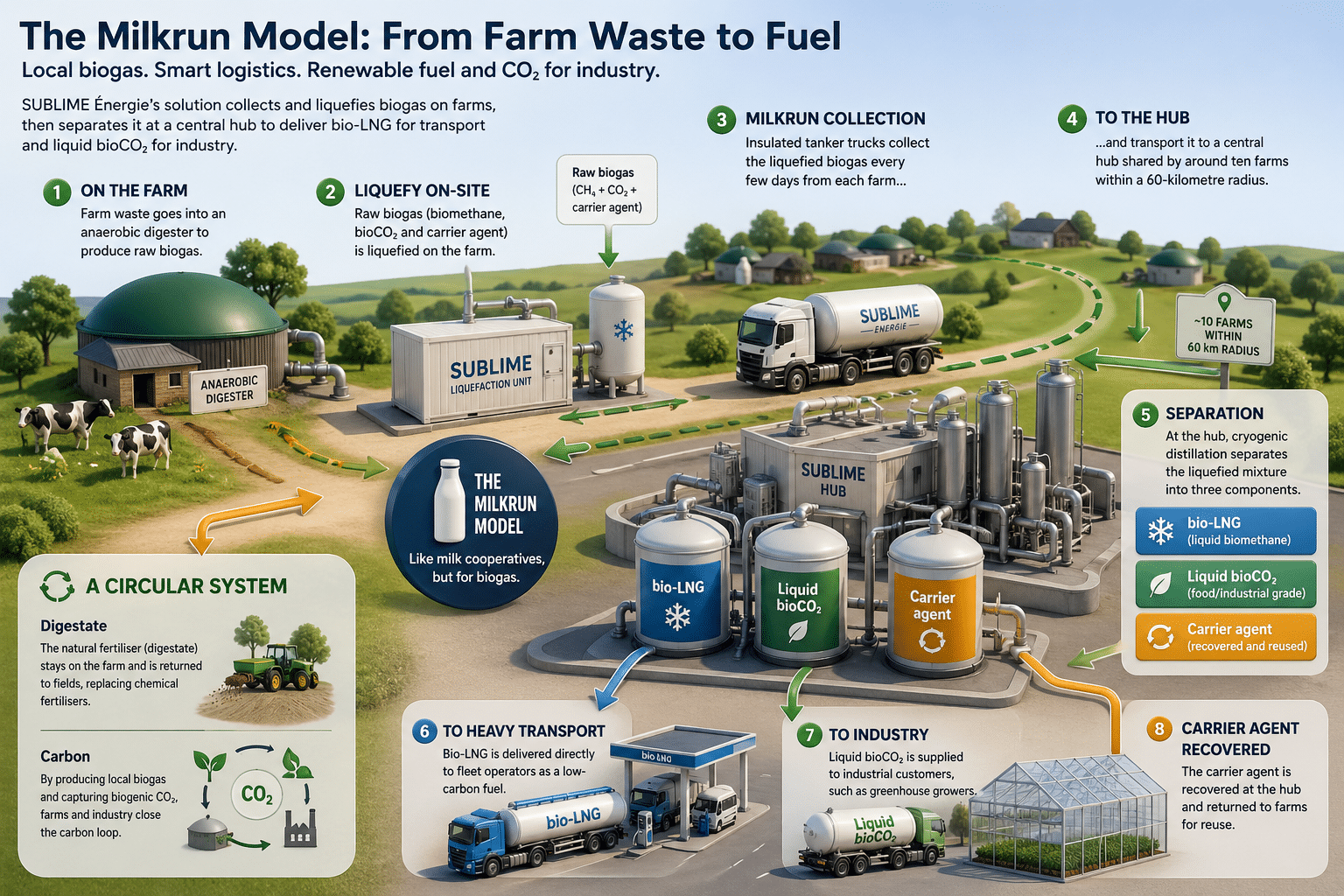
The SUBLIME Energie process at a glance.
SUBLIME Énergie last month inaugurated Charlie, described as the world’s first system capable of liquefying biogas directly on a farm, at the Gazéa site in Plélo, Brittany. The demonstrator has an annual capacity of approximately 180 tonnes of bio-LNG and 330 tonnes of liquid bioCO2. The Gazéa farm is a pig farm, and the biogas comes from its existing anaerobic digester.
Previous iterations — Alpha and Bravo — were laboratory-scale. Charlie is the first to operate on real farm biogas under working conditions. “We already had technical success with liquefying biogas in the laboratory,” Vasse says. “So because of Charlie, we are going to liquefy directly on the farm, with real biogas. This is a scale-up.”
A Circular System
The circularity of the model extends beyond energy. Anaerobic digestion produces digestate — the solid residue left after biogas extraction — which functions as a natural fertiliser. Where on-farm digestion operates, digestate stays on the farm and is applied locally.
Across Europe, digestate already has the potential to replace 17% of the EU’s nitrogen-based fertilisers, with that figure projected to rise above 65% by 2040 as the sector scales.
That matters particularly now. The Strait of Hormuz crisis has disrupted global fertiliser supply chains, with urea prices rising 50% since the start of the war.
The Gulf region is a major producer of the fossil-derived nitrogen fertilisers that European farms depend on.
A model that captures biogas for energy and returns digestate to the soil reduces that dependence at both ends.
Bio-LNG also targets a sector that renewable electricity has so far struggled to reach. Bio-LNG provides a low-carbon alternative to diesel for heavy transport, reducing greenhouse-gas emissions by up to 85%.
It is also applicable to maritime and agricultural machinery — sectors where battery electrification remains impractical at the scale and duty cycles required.
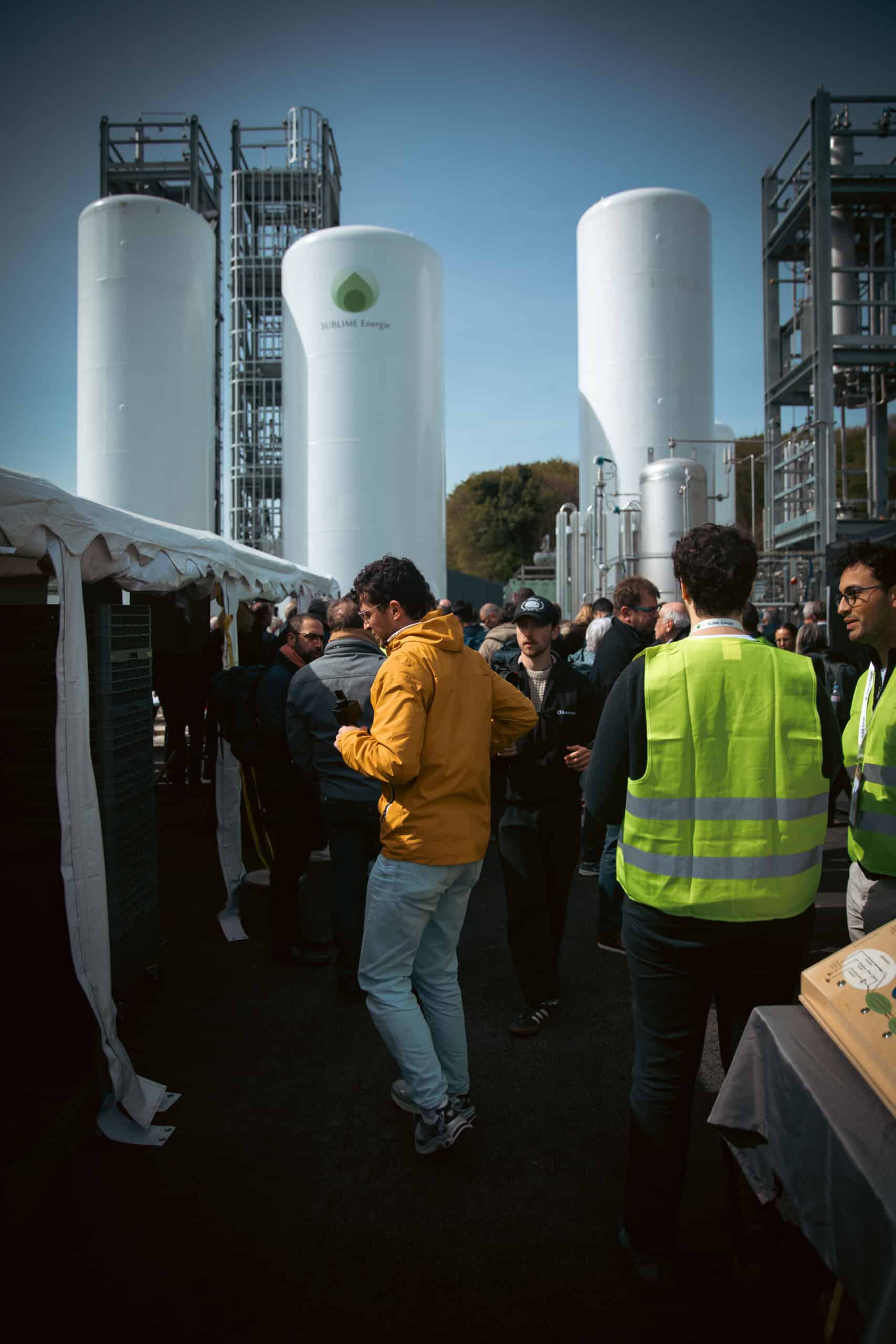
The opening of the Charlie site.
The Regulatory Picture
Vasse also points to a parallel regulatory instrument currently being finalised. Known as IRICC — France’s incentive for the reduction of the carbon intensity of fuels, drawn from the EU’s recast Renewable Energy Directive — the framework introduces sector-specific greenhouse gas reduction targets for transport fuels, with road sector targets starting at 5.9% in 2026 and rising to 10.6% by 2030. Fuel sellers unable to meet those targets face penalties, creating a direct price signal in favour of bio-LNG. “We will be able to speak to an investor, to a farmer too, because he needs to be sure that we have a good price on the market,” Vasse says.
Vasse also flags a deeper policy question that France has yet to resolve: whether future agricultural regulation should favour manure-based feedstocks over energy crops, to avoid any competition between fuel production and food security. “If we want anaerobic digestion to serve a more responsible agriculture, we need regulation to say that manure has more benefits to use than cultures,” he argues. “Do not put in competition energy production and food security.”
SUBLIME Énergie is already preparing Delta, its first commercial-scale project, which will connect around ten farms to a shared processing hub in the same area of Brittany, with commissioning targeted for 2028. Vasse estimates the company could ultimately deliver more than a thousand projects across Europe by 2050, drawing on a resource that SUBLIME puts at 26 TWh of untapped off-grid biomethane potential in France alone.
Whether the broader ambition can be realised at speed depends on more than startup ingenuity. Policy stability, fair pricing mechanisms, and a clear regulatory signal on the future of farm-scale energy are all prerequisites. But as the Hormuz crisis continues to expose the fragility of Europe’s import dependency, the case for treating agricultural waste as a strategic energy resource has rarely been easier to make.