
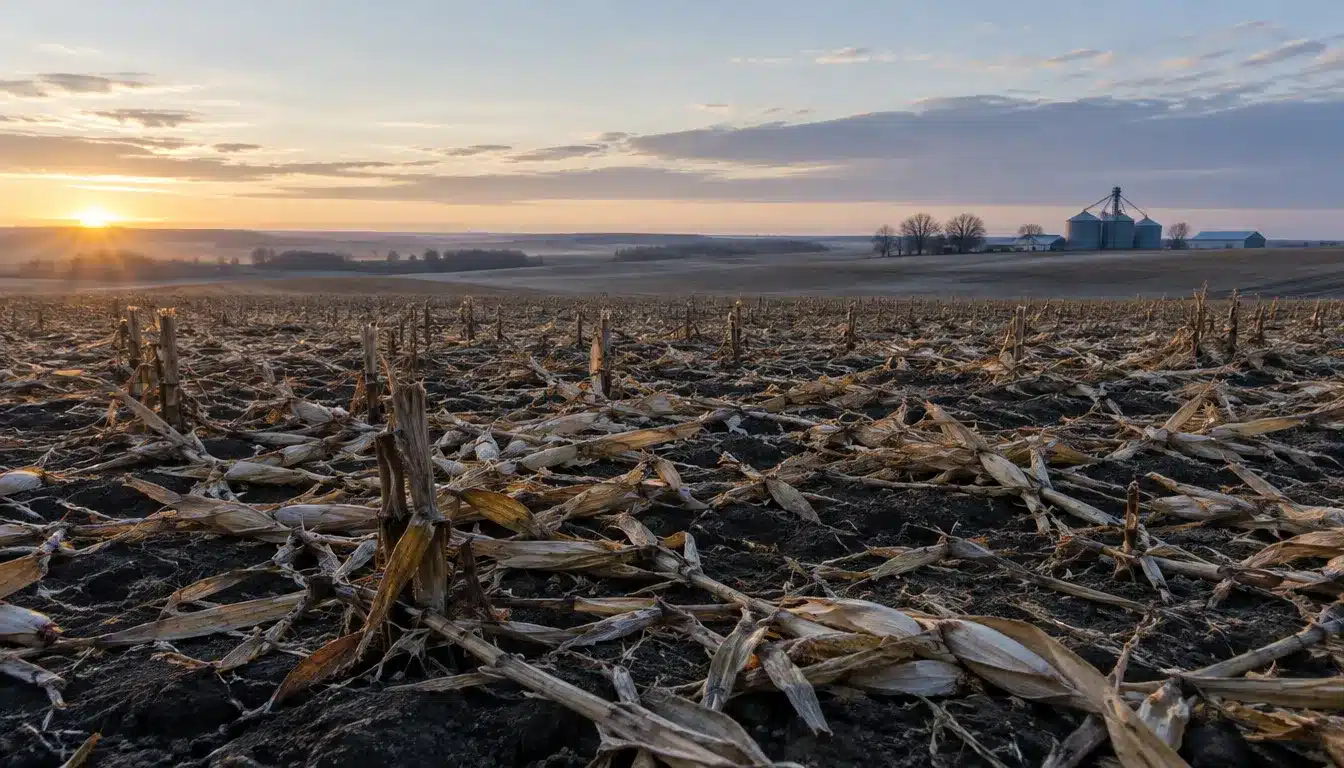
Chicago-based IMIO has raised a $12m seed round led by Sofinnova Partners to scale freeze-dried microbes that break down the stalks and leaves farmers leave behind after harvest.
IMIO, a Chicago-based maker of farm microbes, ανακοινώθηκε στις 20 Οκτωβρίου that it has raised $12m in seed funding. Sofinnova Partners led the round, which takes the company’s total funding to $16.5m. Its products target crop residue nutrients, the nitrogen, phosphorus and potassium held in stalks and leaves left after harvest.
Chipotle’s Cultivate Next venture fund also invested, alongside Starshot Capital, Grow Together Salinas, Earth Foundry and Serra Ventures. IMIO will spend the money on new staff, more output and a new plant and lab in Chicago. It expects to finish its Chicago base in the second quarter of 2027.
From compost to cornfields
Charles Smith founded IMIO in Vermont in 2019, after work in finance and software start-ups. At first, the firm wanted to make money from organic waste through compost. However, Smith found that many compost sites run at a big loss.
“We realized that working with compost facilities would be very challenging,” said Smith, who is IMIO’s founder and chief executive. So the firm turned to farms instead, since they leave huge amounts of residue and spend heavily on fertiliser. “Farmers have this nutrient reservoir that they will sometimes call trash,” Smith said.
Later, IMIO moved from Vermont to Chicago to sit closer to the grain belt. It also wanted to be near local talent.
How the microbes work
IMIO uses natural microbes that aren’t genetically modified. Farmers apply them straight onto residues, so they don’t have to fight the microbes already in the soil. There, they break down lignin and cellulose, the tough fibres in plant stalks. In turn, crop residue nutrients become free for the next crop to take up.
Each strain grows on its own before IMIO freeze-dries it and blends it into a dry powder. The firm says the powder keeps for more than 12 months. Freeze-drying is also gentler than drying with heat, which IMIO says would kill some of its fungi.
Its main products are Re-Gen for Row Crops and Re-Gen for Produce. Farmers often apply them in spring, around planting, so nutrients arrive when the new crop needs them. Smith argues that modern corn types with more lignin leave residues that are harder to break down. Meanwhile, standard farming methods can cut the fungi that would normally do that work.
Trial results and farm economics
Smith puts the value of the nitrogen, phosphorus and potassium in corn stover at about $134 an acre. Stover is the stalks, leaves and cobs left in a field after harvest. Some other crops, such as broccoli, leave residues worth even more.
IMIO tested its products on more than 10,000 acres of Midwest university and farm trials in 2024 and 2025. Across those trials, corn yields rose by 11.9 bushels an acre on average. Single results ranged from five to more than 20 bushels, based on residue levels and farm management. All of these numbers come from the firm itself.
Kirk Stueve, who farms and owns land in Minnesota and Wisconsin, was an early customer. He says a treated 140-acre field in a four-year corn-on-corn rotation beat its yield record by 36 bushels an acre.
He also cut nitrogen costs by $45 to $50 an acre without losing yield. “IMIO is an outlier,” Stueve said.
Fertiliser savings and emissions
Nitrogen fertiliser is a major source of nitrous oxide, a strong greenhouse gas that escapes from farm soils. Therefore, tools that let farmers use less nitrogen could cut farm emissions. Several start-ups are now chasing alternatives to conventional fertiliser για αυτόν τον λόγο.
Still, IMIO makes its case mainly on yield and cost. “We generally orient our data towards the things that drive economic returns for farmers,” Smith said. For a grower, putting crop residue nutrients back to work means buying less fertiliser the next season.
IMIO now has around 100 customers. It first sold straight to farmers and has begun working with dealers. Besides corn, it targets crops such as broccoli, Brussels sprouts and lettuce. Chipotle helped link it with vegetable growers.
The firm also sees cover crops as a chance to grow, although it plans to scale in the US first. Meanwhile, investors keep backing early farm start-ups, including a recent round for καλλιέργειες ανθεκτικές στο κλίμα designed with AI.
Μπορεί να σου αρέσει επίσης
 Η Mafix συγκεντρώνει 5.4 εκατομμύρια δολάρια για να μετατρέψει πυριτικό πέτρωμα σε λίπασμα που απομακρύνει τον άνθρακα
 Η Cotierra συγκεντρώνει 3 εκατομμύρια δολάρια για την κλιμάκωση του αποκεντρωμένου βιοκάρβουνου σε τροπικές καλλιέργειες
 Η OlsAro συγκεντρώνει 5 εκατομμύρια ευρώ για σπόρους για καλλιέργειες σχεδιασμένες με τεχνητή νοημοσύνη, ανθεκτικές στην κλιματική αλλαγή