RadianX has closed a $5m seed round and secured $4m from a manufacturing partner to build a production line for thin perovskite panels aimed at sensors, e-readers and other small devices.
RadianX, a perovskite start-up, has closed a $5m seed round to fund a commercial-volume production line. SOSV and Twynam led the round. The company plans to sell perovskite solar power systems to device makers. Its target products include e-readers that never need charging and sensors that never need new batteries.
One Small Planet, Sachsen Ventures, Avila VC, California Innovation Fund, quantumEDGE, Riceberg Ventures and Alumni Ventures also took part. In addition, Pacific Union Technology Precision Manufacturing is providing $4m in non-dilutive investment. That money will build a dedicated production line for the start-up.
What the panels claim to do
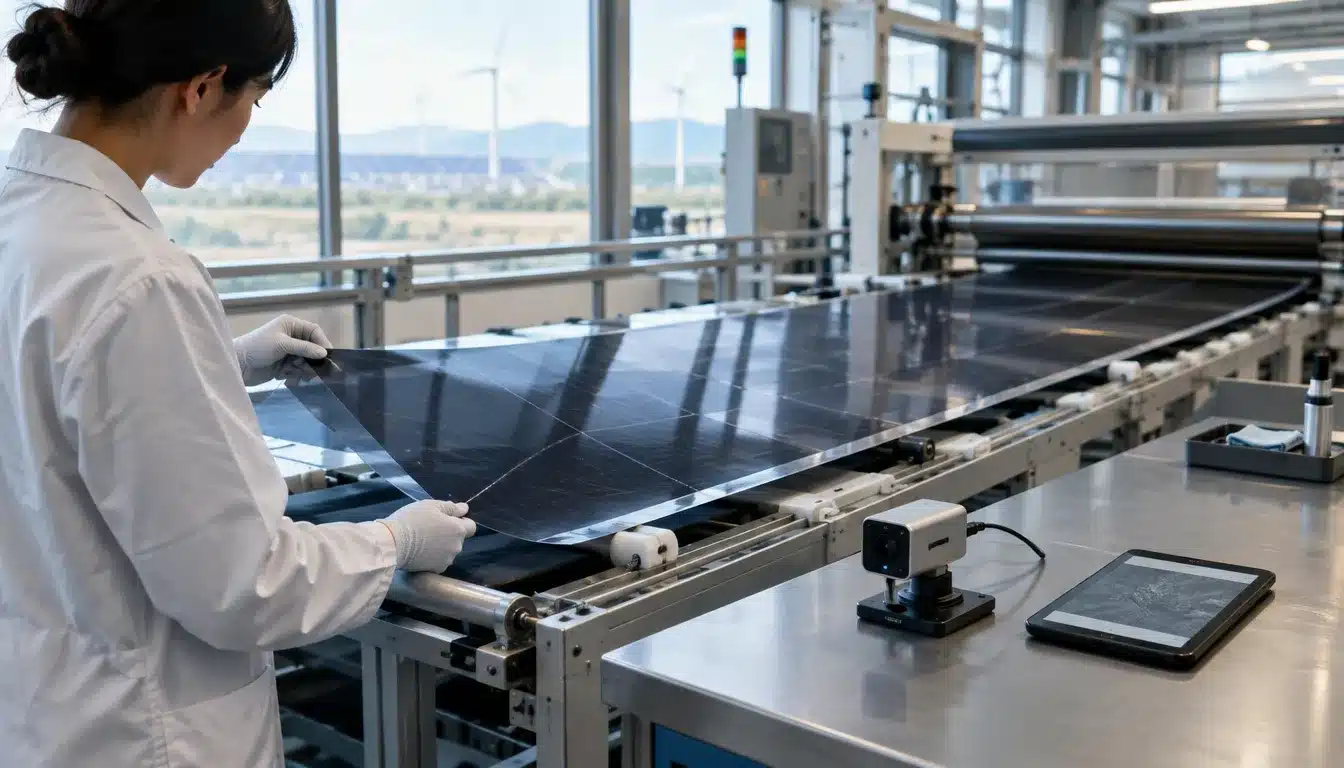
RadianX says its 1.2 m by 0.6 m panel reaches 22.33 per cent efficiency, which it describes as the best on record. That is a company claim. The figure applies to a panel far larger than the small research cells behind many perovskite records. For comparison, a recent perovskite solar cell reached 26.9 per cent.
The company says the material matches existing solar panels outdoors and is twice as good at harvesting light indoors. Josh Douglas, its co-founder and chief operating officer, said: “We can harvest any kind of photon, whether it’s an outdoor or indoor photon.”
That indoor performance explains the choice of market. Rooftop solar competes on cost per watt, whereas a sensor or e-reader spends much of its life under artificial light. Researchers elsewhere are chasing similar gains, including solar windows that use indoor and outdoor light.
Durability and cost remain the test
Perovskites have long drawn interest for their energy output. Vivian Qu, co-founder and chief executive of RadianX, said: “The reason why perovskites have been so interesting is the high power density.” However, the materials cost more than silicon panels and have been less durable, although they have improved in recent years.
RadianX says it has met a key industry durability standard, although the details available don’t name it. Indoor use also exposes panels to less wear, which eases one of the hardest problems for perovskite solar power. So devices may give the technology an easier first market than rooftops.
The panels can be as thin as 0.7 mm, and the company can size them to fit a device. Those traits suit products where space is tight, such as wearables. The company also names factory sensors and long-runtime robots as possible uses. Each must work for long periods without a plug, so each gives RadianX a different test.
Selling systems instead of panels
RadianX won’t sell bare panels. It plans to supply packaged power systems, because most existing power electronics suit silicon. Qu said silicon “has a very different light soaking characteristic”, so the start-up is developing electronics tuned to perovskites.
That approach could save customers from designing their own power management around an unfamiliar material. Qu said: “RadianX is trying to package all of this and sell this to device makers as something they don’t need to worry about.” In turn, RadianX takes on more of the engineering risk itself. It must make the panels and the electronics work together in each customer’s product.
Production comes next
The seed money and the partner’s $4m share one goal, which is a production line at commercial volume. RadianX hasn’t given a date for commercial production, and it hasn’t named any device makers as customers. The details available don’t say where the line will sit. The company’s efficiency and durability claims also await independent results.
Still, the funding gives RadianX a way to test whether perovskite solar power can win in small electronics first. The non-dilutive money also means the partner pays for manufacturing capacity without taking equity. If device makers sign up, sensors and e-readers would give the material a commercial foothold before it has to compete with silicon on rooftops.