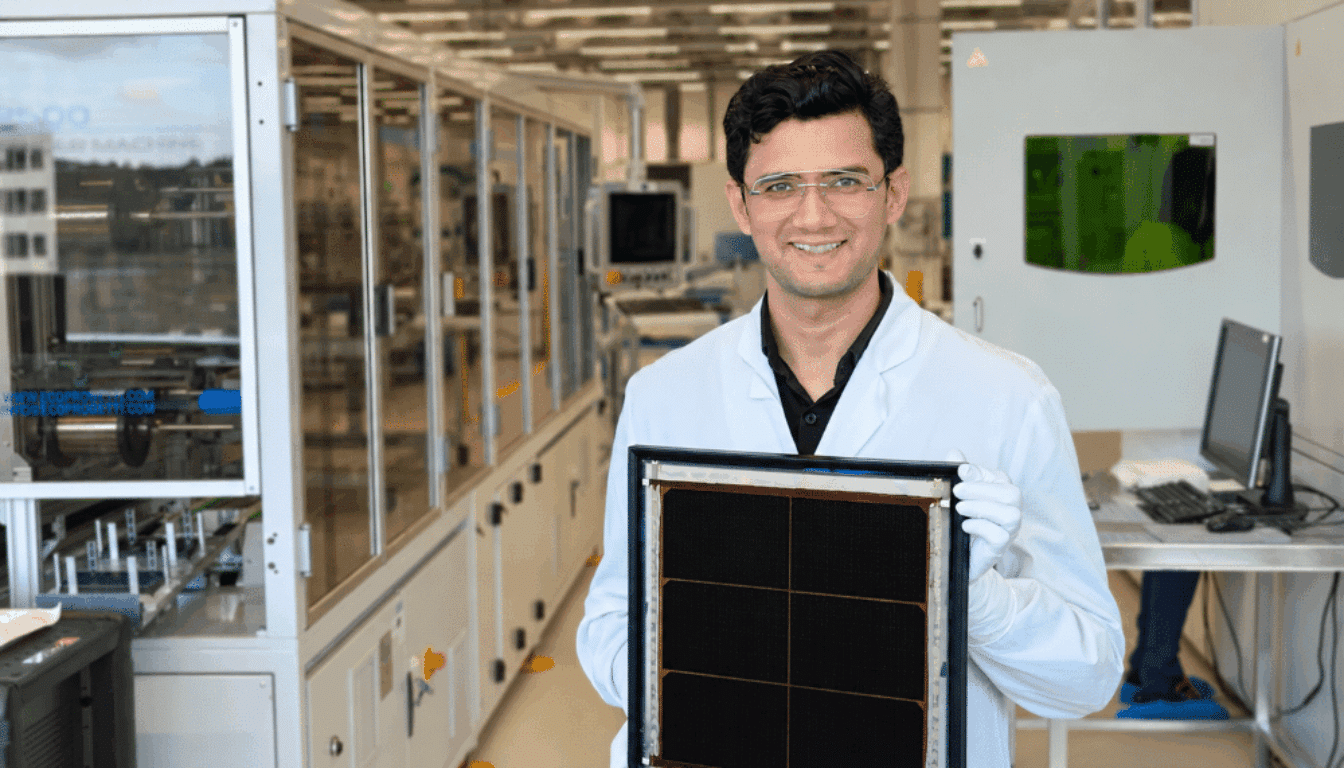
Noak, a spin-off of imec and Hasselt University, has raised €5m in seed funding to prepare its perovskite-silicon cells for gigawatt-scale manufacture through industrial partners.
Belgian start-up Noak has raised €5m in a seed round to scale up its tandem solar cells. These pair a perovskite layer stack with silicon. The investors are Helios Foundation, Nuhma and V2HFin, and the company didn’t name a lead. Noak spun out of the research institute imec and Hasselt University, and it announced the round on 30 October.
The money will speed up development using existing facilities at EnergyVille in Genk, which has more than 700 researchers. It will also pay for early work on gigawatt-scale manufacturing partnerships. However, Noak hasn’t named a factory site or an industrial partner. Nor has it said when production could begin.
Three regional backers
All three investors have Belgian roots. Helios Foundation is a Belgian foundation that focuses on climate change and workforce well-being. Nuhma is the climate investment company of municipalities in Limburg, the province that includes Genk. Meanwhile, V2HFin is a wholly owned subsidiary of Flemish Energy Holding and invests in Flemish start-ups and scale-ups.
That gives the company a local shareholder base as it looks abroad for manufacturing. Noak says it wants to build a value chain through global industrial partnerships. Geert Palmers, chief executive of Noak, said: “Noak’s innovation goes beyond technology.” The company sets that claim beside its work on metal use and recycling.
Why tandem cells draw investors
Conventional silicon cells are approaching a practical limit of about 27 to 28 per cent efficiency, according to Noak. By contrast, the company puts perovskite-silicon tandems at 30 to 35 per cent. The two materials capture different parts of the solar spectrum. Perovskite has been moving quickly in the lab too, as recent work on perovskite solar cell efficiency shows.
Stability remains the main doubt over the technology. So Noak’s backers are leaning on durability data.
Imec and Hasselt University report five years of outdoor use. Their tests ran at more than 10 sites in Asia, Europe and North America. Those sites covered intense sun, heavy rain, extreme heat and sub-zero temperatures.
Still, Noak hasn’t published efficiency measurements or degradation figures from those tests. It says its next phase will focus on long-term stability and performance at scale. So those are the results that buyers will want to see.
Moving the wiring behind the cell
Noak’s main design feature is a proprietary 3D woven foil. It carries the electrical connections at the rear of the cell.
That removes the need for metal lines on the front, and so it cuts shading losses. The company can also divide the tandem into smaller sub-cells wired in series and parallel. That gives it more design freedom and lowers metal use.
The foil could also ease a supply problem, because solar manufacturers rely on costly metals for their contacts. Noak says its foil and tile layout drastically reduces use of expensive and rare metals, although it gives no figure. In addition, it’s designing its tandem solar cells so they can be taken apart on demand. It’s also working with suppliers on certified recycled metals.
From lab to factory
The team now has to turn laboratory expertise into a product that factories can build. Jef Poortmans is programme director for photovoltaics at imec and R&D coordinator of EnergyVille.
He said: “With Noak, we now have the opportunity to translate that expertise into industrial manufacturing.” Marlies Van Bael directs the IUMAT institute. She said Noak “is the result of years of dedicated research, long before a spin-off was envisioned”.
A €5m seed round won’t pay for a gigawatt-scale plant, which explains the partnership route. Instead, the money buys time to prove that tandem solar cells on Noak’s foil can hold their output. Its partners will then have to decide whether that record justifies a production line.