Cambridge spin-out Reclinker has raised £10m in an oversubscribed Series A to take its process for recycling old cement paste through steel furnaces from trials to commercial production in Cardiff.
Reclinker has raised £10m in a Series A round to take its low-carbon cement process into commercial production in Cardiff. The Cambridge spin-out announced the round on 5 October and said it was oversubscribed. Clean Growth Fund and AP Ventures co-led the raise, with the Development Bank of Wales and Kibo Invest joining. Existing investors Zero Carbon Capital and Cambridge Enterprise also took part.
The company says its process halves the emissions of cement at the same cost as the conventional product. It’s targeting output of 120,000 tonnes a year in Cardiff. Beyond Wales, Reclinker plans to take the process to other electric arc furnace sites in Europe and the US.
“This oversubscribed round sends a strong signal that UK investors are serious about decarbonisation,” said Bill Yost, chief executive of Reclinker.
Cement’s clinker problem
Cement accounts for about 7 per cent of global carbon dioxide emissions, according to Reclinker. That’s roughly three times the share of aviation. Most of it comes from clinker, the ingredient that binds cement together.
To make clinker, kilns heat limestone until it gives off carbon dioxide. The fossil fuels that fire those kilns then add more. Reclinker puts the split at 53 per cent of clinker emissions from limestone and 35 per cent from fossil-fuel heat.
Other developers are working on the same problem. For instance, Cemvision has partnered with Vattenfall on a 95 per cent cut in cement emissions. The investors backing Reclinker point to the same difficulty.
“Cement is one of the most challenging sectors to decarbonise,” said Stephen Price, investment partner at Clean Growth Fund. He added that its emissions are “deeply embedded in both process chemistry and energy use”.
Recycling cement through steel furnaces
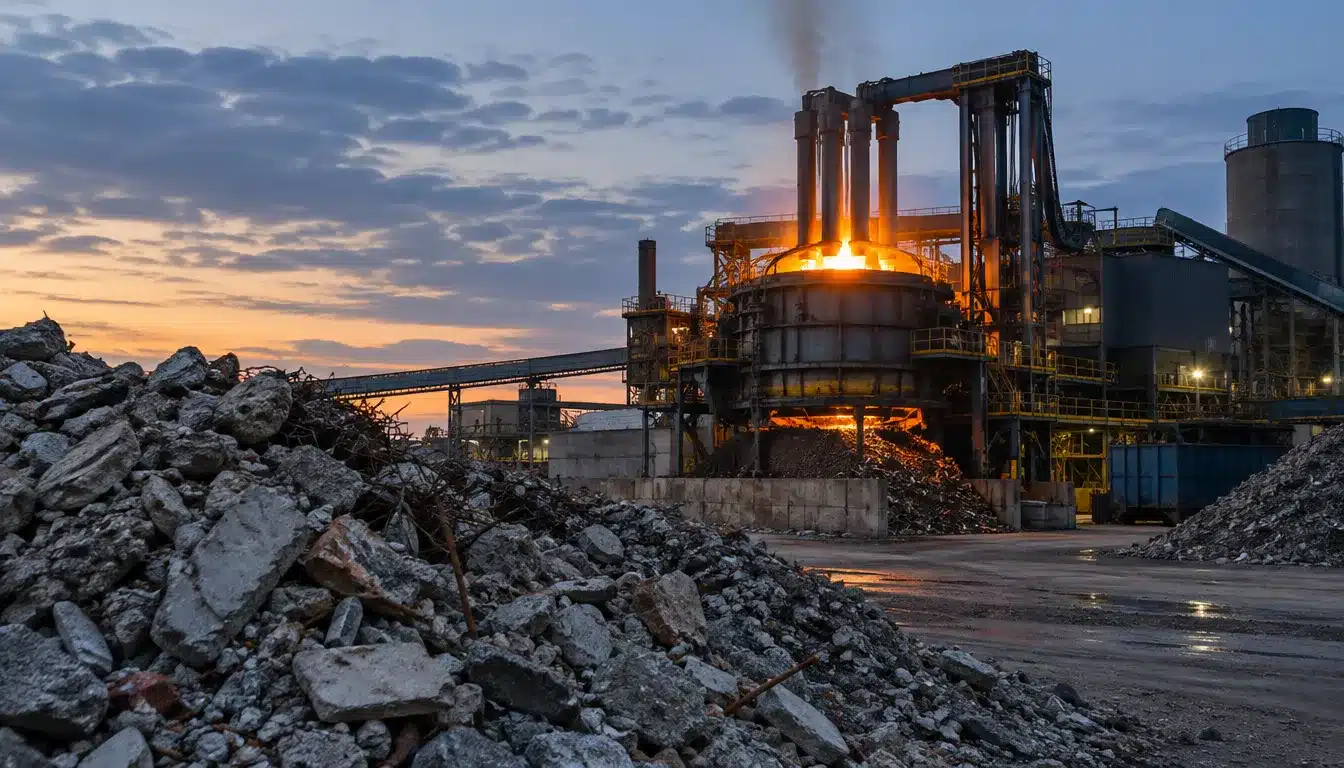
Researchers at the University of Cambridge developed the method and described it in a 2024 paper in Nature. First, the process recovers old cement paste from demolished buildings. Then that paste goes into the electric arc furnaces that already recycle scrap steel. These furnaces melt scrap with electric current, so they need no coking coal.
Inside the furnace, the paste turns back into clinker while the scrap becomes recycled steel. So one furnace run makes both materials at once. As a result, the method needs no kiln, no quarried limestone and no fossil-fuel heat.
Reclinker expects a 50 per cent cut in emissions at first. It says deeper reductions should follow as the technology scales. Meanwhile, the company has already made thousands of tonnes of its product at 7 Steel UK’s plant in Cardiff. It has also secured its first commercial sales.
A shrinking supply of slag
Reclinker is targeting a gap in supply. For years, concrete makers have used blast-furnace slag, a by-product of steelmaking, to make cement blends with less clinker. However, that slag is running out as steelmakers move away from blast furnaces.
Demand for alternatives is building on the buyer side too. Large concrete users have signed up to the Innovate UK Advance Market Commitment. Under it, they have pledged to use more low-carbon materials over the next five years. That gives low-carbon cement producers a clearer route to market in the UK.
Andrew Hinkly, managing partner at AP Ventures, said Portland cement clinker is “essential to infrastructure development”. Yet it “remains one of the hardest industrial emissions sources to abate”, he added.
Welsh backing for the Cardiff plant
The Development Bank of Wales invested alongside the specialist climate funds. It said the deal would help Reclinker establish and grow its presence in Wales. Because the process runs inside existing steel furnaces, the Cardiff site gives the company a working model to copy elsewhere.
That model now has to work at commercial volumes. The 120,000-tonne goal for Cardiff will test whether steel recycling furnaces can also make low-carbon cement at scale. If they can, the company has a ready route into Europe and the US.