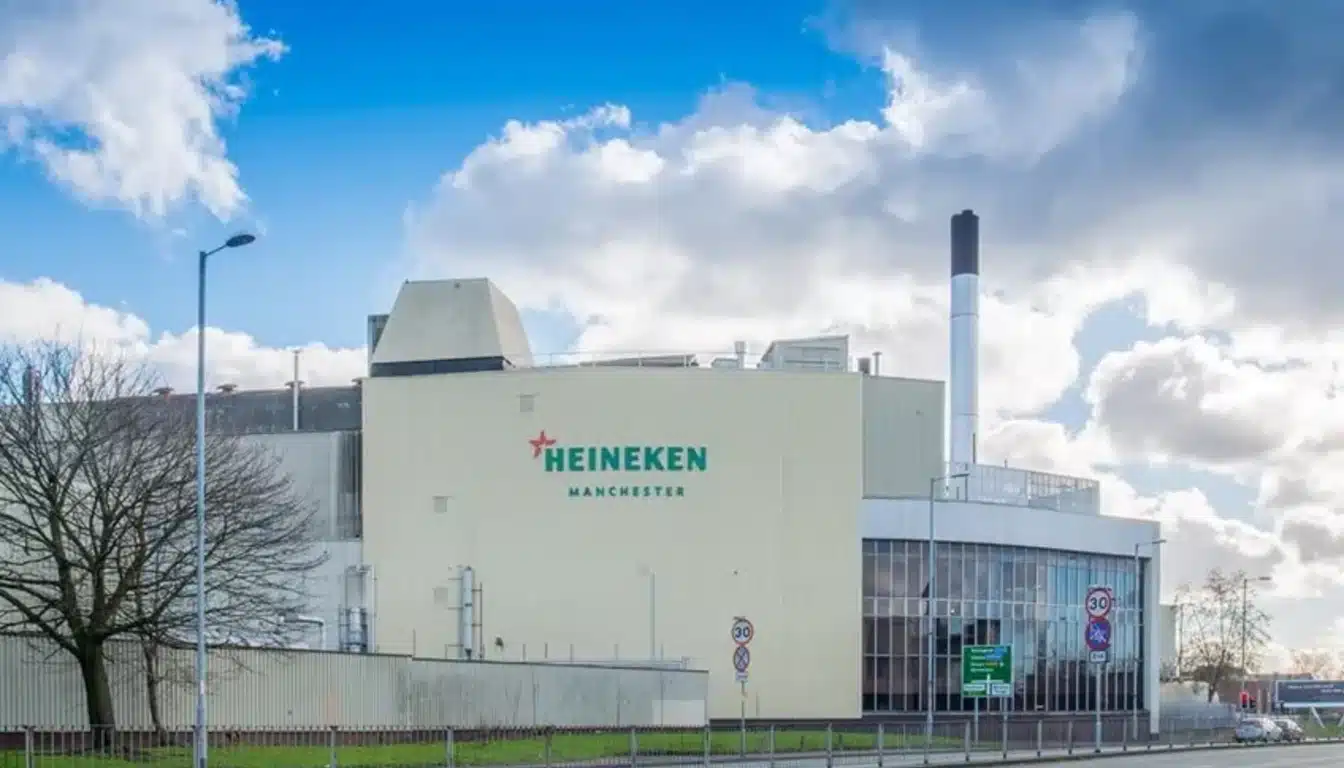
A £28.2 million industrial heat pump network at Heineken UK’s largest brewery has cut on-site gas use by a third and emissions intensity by 42 per cent, giving food and drink manufacturers a working template.
Heineken UK reported the figures on 10 September. They compare July to December 2025 with the same months a year earlier. Natural gas use on site fell by 33 per cent, and CO2 emissions intensity, measured in kilograms per hectolitre, fell by 42 per cent.
Manchester is the company’s largest UK brewery. It produces around 2.5 million pints a day, including Heineken, Birra Moretti, Cruzcampo, Foster’s, Amstel and Red Stripe. Over 240 people work there, and the site marked 150 years of brewing in 2025.
How the project was built
Installation began in 2023, and the heat pump network was commissioned in June 2025. Heat pumps now supply process heat across the site, so the brewery leans far less on gas boilers. That also reduces its exposure to gas price swings.
The £28.2 million bill was met through capital investment and a government grant. The Industrial Energy Transformation Fund contributed £3.7 million. Heineken says this is the first retrofit at this scale anywhere in its global operations.
The system is still being tuned
The project has entered a 12 to 18 month optimisation phase. Performance should improve as engineers fine-tune the system. So far the installation has delivered on average 80 per cent of the estimated on-site gas reduction.
Chris Kerr, Supply Chain Director at Heineken UK, said: “Decarbonising a brewery requires a combination of technology and skill, and is a complex challenge facing our industry. This project marks a step-change in how energy can be generated and used in our Manchester Brewery and has impacted every part of our operations from inception to launch.”
He described the site as a blueprint for the wider brewing and manufacturing sectors. Interest from other manufacturers has followed the results. Retrofits of this kind are still rare at brewery scale.
Process heat is the wider problem
Food and drink manufacturing runs on low and medium temperature heat. Most of that heat still comes from gas. Electrified heat is therefore one of the clearer routes to cutting industrial emissions in the sector.
Sonia Thimmiah, Corporate Affairs Director at Heineken UK, said: “Private sector investment into decarbonisation initiatives is accelerated when supported by the public sector. It is through this collaborative approach with government that we can continue to drive innovation like we have in Manchester.”
Heineken links the result to its Brew A Better World strategy and a target of net zero across the value chain by 2040. The £3.7 million of public money covered roughly an eighth of the cost. Whether other manufacturers follow depends largely on whether similar support continues.