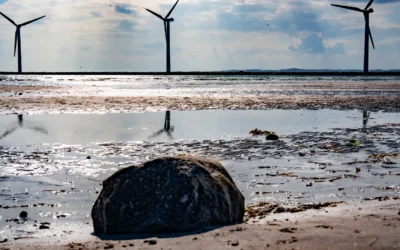

Research from the Earthshot Prize and the University of Exeter identifies 51 solution areas where progress could become self-reinforcing. Cheap clean electricity is the cascade that improves the economics of everything else.
Tipping points usually turn up in climate news as a threat. Amazon dieback and ice sheet collapse are lines beyond which damage can’t be undone. New research from the Earthshot Prize and the University of Exeter’s Green Futures Solutions team turns the idea around. It maps 51 solution areas where progress could become fast and self-propelling within five years.
The report is called Positive Tipping Points: Accelerating System Change to Repair Our Planet. Exeter published it on 10 September. It extends Professor Tim Lenton’s earlier work on positive tipping points to all five Earthshot categories: nature, air, oceans, waste and climate. The Earthshot Prize says it will use the findings to pick solutions that can set off fast change.
How a positive tipping point works
The mechanism is simple. When take-up lowers costs, success draws in more money and policy spreads to other places. That creates a cascade. Solar power is the clearest example. Its costs have fallen around 90 per cent in a decade. Each new wave of panels has cut factory costs further, pulling in more money and better kit. Solar is now the cheapest source of electricity in most of the world.
The report calls clean electricity a master cascade. Cheaper solar and wind improve the economics of electric transport, clean buildings, industry and cleaner air all at once. Marine protected areas show a similar pattern. Well-policed reserves have restored fish stocks within years. As coastal towns have felt the gains, the reserves have grown. The High Seas Treaty came into force in January with the backing of more than 140 countries.
Clean cooking is close to tipping in several markets, the report finds. Pay-as-you-go solar and clean cooking firms are scaling up across East and Southern Africa. In Latin America and parts of Asia the switch to LPG is largely complete.
Three conditions to tip
For a solution to tip, the researchers set out three prerequisites. It must be affordable, so it can compete on cost with the harmful option it replaces. It must be within reach of those who need it. And it must be attractive enough, with enough social proof, to make the switch the obvious choice.
A central finding is that the five Earthshots share the same conditions, assets and risks within one system. That cuts both ways. The clean power cascade could speed up tipping points across all five. Yet the funding gap in the Global South could stall progress in the regions that need it most.
Dr Steven Smith is the report’s lead author and a Research Fellow in Exeter’s Green Futures Solutions team. He said the team noticed how often progress in one area depended on another. “We’re not claiming every system is about to tip,” he said. “Our report shows where the self-reinforcing mechanisms are, and what governments, investors and innovators can do to unlock them.”
What the Earthshot Prize will do with it
Jason Knauf, Chief Executive of the Earthshot Prize, said the research explodes the myth that fixes are out of reach. “The Earthshot Prize will apply this latest science to find and back the solutions capable of triggering exponential progress for our planet by 2030,” he said.
Timing is part of the pitch. This northern summer brought extreme heat and fire, and forecasters expect an unusually strong El Niño. So the authors present the work as a shared agenda for action. For investors the message is more precise: the returns on cheap clean power reach well beyond the power sector.