
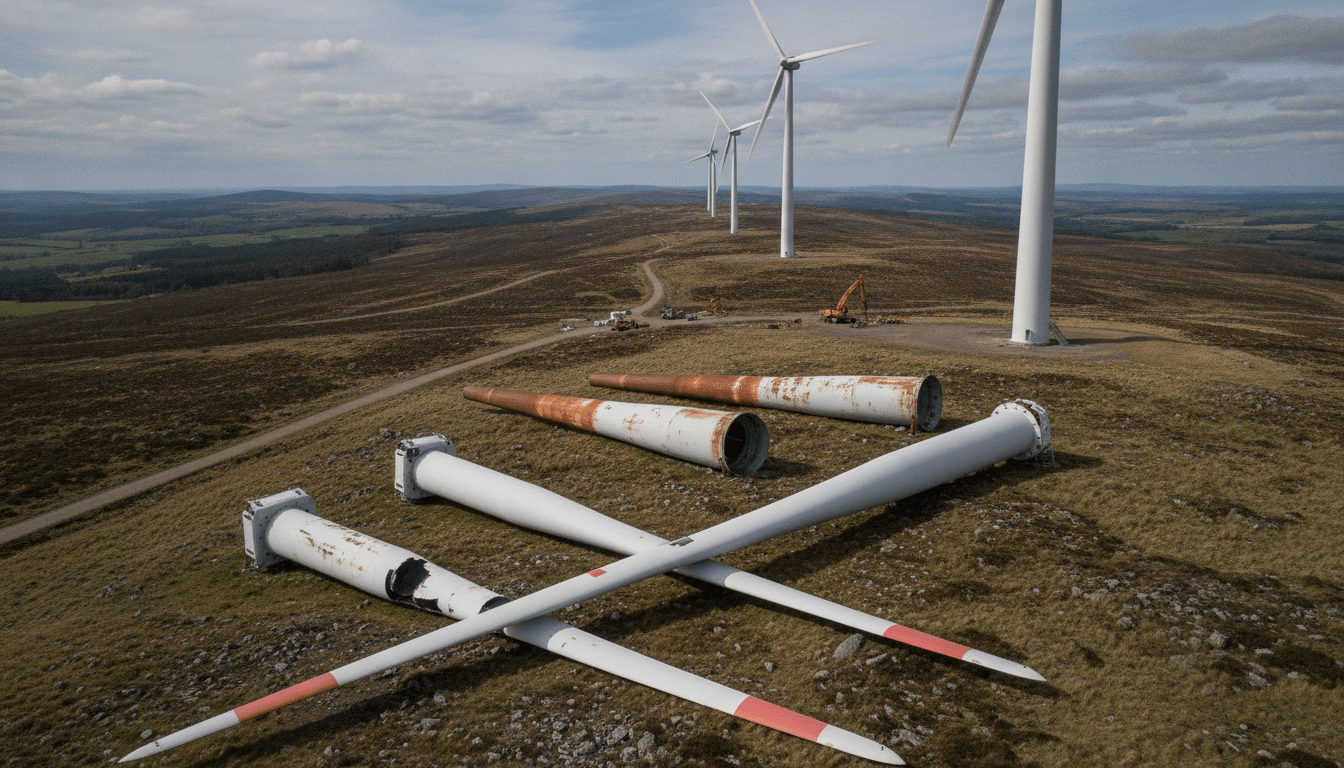
An independent review by Mott MacDonald found that 99.9% of materials from the original Hagshaw Hill wind farm in South Lanarkshire were recycled or reused when its 26 turbines were taken down.
The Iberdrola-owned utility said the review found 79.5% of materials from the turbines and associated components were recycled and 20.4% were reused or kept as spares, according to Windpower Monthly reported. ScottishPower has said that less than 0.1% of turbine material went to landfill.
Hagshaw Hill began generating in 1995 and is described by ScottishPower as Scotland’s first commercial onshore wind farm. Its original turbines were dismantled in 2023 and replaced with 14 larger machines providing more than 79MW, so the site now produces far more power from fewer towers. The company says it wants to apply the same approach across its fleet, with around 1GW of its own turbines due to come down over the next decade.
Blades turned into fencing and drainage
Blades are the awkward part of any turbine to dispose of, because their composite construction resists conventional recycling. All the Hagshaw blades were processed by Plaswire, based in Lurgan, Northern Ireland, into a polymer intended for construction and engineering uses such as fencing, marker posts and drainage components. Some other components were set aside for industry training.
At least 10 companies in Scotland and elsewhere in the UK won contracts connected with the decommissioning, and ScottishPower has previously said more than 100 jobs were supported across the combined decommissioning and repowering programme. Plaswire chief executive Andrew Billingsley said his company’s output was 50% higher this year after growing 30% the year before, and that he expected to double its workforce over the next 12 months.
What the headline number leaves out
The figure deserves some scrutiny, as Circular Online, the CIWM’s trade title, pointed out on 1 September. ScottishPower has not published the Mott MacDonald report, and its announcement gives no total tonnage, no material inventory and no statement of whether the percentages were calculated by weight. It is unclear whether foundations, concrete, underground cables, access tracks, oils or electrical equipment were counted.
The boundary matters because a July 2026 government-commissioned study found concrete is the dominant material in an onshore wind farm once foundations are included. An earlier presentation by European Metal Recycling in November 2024 described a Hagshaw Hill case study covering 24 turbines and 657 tonnes, with 97% recycled and 3% reused. Those figures predate the blade processing and are unlikely to share a denominator with the later review, so the difference may reflect scope and timing rather than performance.
The wider point stands regardless. The government’s Onshore Wind Taskforce expects decommissioning to peak in the late 2020s and through the 2030s at roughly 0.5GW to 1GW a year, most of it in Scotland. As the first large fleets retire, end-of-life handling is turning into a permitting and social licence condition, and developers will need audited numbers rather than headline percentages to meet it.