
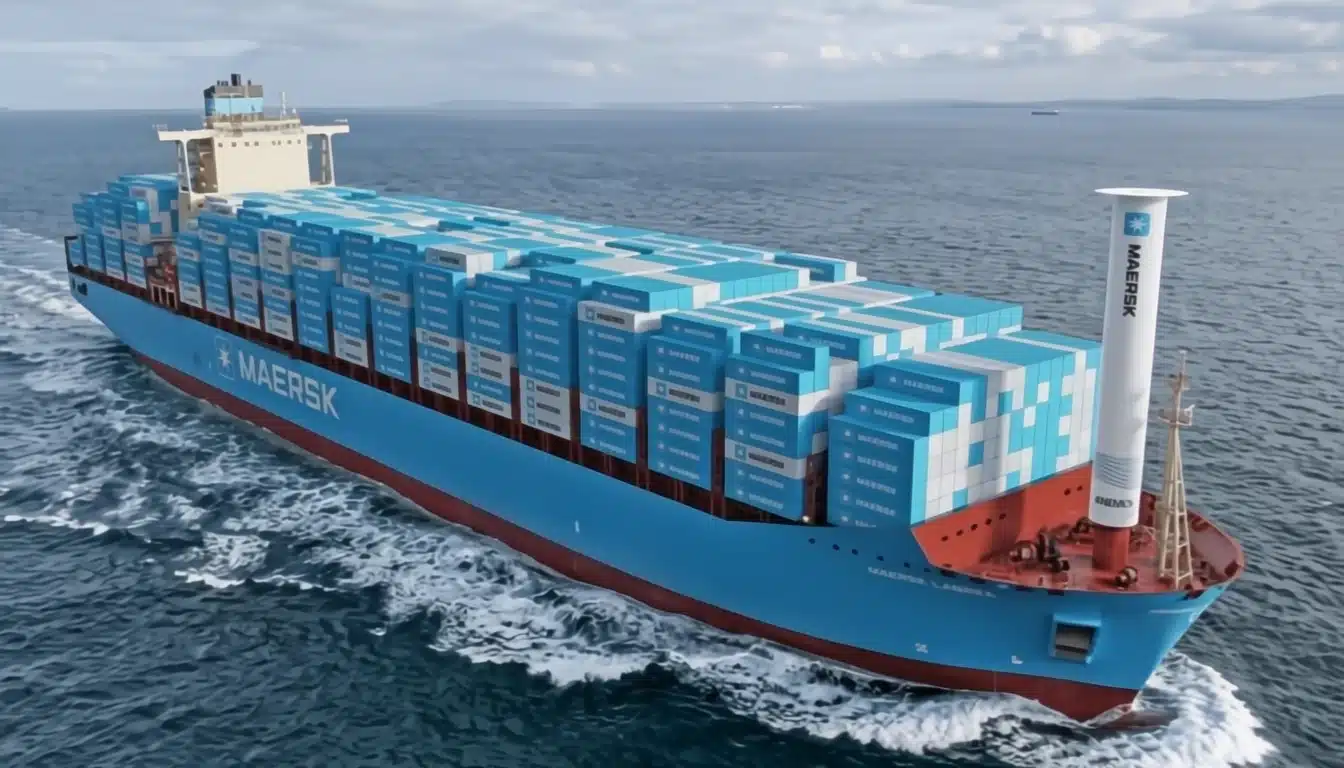
A.P. Moller-Maersk has selected Anemoi Marine Technologies to supply a rotor sail for an 8,700 TEU container ship. It will be the first rotor sail fitted to a box ship.
The UK firm confirmed the selection on Wednesday, with installation due in mid-2027 and testing planned on the vessel’s regular North and South Atlantic voyages. The sail measures five metres in diameter and 35 metres high. Reporting the deal, Ship & Bunker noted that wind-assisted propulsion has until now been confined largely to bulk carriers.
Ole Graa Jakobsen, head of fleet technology at Maersk, called the pilot “a valuable opportunity to build practical experience and assess its relevance for our fleet”. He described wind assistance as one of several routes to better vessel efficiency.
How the technology works
Rotor sails are vertical cylinders driven to spin by a small motor. Air passing over the turning surface creates a pressure difference, and that difference produces thrust at right angles to the wind. Engineers call it the Magnus effect. The thrust supplements the main engine, so the ship burns less fuel at a given speed.
Wind angle governs the size of the gain. Beam winds deliver most, while headwinds deliver almost nothing. The design itself is a century old. Anton Flettner fitted rotors to the German ship Buckau in the mid-1920s, and cheap oil then buried the idea for decades.
Anemoi’s record so far
Anemoi span out of Greek dry bulk owner Blue Planet Shipping and installed its first four sails on the ultramax bulker Afros in 2018. In May the company said the vessel had completed more than 150 voyages, with a dry dock inspection finding the sails in strong condition after nearly a decade at sea. Nick Contopoulos, co-founder and chief commercial officer, described the result as “the clearest long-term proof yet that modern wind propulsion works in real-world commercial shipping”, in a statement issued in May 2026.
Larger jobs followed. Anemoi fitted five 35-metre sails to the 400,000 dwt ore carrier Sohar Max at COSCO Zhoushan in October 2024. A year later it completed a five-sail retrofit on the very large ore carrier NSU Tubarao, operated by Vale International, taking its installed base past 1.6 million dwt, according to Maritime Executive. DNV granted type approval to the 5x35m design in 2024.
Why box ships came last
Container ships stack cargo on deck, so free deck space is scarce and crane clearance matters. Air draught constrains terminal calls and bridge transits. Higher service speeds also cut the apparent wind advantage that slower bulkers enjoy. One sail on a ship this size will save a small share of fuel. The point of the exercise is operational data.
Regulation shapes the sums
European rules already price the benefit. FuelEU Maritime applies a wind reward factor to a ship’s greenhouse gas intensity calculation. A vessel drawing 15% or more of its propulsion power from wind receives a 5% discount, with smaller rewards at 5% and 10%. Atlantic services calling at European ports fall within scope.
Global rules remain unsettled. IMO member states adjourned the extraordinary session on the Net-Zero Framework in October 2025 and agreed to reconvene 12 months later, the organisation said. That vote is now due this autumn.
A precedent inside the group
The wider Maersk family has tested rotors before. Maersk Tankers, Norsepower, the Energy Technologies Institute and Shell ran two 30-metre rotor sails on the LR2 product tanker Maersk Pelican from August 2018. Lloyd’s Register validated aggregated fuel savings of 8.2% over the year to September 2019, worth about 1,400 tonnes of CO2, Norsepower said. Maersk Tankers kept the sails aboard.
Seven years on, the group is asking whether the same arithmetic works when the cargo sits on deck.