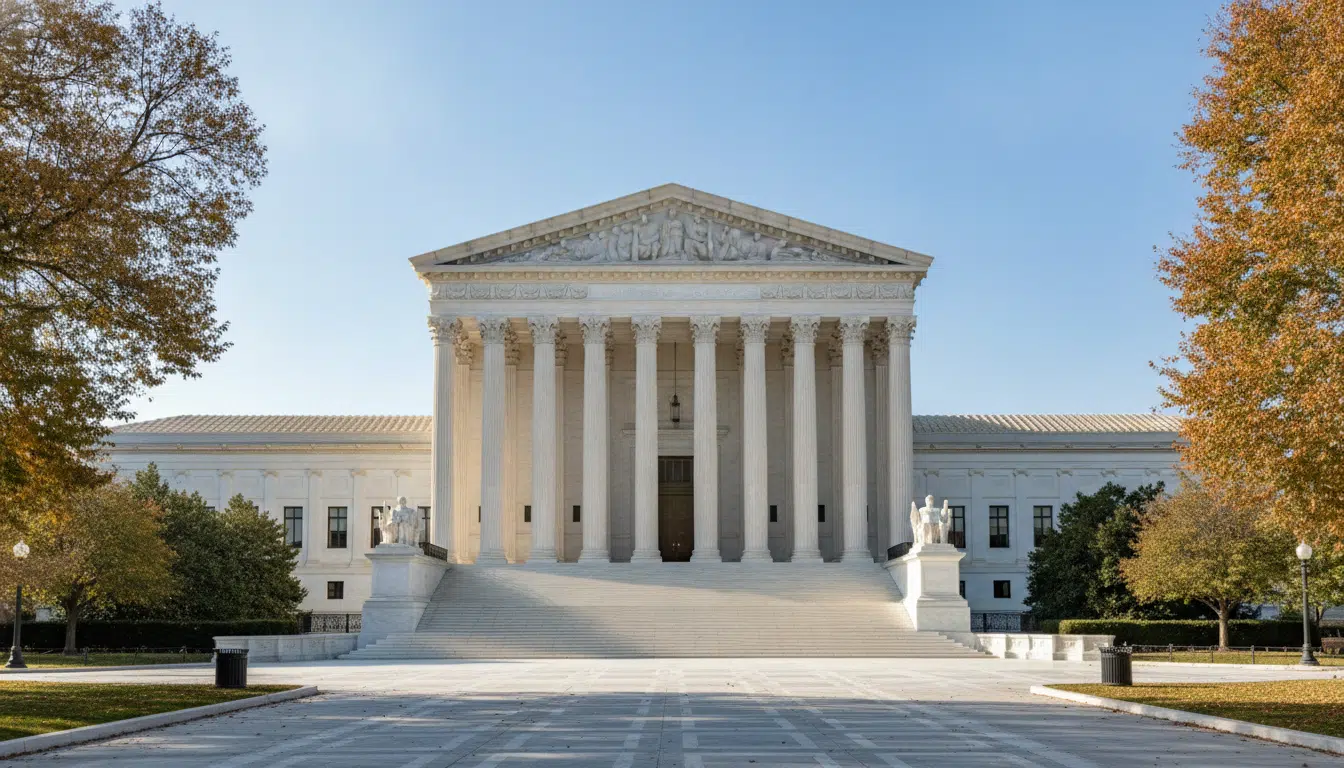
The justices hear Suncor Energy v County Commissioners of Boulder County on 5 October. Their ruling will shape more than two dozen climate liability suits now pending against the oil industry.
Local and state governments across the United States have spent nine years filing lawsuits against major fossil fuel companies, seeking damages for climate harms and alleged deception. None has reached trial. The Supreme Court has now agreed to step in at the request of the oil company defendants, and the case it has chosen will be the first the justices hear when their new term opens.
The court is scheduled to hear oral arguments on 5 October in Suncor Energy v County Commissioners of Boulder County. Suncor and ExxonMobil want the justices to quash a climate tort suit brought by the city and county of Boulder, Colorado. Legal experts say the fate of most pending climate accountability cases could turn on the outcome.
“It could be incredibly consequential,” said Pat Parenteau, emeritus law professor and climate law expert at Vermont Law and Graduate School. The ramifications, he noted, could extend “way beyond climate.”
A question of preemption
Boulder first sued ExxonMobil and Suncor in 2018. It sought money to cover the cost of adapting to local climate impacts such as extreme heat and wildfires, arguing those impacts followed decades of deception about the climate risks of the companies’ products. In 2025 the Colorado Supreme Court allowed the suit to advance towards trial, and that ruling is what the companies now challenge.
The question the petitioners put to the court is framed broadly: whether federal law precludes state law claims seeking relief for injuries allegedly caused by the effects of interstate and international greenhouse gas emissions on the global climate. An affirmative answer would reach far past Boulder. “In the end, if the oil companies win, that’s the end of the cases,” Parenteau said.
Exxon and Suncor argue that climate change is a global problem beyond the limits of state law, so the Clean Air Act and the Constitution preempt Boulder’s claims. Boulder says its suit is about alleged corporate deception and the local harm that followed.
An off-ramp on jurisdiction
The justices added a question of their own, asking whether they even have authority to hear the case at this stage. That threshold issue gives the court a way to avoid deciding the fate of dozens of state climate cases before any has gone to trial.
“It’s possible they will rule that the case is just too early to decide, since there hasn’t been a trial yet,” said Michael Gerrard, founder and faculty director of the Sabin Center for Climate Change Law at Columbia Law School.
Boulder makes the same argument first in its own brief, contending that the court lacks jurisdiction and that its claims survive both the structure of the Constitution and the Clean Air Act. “Petitioners have come to the wrong forum at the wrong time with the wrong arguments,” the brief asserts.
Seventy briefs and a fight over funding
Nearly 70 amicus briefs have been filed, from members of Congress, the Trump administration, states, local governments, Native American tribes, former federal officials and former military leaders. Forty arrived in May backing the oil companies. They argue that a single municipality should not set climate or energy policy for the whole country.
Many repeat the warning of ruinous liability. “The multi-billion-dollar judgments that may flow from these claims could cause major economic disruption,” the American Petroleum Institute argues. A brief from Alabama and more than two dozen other Republican-led states says the cases “threaten the availability of affordable energy and the sovereignty of States”.
Briefs supporting Boulder push back. The American Association for Justice calls the warnings alarmist and says the parties backing the companies “expend a great deal of ink and energy to construct and attack a straw man”. Climate and environmental economists write that industry trends and economic modelling do not support disruption on that scale.
Immunity by another route
Ninety members of Congress, led by Senator Sheldon Whitehouse and Representative Pramila Jayapal, argue that the Clean Air Act gives no such sweeping preemption. Accepting the companies’ reading, they say, “would turn any regulatory regime for a national industry into a default liability shield.”
Their brief points to the Stop Climate Shakedowns Act, introduced in April by Republican Senator Ted Cruz and Republican Representative Harriet Hageman, which would explicitly preempt state law climate actions. Both Cruz and Hageman joined amicus briefs backing Exxon and Suncor.
An amicus brief from Colorado and 18 other states puts the objection plainly. “What Petitioners advocate for is nothing less than a judicially crafted liability shield for the fossil fuel industry,” it says. An analysis by the public interest group Consumer Watchdog found that nearly two thirds of the organisations filing briefs for the companies have documented funding ties to fossil fuel interests or to the billionaire-backed climate denial network.
How broad a ruling
Alejandro Camacho, an environmental law professor at the UCLA School of Law, said there is a strong case for rejecting the broad preemption argument. Still, the decision to grant the petition at all makes him uneasy. “We aren’t living in normal times, and this is a court that is still figuring out the full parameters of how judicially active it wants to be,” he said.
Boulder’s claims are tort-based, covering nuisance and trespass. Gerrard said a ruling could still reach other state law claims, such as the consumer fraud counts at issue elsewhere. A holding that federal law bars all state climate claims would also threaten youth constitutional suits against state governments, a scenario Our Children’s Trust warns about in its brief.
Nate Bellinger, a senior staff attorney at Our Children’s Trust, doubts the court will go that far. “I hope and trust that [the justices] will be thoughtful in whatever decision they come out with and keep it limited to the real issues before the court, which are the tort claims, not all climate cases,” he said.
Who pays for adaptation
Exxon and Suncor told the court in their petition that “the stakes in this case could not be higher”, warning that “the energy industry is facing the threat of damages awards that could run into the billions of dollars”.
Parenteau sees the opposite risk. A broad ruling for the companies, he said, “would be a full-frontal attack on state sovereignty, the rights of states to protect their citizens from damage caused by sources outside the state”.
Beneath the constitutional argument sits a question of money. Robert Glicksman, an environmental law professor at George Washington University, framed it as a matter of who absorbs the cost of a warming climate. “If the oil companies are not held accountable, then the potentially massive costs of adapting to climate change are shifted onto the backs of state and local taxpayers,” he said, “and the oil companies basically get off scot-free.”