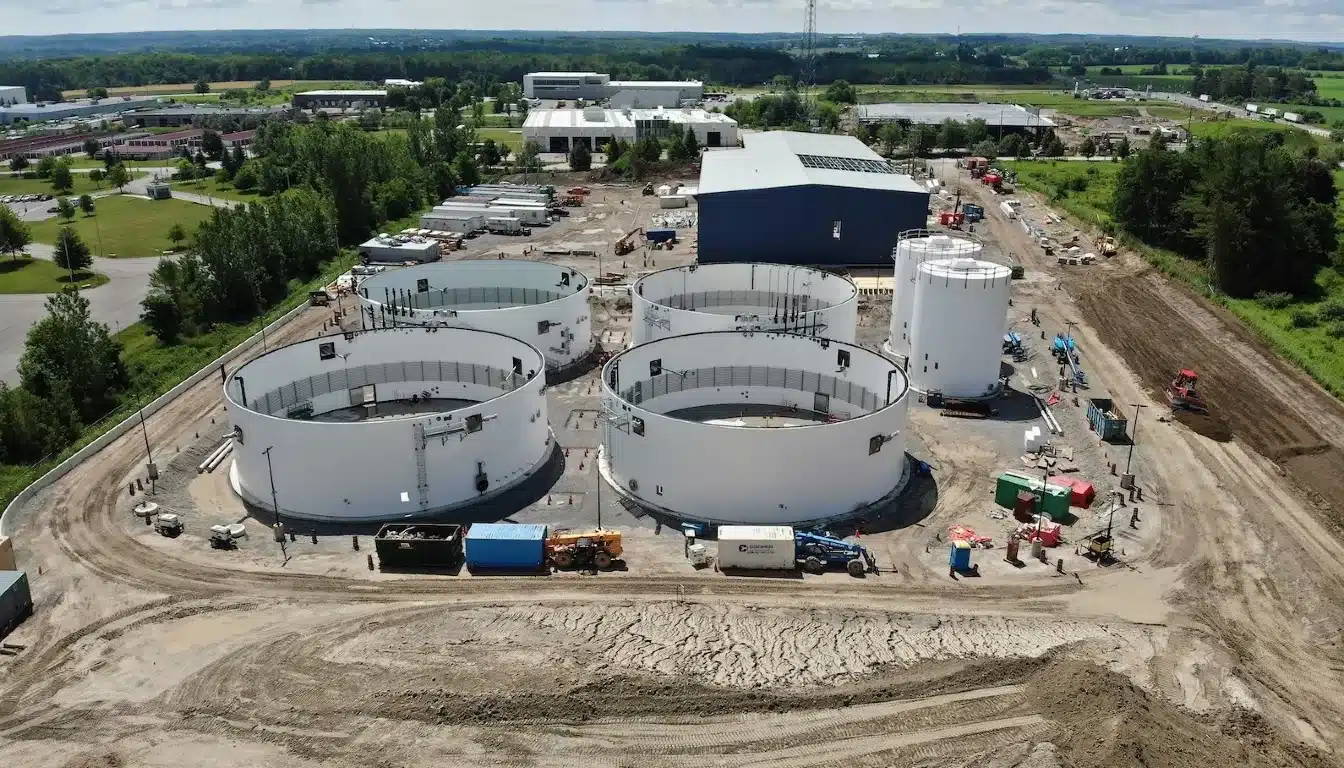
Convertus Group has closed CA$135m of project financing for its York Biofuel Facility in Ontario, a plant designed to turn household food waste into renewable gas, food-grade carbon dioxide and liquid fertiliser.
Convertus Group has raised CA$135m, roughly $96.2m, in project financing for its flagship biofuel plant in Ontario. Power Sustainable Infrastructure Credit, or PSIC, provided the capital, while Selkirk Advisory Group advised the Canadian waste-to-energy developer on the transaction. Convertus confirmed the close on 6 August.
The money goes to the York Biofuel Facility in York Region, north of Toronto. Construction is already running, so the round funds completion rather than a standing start. Commissioning begins later this year, and commercial operations follow in early 2027.
What the plant will produce
Convertus built the facility around anaerobic digestion. It can take up to 200,000 tons of source-separated organic waste a year, and it splits that feedstock into three saleable outputs. Renewable natural gas comes first, with annual biomethane production of 350,000 to 400,000 gigajoules. The plant also captures biogenic carbon dioxide and liquefies it for food, beverage and industrial customers. Because the digestate still carries nutrients, the third product is a low-carbon liquid fertiliser for farms.
That mix matters commercially. Many digestion projects rely on a single gas offtake, so their returns track one commodity price and one buyer. Convertus instead spreads exposure across gas, CO2 and fertiliser markets. Food-grade CO2 sells into brewing, soft drinks and food processing, while the fertiliser goes to agriculture. As a result, a weak month in one market need not drag down the whole plant.
Who put up the money
PSIC is the infrastructure credit arm of Power Sustainable, and it lends against projects rather than taking equity stakes. The structure suits a facility of this type, because the revenue is contracted and the feedstock is municipal.
“This financing represents a major milestone for Convertus and reflects the confidence that PSIC has placed in our business, our team and our long-term vision,” said Jamie Jongsma, chief financial officer of Convertus Group. He also called the site the next generation of anaerobic digestion infrastructure.
Benjamin Shenwick, principal at Power Sustainable Infrastructure Credit, described the project as essential environmental infrastructure with strong operational redundancy. Redundancy isn’t a footnote on a plant like this. Organics keep arriving whether or not a digester is running, so spare capacity is the difference between processing waste and diverting it to landfill.
Ontario organics and the Canadian RNG pipeline
The Greater Toronto Area needs long-term organics processing capacity, and the York plant adds a sizeable block of it. Municipalities across the region already collect separated food waste, therefore feedstock supply tends to be steadier than at bioenergy projects that compete for agricultural residues. Convertus, meanwhile, gains a reference asset in its home market.
Canada’s renewable natural gas sector has been active elsewhere too. British Columbia has seen recent biogas upgrading deployments, while Quebec has awarded provincial funding to landfill biomethane projects. Although the schemes differ in scale and technology, together they suggest lenders are growing more comfortable with the asset class.
Still, the test for Convertus is delivery. Commissioning through the back half of this year will show whether the plant hits its gas and CO2 numbers. Buyers of food-grade CO2 apply strict purity standards, so the liquefaction train has to perform from the first month. If it does, early 2027 gives Convertus a working plant to point at when it raises money for the next one.