Spark Cleantech has secured €30 million in Series A funding to scale up a novel approach to low-carbon hydrogen and industrial heat. The Paris-based start-up plans to use the capital to industrialise a methane pulsed-plasmalysis process designed to cut direct emissions from high-temperature manufacturing by around 85 per cent.
The investment will support the completion and commercialisation of Spark’s first production modules by late 2027. The company says the funding will allow it to expand its team, qualify its first commercial solid-carbon products and install units at customer sites.
Patrick Peters, Spark’s co-founder, said: “Following our seed round in the summer of 2023, we succeeded in deploying a first industrial pilot in under a year. We have validated clear market traction and assembled a world-class international team. This funding will enable the scale-up that industrial players are seeking to reduce their carbon footprint cost-effectively and to accelerate commercial deployment.”
The round was led by 360 Capital and Taranis, with participation from the Île-de-France Reindustrialisation Fund and Asterion Ventures. Thomas Nivard, a partner at 360 Capital, said: “The decarbonisation of heavy industry is one of the defining challenges of the decades ahead. But we must be candid: without economic viability, it simply will not happen. In Spark Cleantech, we found a team of entrepreneurs and industrial leaders who share this pragmatic view and who are delivering a technology that responds directly to it.”
How plasmalysis works
Heavy industrial sectors such as steel, glass and battery materials depend on very high-temperature processes that are difficult to electrify. These industries typically burn natural gas, releasing large quantities of carbon dioxide and locking in decades of emissions.
Spark’s technology sits between a site’s gas supply and its industrial burners. Rather than combusting methane, the system applies rapid pulses of electrical plasma to split methane into hydrogen and solid carbon without oxygen. The hydrogen burns cleanly, providing high heat with no CO₂. The carbon becomes a fine nanomaterial instead of a greenhouse gas.
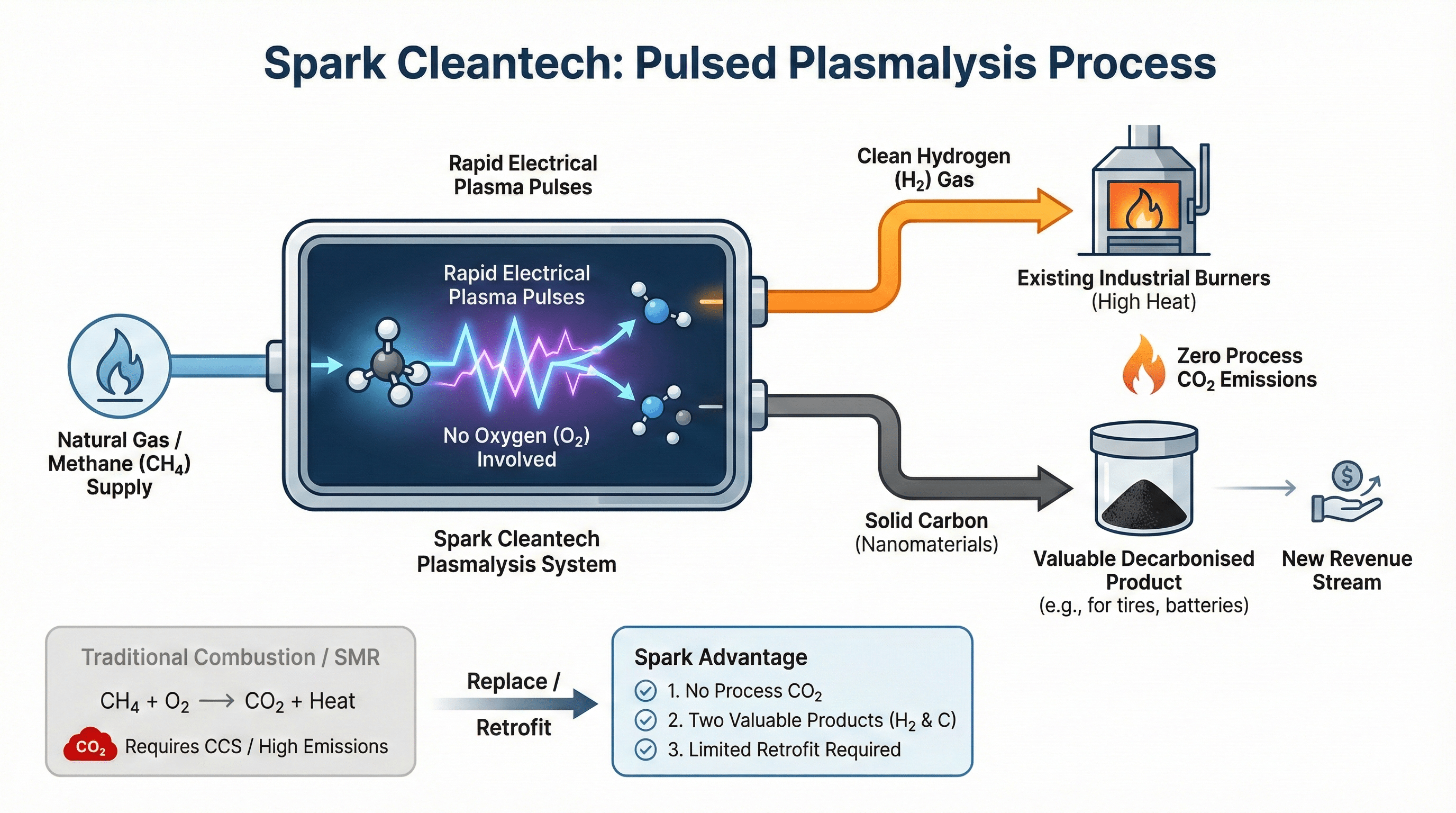
The company says this approach produces valuable decarbonised materials while avoiding the capture, transport or storage challenges associated with carbon dioxide. In practical terms, pulsed plasmalysis converts hydrocarbons into two useful products whose combined economic value is several times higher than the original gas.
Unlike steam methane reforming, the dominant form of hydrogen production globally, Spark’s process does not generate CO₂ emissions. The company also argues that its system requires only limited modifications to existing plant infrastructure, making it easier for customers to adopt.
Economic opportunity and use of the carbon by-product
The solid carbon co-product can replace petroleum-based carbon black typically used in batteries, polymers and industrial materials. Removing that supply chain dependency offers a second source of emissions savings. Spark aims to qualify its first commercial carbon grades as part of the scale-up financed by this round.
Because hydrogen is produced and consumed directly on site, Spark avoids the logistics costs and safety challenges linked to transporting compressed hydrogen. Solid carbon can be collected and dispatched off-site with relative ease.
Industrial deployment pathway
Spark is already running an industrial pilot and says multiple major manufacturers are now testing the technology, including companies in metallurgy, glassmaking, polymer production and battery materials. Initial commercial contracts are in place to prepare unit deployment in 2027.
The business was founded in 2022 out of CentraleSupélec laboratories and has raised €34 million to date. It has built a multidisciplinary team supported by high-profile scientific and industrial advisers, including a Nobel Prize laureate in physics and former R&D leaders from Aramco and Hutchinson.
The broader climate context
Decarbonising heavy industry is one of the most expensive and technically complex components of the energy transition. Hydrogen has emerged as a key candidate to replace fossil combustion, but green hydrogen produced from electrolysers remains expensive in many regions due to high power prices and limited renewable supply.
Spark positions plasmalysis as a lower-cost complement to electrolytic hydrogen that can accelerate near-term industrial decarbonisation while cutting emissions at source. The model relies on an industrial customer’s existing gas supply and offers an incremental transition pathway rather than a full fuel switch.
Cost and performance validation at larger scale will determine whether this approach becomes competitive with other low-carbon heat technologies. Demand for the carbon by-product will also need to remain strong to support the business case. However, the combination of hydrogen production with a saleable material may improve economics relative to other low-carbon industrial heat options.
Spark’s future
The company’s next stage will involve demonstrating that its standard module can operate reliably and cost-effectively at commercial industrial sites. If successful, the technology could provide a pragmatic route to tackle emissions in sectors with limited alternatives.
Investor appetite for hard-to-abate decarbonisation has become more selective in recent years. The scale of this Series A suggests confidence that the market need is real and that Spark is well positioned to deliver.