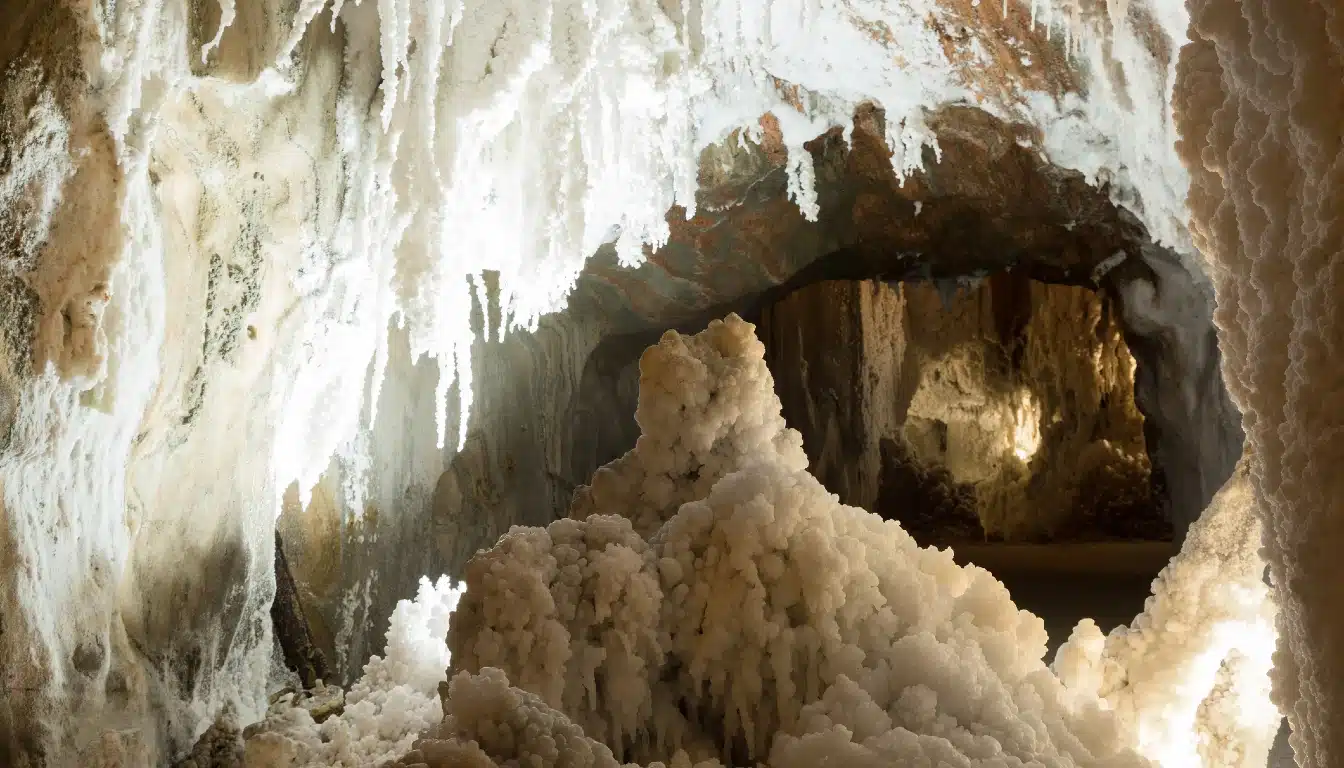
Denmark is examining whether disused salt caverns could store surplus wind energy at scale. The investigation pairs Nobian, a Dutch salt and chemicals group, with Airengy, an Israeli energy technology company. Together, they are assessing whether underground geology can work alongside Airengy’s compressed-air storage system, known as AirBattery.
The case for exploring this combination is straightforward in principle. Wind generates electricity intermittently. When supply exceeds demand, that surplus is often wasted. AirBattery captures excess electricity by compressing air underground, then releases it back as power when the grid needs it.
Two Companies, Complementary Assets
Nobian operates underground caverns across the Netherlands, Germany, and Denmark. The company has stored hydrogen, natural gas, diesel, compressed air, and nitrogen in its subsurface facilities. Its Danish site sits in Mariager, and the company draws on more than a century of salt production experience there.
Airengy developed AirBattery to move compressed-air storage from theory into commercial operation. The company is now testing whether that system can work at European scale. The Danish study is one of its active efforts to demonstrate viability in real-world conditions.
Nobian’s position is that its underground assets give it a natural role in Europe’s energy transition. The company has been developing cavern storage for energy materials for some time. Salt caverns attract interest because they offer large subsurface volumes and, in some cases, existing industrial infrastructure that reduces development costs.
Why Long-Duration Storage Matters Now
Grids across Europe are carrying growing shares of wind and solar generation. Both are variable by nature. A period of high wind output followed by a calm week can strain grid operators managing supply and demand in real time.
Long-duration storage technologies address this directly. They hold energy for hours or days, smoothing out the peaks and troughs that short-term batteries cannot always handle. Salt caverns are one candidate for this role. Their scale and geology suit the extended storage that compressed-air systems require.
The Danish investigation reflects a pattern emerging across the continent. Governments and energy companies are looking beyond lithium-ion batteries. They want storage that can hold large volumes of energy across longer time periods. Compressed air stored underground is one of several approaches now under active examination.
A Parallel Project in Romania
Denmark is the second European market where Airengy has announced a compressed-air initiative. In Romania, Airengy and Hagag Europe are planning a compressed-air power plant using the same AirBattery system. That project, reported in June, is expected to be built in phases. At full development, it could deliver a discharge capacity of 25 megawatts and store up to five gigawatt-hours of energy.
The Romania scheme gives some indication of the scale Airengy is targeting. Five gigawatt-hours is a meaningful volume. For context, that is enough to power tens of thousands of homes for several hours during a supply shortfall.
The Danish project is still at the investigation stage. No capacity figures have been released for the Mariager site. The two companies are assessing technical and geological feasibility before any commercial commitments.
What the Study Could Show
The Danish investigation has two distinct outcomes worth watching. One is whether the Mariager caverns are geologically suitable for compressed-air storage at commercial scale. The other is whether Airengy’s system can integrate with existing salt cavern infrastructure without requiring full reconstruction of the site.
Both questions matter for the broader European storage market. Salt caverns exist in several European countries with significant renewable energy ambitions. If the Danish study shows that disused industrial caverns can be adapted for compressed-air storage, it would give developers a larger pool of potential sites to work with.
Nobian’s involvement is also notable from a commercial standpoint. The company runs a traditional salt and chemicals business. Its move into energy storage reflects a calculation that underground assets will carry growing value as European grids shift away from fossil fuels.
Airengy, for its part, is building a portfolio of pilot and development projects. The Romania announcement and the Danish study together suggest the company is advancing on multiple fronts. Whether either project reaches commercial operation remains to be seen. The technology is credible in principle, though large-scale compressed-air storage has a limited track record in Europe at commercial scale.