Germany is mounting solar panels on fences. It sounds modest. The results, however, are drawing serious attention from airport operators, farmers, and energy analysts alike.
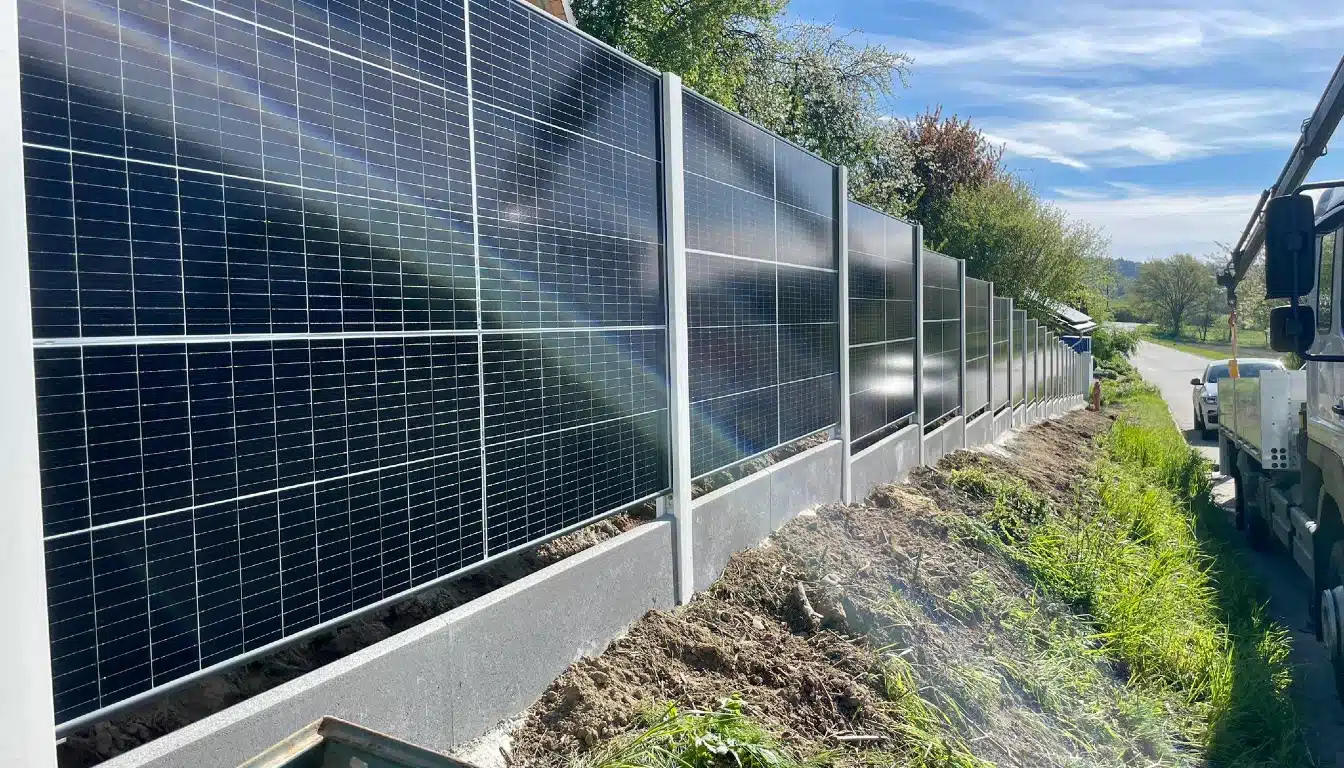
Companies such as Next2Sun are fitting boundary fences with bifacial photovoltaic modules. These panels generate electricity while still marking property lines. The concept addresses a genuine problem in the German energy market: suitable rooftop space is finite, and demand for distributed generation keeps growing.
Why Rooftops Are No Longer Enough
Many German buildings cannot carry conventional solar installations. Shaded roofs, awkward pitch angles, and structural load limits all restrict standard panel arrays. Vertical fencing gives property owners another option. It makes use of narrow land strips that would otherwise sit idle.
Bifacial cells absorb light from both sides of the panel. A vertically mounted module misses some of the strong midday sun that a tilted roof array captures. It compensates by harvesting reflected and diffuse light throughout the day. Morning and evening output is notably stronger than from conventional roof systems. This smooths the generation curve across daylight hours.
A ten-metre residential fence typically delivers between one and 1.5 kilowatts of installed capacity. Under favourable conditions, that produces around five to 7.5 kilowatt-hours daily. That covers a meaningful share of an average household’s electricity needs.
Energy Policy Is Driving Adoption
Germany’s push for energy independence has given vertical solar added commercial relevance. Recent turbulence in European energy markets accelerated pressure on households and businesses to generate more electricity on site. Solar fencing fits that pressure well. It requires no additional land and works on existing boundary infrastructure.
Next2Sun has developed systems for residential, agricultural, and commercial applications. Each installation doubles as a privacy barrier and a power source. The dual function makes the economics more defensible for buyers weighing upfront installation costs against long-term returns.
Germany’s broader Energiewende policy framework encourages distributed generation at every scale. Solar fencing sits comfortably within that framework. It is small enough for individual homeowners and scalable enough for large commercial operators.
Frankfurt Airport Sets the Scale
The most significant deployment to date is at Frankfurt Airport. Fraport, the airport’s operator, has inaugurated a 2.8-kilometre vertical solar installation along the airport perimeter. The project uses approximately 37,000 modules. Installed capacity reaches 17.4 megawatts.
Fraport expects the installation to generate up to 17.4 million kilowatt-hours annually. The electricity primarily powers terminal air conditioning systems and the airport’s expanding electric vehicle charging fleet. Both are high and growing loads at major European hubs.
The Frankfurt project carries weight beyond its headline figures. It shows that vertical solar can integrate into large pieces of existing infrastructure without consuming additional land. That matters acutely in densely populated regions where land competition is intense and planning restrictions are tight.
Airports present a particular opportunity. Their perimeters are long, fenced for security reasons, and largely unshaded. The infrastructure already exists. Adding photovoltaic capacity to it requires no new land acquisition and minimal disruption to operations.
What the Technology Still Needs to Prove
Vertical solar fencing is a credible and deployable technology. Its commercial case is strongest where roof space is constrained, land is expensive, and boundary infrastructure already needs replacing or upgrading.
The output figures from a residential fence are real but limited. Five to 7.5 kilowatt-hours per day covers partial household consumption. It does not replace a full rooftop system where one is available. Buyers should weigh both options before committing.
Performance data from large installations like Frankfurt’s will be important. Independent verification of annual generation figures, degradation rates, and maintenance costs will determine how confidently developers can scale the technology across Europe’s transport and logistics infrastructure.
Next2Sun and Fraport have not published third-party audited performance data in the source material reviewed for this article. Claims about expected annual generation figures should be treated as operator projections until verified by independent assessment.
Germany’s solar fence experiment is a practical answer to a specific set of constraints. It will be most relevant in countries where roof space is scarce, energy costs remain high, and governments are pushing hard on distributed generation targets. The UK, the Netherlands, and Belgium all fit that description.
The fence was always there. Now it does something.