The inspection of offshore infrastructure has long been among the most carbon-intensive activities in maritime operations. A single crewed vessel burns between five and 15 tonnes of marine diesel per day, generating as much as 45 tonnes of CO2 per operational day. A start-up is aiming to address that.
Bubble Robotics, a Paris and Zurich-based deep-tech startup, has raised $5 million in a pre-seed round co-led by Episode 1 Ventures and Asterion Ventures, with participation from Norrsken Evolve, Entrepreneurs First, Angel Invest, Venture Together, and Transpose Platform. The round also drew backing from experienced operators including former senior executives at Vestas, GE Vernova, Naval Group, Total, Google, and Aker Solutions. The company has emerged from stealth mode with over $4 million in signed letters of intent from customers across offshore wind, maritime security, and subsea infrastructure.
What the platform does
Bubble describes its systems as “Physical AI”: autonomous robots that can perceive, decide, and act in complex ocean environments without human intervention. By combining robotics, edge AI, and satellite connectivity, the platform can operate continuously at sea for months. Instead of mobilising a vessel for each inspection, Bubble deploys systems that remain on site and can be activated remotely to perform inspections, capture data, and transmit results. The shift is from campaign-based offshore operations to persistent monitoring.
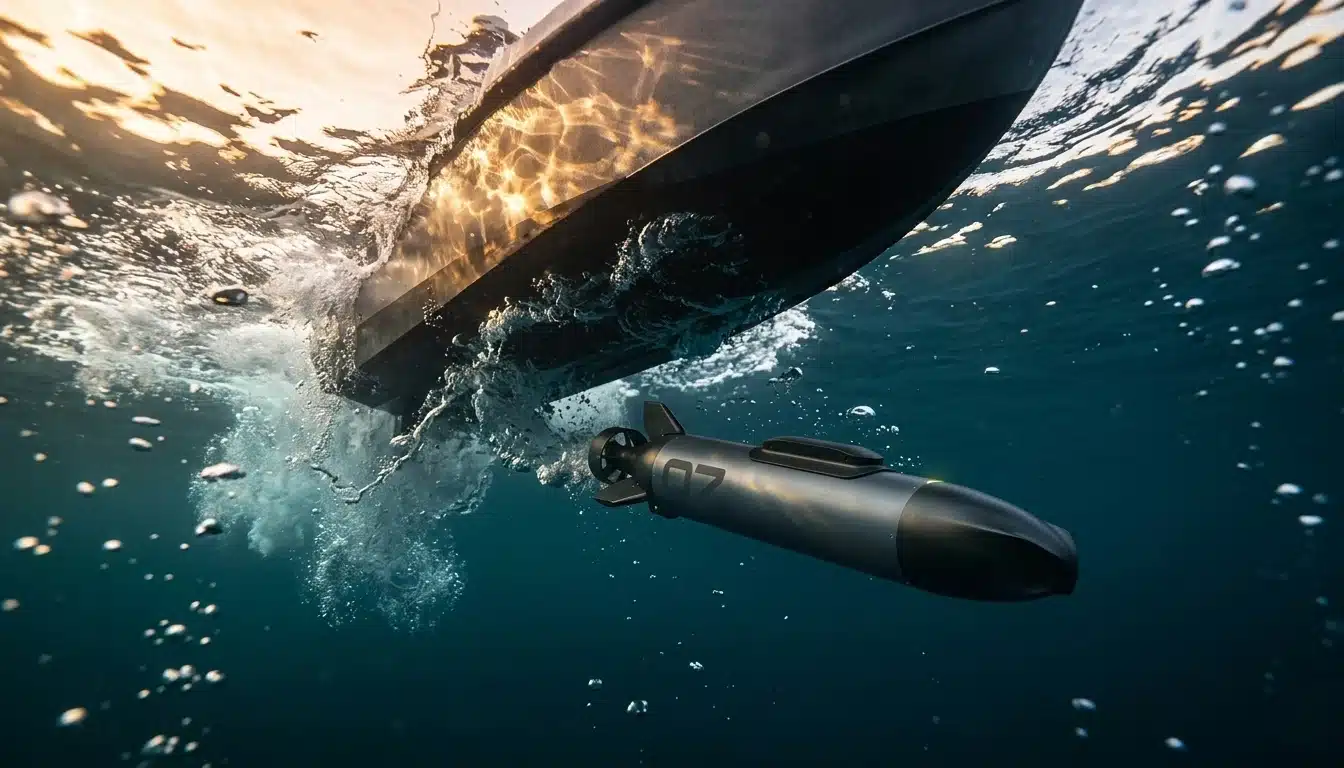
The BubbleDock, an unmanned surface vehicle, acts as a marine base station. It deploys and retrieves autonomous underwater vehicles capable of remaining at sea for up to six months, supported by onboard energy generation. Multi-sensor payloads, including optical cameras, sonar, acoustic instruments, water quality monitors, and sediment sensors, produce millimetre-scale mapping of underwater assets. Data is processed using AI to generate inspection reports, digital twins, and predictive maintenance assessments. The company operates on a robotics-as-a-service model, removing the need for upfront capital expenditure.
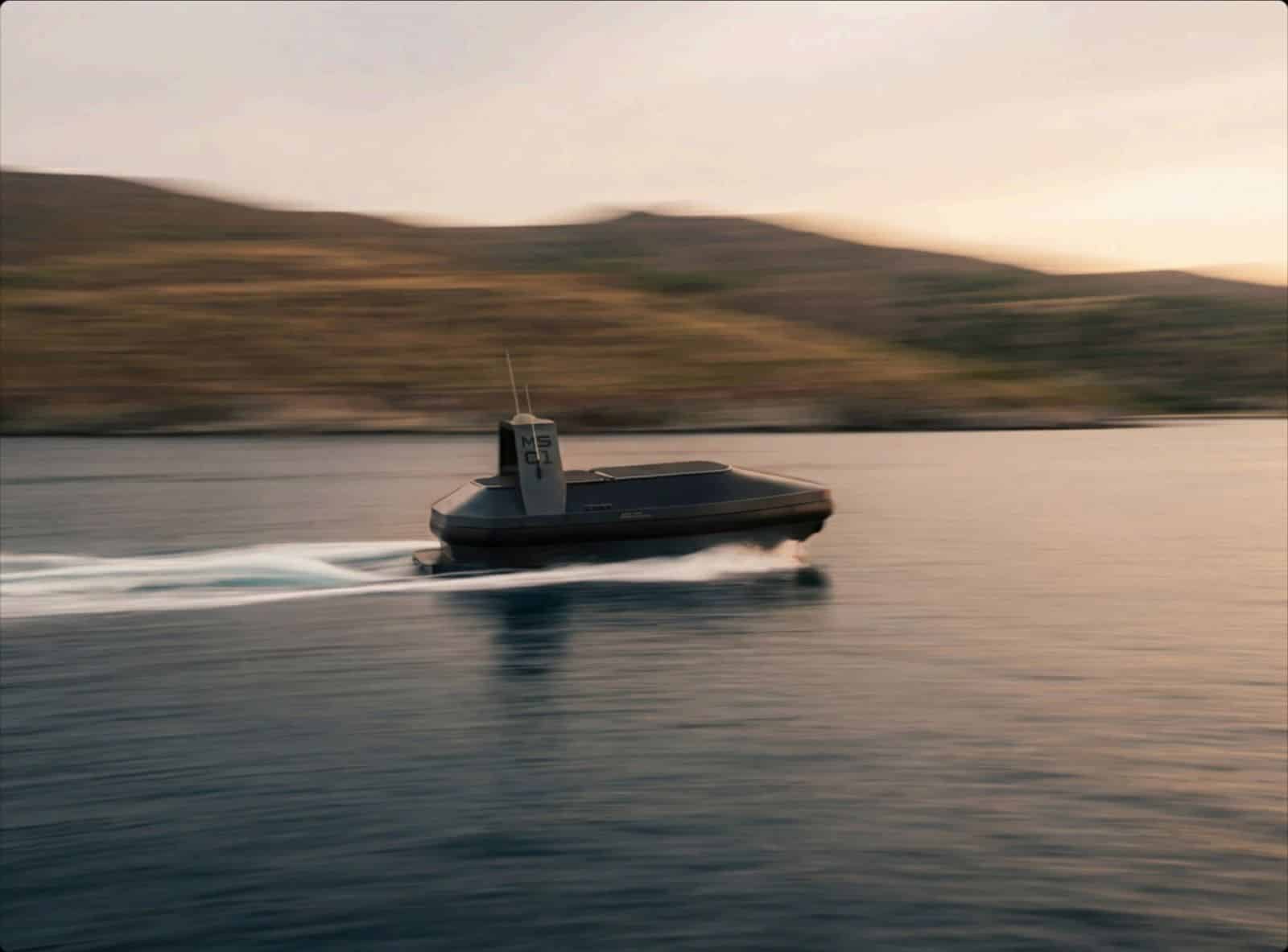
Bubble Robotics’ ‘mother ship’
The emissions case
Jean Crosetti, CEO and Co-Founder of Bubble Robotics, sets out the scale of the emissions opportunity. Conventional offshore inspection vessels consume five to 15 tonnes of marine diesel per day, producing between 15 and 45 tonnes of CO2 per operational day. Bubble’s hybrid-electric platform reduces that footprint by up to 90 per cent, against a long-term ambition to run fully on renewable onboard power. The ocean economy is valued at approximately $3 trillion, and the infrastructure it supports, spanning offshore wind farms, subsea cables, oil and gas platforms, aquaculture, and ports, demands continuous inspection and maintenance. That demand currently drives a large and growing volume of vessel-based emissions.
Unlocking offshore wind at scale
Offshore wind presents a particularly compelling use case. The technology produces energy at capacity factors up to double those of onshore wind, and the largest farms now reach one to two gigawatts, comparable in output to a nuclear reactor. Yet vessel-based inspection of foundations, cables, and turbines currently costs between $30,000 and $100,000 per day. That operational burden has become a genuine constraint on the sector’s growth. Crosetti argues that continuous, low-carbon monitoring is what makes large-scale offshore wind operationally viable, and a necessary component of the infrastructure required for a credible fossil fuel phase-out.
Monitoring ecosystems and climate events
The platform’s environmental utility extends well beyond cutting inspection emissions. The same systems that monitor offshore infrastructure can also track marine ecosystem conditions around those installations. Acoustic, optical, water quality, and sediment monitoring instruments gather continuous baseline data on the ocean environments in which offshore assets operate. Crosetti is direct about the current state of that data. It is collected episodically, at high cost, and often not collected at all. “We can’t protect what we can’t measure,” he says.
The company identifies further applications. The platform can track extreme weather events including hurricanes, detect harmful algal blooms before they spread, and monitor sensitive maritime zones for underwater threats. All of these are currently managed with limited data and delayed response times. The long-term vision is to build what Bubble describes as an “underwater world model”: a real-time, dynamic representation of the ocean environment, assembled through a distributed constellation of resident autonomous systems feeding continuous multimodal data to operators, researchers, and regulators. The analogy the company draws is to satellite constellations, which transformed the availability of Earth observation data from space.
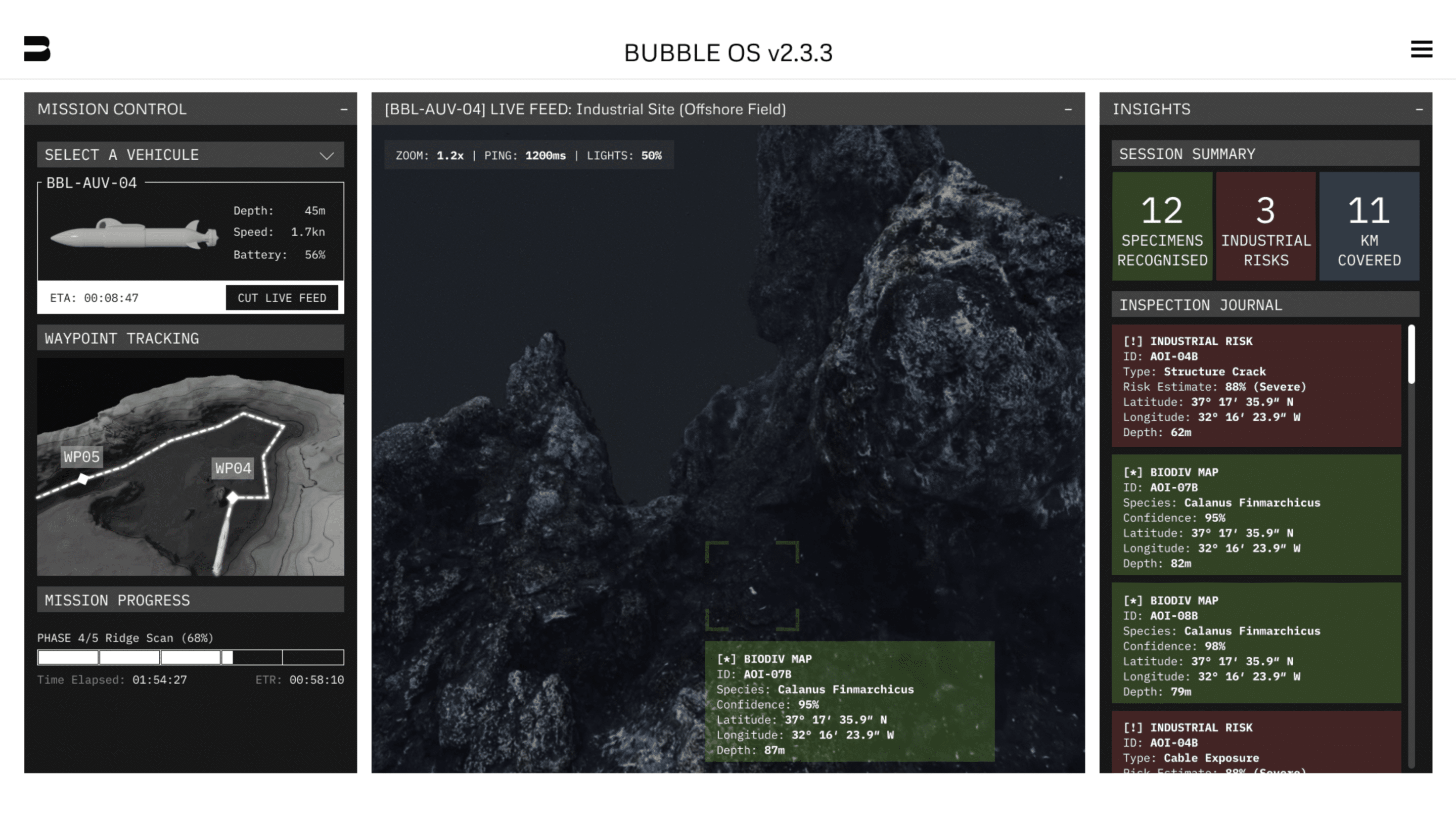
Underwater monitoring dashboard.
Removing humans from hazardous environments
There is a safety dimension too. Subsea inspection currently exposes divers and vessel crews to considerable physical risk. Autonomous platforms remove that exposure entirely. The energy sector also faces a structural staffing constraint: an estimated 600,000 additional offshore professionals will be needed globally by 2030. Bubble’s model offers a route through that gap without scaling dependency on large crewed deployments.
“Today, 80 to 90% of offshore inspection costs come from vessels and crews,” said Jean Crosetti. “By removing that dependency, we unlock a step change in cost, safety, and operational frequency. What used to be episodic becomes continuous.”
Founding team and next steps
Bubble Robotics was co-founded in 2025 by Crosetti and Patricia Apostol, who serves as CTO. Apostol brings robotics engineering experience from NASA JPL and ETH Zürich. The company has offices in Paris, Zurich, and San Francisco, with institutional research partners including IFREMER, the French ocean science agency, and ETH Zürich. It was ranked in the top six of the Industrial AI and Robotics category in Hello Tomorrow’s Top 100 Deep Tech Startups to Watch in 2026. The funding will be used to accelerate product development, expand the engineering team, and support initial commercial deployments across offshore energy, security, and infrastructure markets.